
How To Create a Personal Manifesto That Truly Inspires You

We may earn a commission for purchases made using our links. Please see our disclosure to learn more.
You know that weird feeling when life is technically “fine,” but your choices feel scattered? You say yes to things you do not want, chase goals you are not sure you care about, and keep promising yourself you will “get clear” someday. That is exactly where a Personal Manifesto can help.
Consider it your own compass. Not a stiff corporate document. Not a dramatic declaration written by candlelight while wearing a velvet robe—although, honestly, no judgment. A Personal Manifesto is a clear statement of your values, beliefs, priorities, and the kind of person you are choosing to become.
In this guide, you will learn how to write one that feels honest, practical, and inspiring enough to come back to when life gets noisy.
Disclosure: This article includes Amazon product suggestions. If you buy through these links, the site may earn a small commission at no extra cost to you.
What Is a Personal Manifesto?
A Personal Manifesto is a written declaration of your core values, life principles, beliefs, and intentions. It answers a few big questions:
- What do I stand for?
- What kind of life do I want to build?
- What behaviors do I want to practice?
- What do I refuse to keep tolerating?
- How do I want to show up when life gets difficult?
It is part values statement, part personal mission statement, and part gentle pep talk from your wiser self.
Your manifesto does not need to sound fancy. In fact, it works better when it sounds like you. If your real voice says, “I want peace, strong coffee, honest friendships, and fewer fake obligations,” write that.
Why a Personal Manifesto Matters for Self-Improvement
Self-improvement gets messy when it becomes a pile of random habits. Get up earlier. Continue reading. Improve your diet. Stretch. Meditate. Drink water. Become a glowing productivity wizard by Tuesday.
A Personal Manifesto gives those habits a reason.
Instead of saying, “I should exercise,” you might write, “I care for my body because it carries me through the life I am building.” That small shift matters. It connects action to identity.
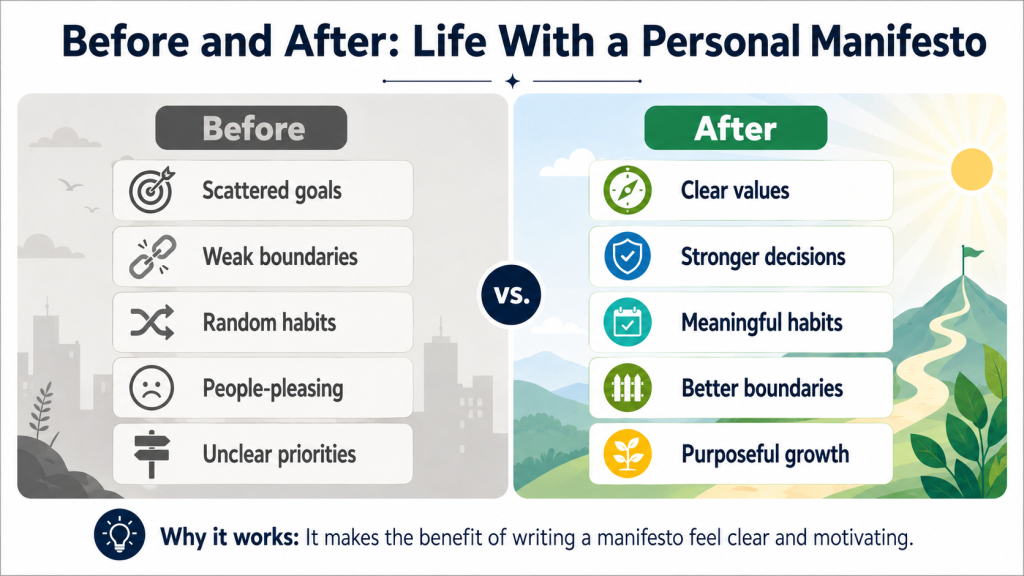
A strong manifesto can help you:
- Make decisions faster
- Set better boundaries
- Stay grounded during stress
- Choose goals that match your personal values
- Build habits that feel meaningful
- Stop copying someone else’s version of success
It becomes your quiet reminder: “This is who I am. This is what I choose.”
Personal Manifesto vs Personal Mission Statement
A personal mission statement usually focuses on purpose and direction. It might sound like, “My mission is to help people feel more confident through honest writing and thoughtful guidance.”
A Personal Manifesto is broader. It includes your mission, but it also captures your values, beliefs, standards, and personal rules for living.
Simple difference
“This is what I am here to do,” reads a personal mission statement.
A Personal Manifesto says, “Here is how I choose to live.”
Both can support personal growth. However, a manifesto often feels more human because it can include emotion, personality, and practical life principles.

Step 1: Name Your Personal Values
Start with your values. These are the roots of your Personal Manifesto.
Do not choose values because they sound impressive. Choose the ones that actually shape how you want to live.
Try this quick values check
Ask yourself:
- What makes me feel proud of myself?
- What makes me feel uneasy when I ignore it?
- What qualities do I find admirable in others?
- What do I want more of in my daily life?
- What do I want less of?
Your values might include:
- Honesty
- Faith
- Creativity
- Family
- Discipline
- Peace
- Courage
- Learning
- Service
- Freedom
- Health
- Simplicity
Pick five to seven. Too many values can turn your manifesto into a grocery receipt.
Step 2: Define Your Core Beliefs and Life Principles
Now turn those values into beliefs.
For example, if your value is honesty, your belief might be, “I would rather have a hard conversation than live inside a quiet resentment.”
If your value is growth, your belief might be, “I can be a beginner without being embarrassed.”
This is where your manifesto starts to breathe.
Examples of life principles
- I choose consistency over perfection.
- I don’t apologize for keeping my peace.
- I treat my body like a partner, not a project.
- I listen before reacting.
- I do not shrink to make others comfortable.
- I build a life that feels good from the inside, not just one that looks good online.
These statements work because they are clear, personal, and practical.
Step 3: Write a Vision That Feels Honest
Your vision is not a fantasy life where you wake up rich, calm, hydrated, and somehow fluent in Italian. It is a grounded picture of the person you are becoming.
Ask yourself: “If I lived by my values for the next year, what would change?”
Maybe you would speak more honestly. Maybe you would stop overworking. Maybe you would create a calmer home. Maybe you would finally take your health seriously without turning it into punishment.
Keep it real
Try writing:
“I am becoming someone who…”
Then complete the sentence 5–10 times.
For example:
- I am becoming someone who keeps promises to myself.
- I am becoming someone who rests without guilt.
- I am becoming someone who chooses meaningful work.
- I am becoming someone who moves my body with respect.
- I am becoming someone who asks for help before I burn out.
This gives your manifesto emotional direction.

Step 4: Turn Big Ideas Into Daily Actions
A Personal Manifesto should inspire you, but it should not float above your real life like a motivational balloon.
Bring it down to earth.
If your manifesto says, “I value health,” what does that look like on a random Tuesday? A walk? A stretch? A simple meal? Going to bed before your phone steals another hour of your life?
If movement is part of your personal growth plan, it can help to create a small, inviting space at home. A simple, supportive workout mat for building a consistent movement routine can make exercise feel less like a production and more like a normal part of your day.
Make every value visible
Try pairing each value with one behavior:
- Peace → I pause before saying yes.
- Health → I move for 10 minutes daily.
- Creativity → I make something before I consume content.
- Family → I give people my full attention.
- Learning → I read or listen for 15 minutes a day.
Small actions make big beliefs believable.
Step 5: Add Boundaries, Habits, and Non-Negotiables
A manifesto is not only about what you say yes to. It also names what you are done carrying.
Boundaries differ from walls. These are handle-equipped doors. You determine who has access, when, and under what circumstances.
Helpful manifesto boundaries
You might write:
- I do not trade sleep for approval.
- I do not say yes just to avoid disappointing someone.
- I do not confuse urgency with importance.
- I do not let one bad day become my identity.
- I do not build my life around people who only value me when I am useful.
This section can feel surprisingly powerful. Sometimes personal growth begins with one clear “no.”
Personal Manifesto Examples You Can Adapt
Use these examples as starting points. Make the words sound more like you.
Short Personal Manifesto example
“I choose to live with honesty, courage, and care. I keep promises to myself. I protect my peace, nurture my body, and speak with kindness. I do not chase perfection. I choose progress, presence, and purpose.”
Career-focused manifesto example
“I create work that reflects my values. I lead with curiosity, communicate clearly, and keep learning. I do not measure my worth by productivity alone. I build success with integrity, not burnout.”
Wellness-focused manifesto example
“I care for my body with patience. I move, rest, eat, and breathe in ways that support my life. I reject shame as a motivator. My health is not a punishment plan. It is a relationship.”
Confidence-focused manifesto example
“I trust myself to grow. I can be nervous and still act. I can fail and still learn. I can be misunderstood and still stay true to my values.”
Best Amazon Tools for Writing Your Personal Manifesto
You do not need products to write a Personal Manifesto. A napkin works. So does the back of an old receipt. But the right tool can make reflection feel easier and more enjoyable.
1. BestSelf 13-Week Self Journal & Goal Planner
This undated planner is useful if you want to connect your manifesto to weekly goals, habits, gratitude, and reflection.
Features: Goal planning, daily structure, habit tracking, reflection prompts.
Best for: People who want their values to turn into measurable routines.
Use case: Write your manifesto, then choose one weekly action that supports it.
2. Intelligent Change The Five Minute Journal
This guided gratitude journal works well for people who want a simple morning and evening reflection habit.
Features: Gratitude prompts, affirmations, quotes, daily highlights, evening reflection.
Best for: Beginners who want a low-pressure journaling routine.
Use case: Use the affirmation section to rewrite one line from your manifesto each morning.
3. The High Performance Planner by Brendon Burchard
This planner is designed for productivity, focus, and intentional performance.
Features: Daily planning pages, self-assessment prompts, productivity structure.
Best for: Goal-driven readers, entrepreneurs, students, and busy professionals.
Use case: Pair your manifesto with daily priorities so your schedule reflects your values.
4. Start Where You Are: A Journal for Self-Exploration by Meera Lee Patel
This creative journal is gentle, colorful, and reflective. It is great if blank pages intimidate you.
Features: Open-ended prompts, inspirational quotes, artwork, self-exploration exercises.
Best for: Creative thinkers, sensitive souls, and anyone who likes guided reflection.
Use case: Use the prompts to uncover themes before drafting your manifesto.
5. The Daily Stoic Journal by Ryan Holiday and Stephen Hanselman
This journal focuses on reflection, discipline, wisdom, and the art of living.
Features: 366 days of writing prompts, Stoic reflections, morning and evening journaling.
Best for: Readers who like philosophy, discipline, and thoughtful self-leadership.
Use case: Use it to test your manifesto against daily choices and emotional reactions.
The Research-Backed Power of Writing Your Values
Writing a manifesto may sound soft and reflective, but there is real psychology behind it.
One helpful research area is self-affirmation. A 2014 review by Geoffrey Cohen and David Sherman explains that self-affirmation exercises often involve writing about core personal values. These exercises can help people respond to threats or stress with a broader sense of self, instead of becoming defensive or discouraged. You can read more in this review on writing about core personal values.
Goal-setting research also supports the idea that clarity matters. Locke and Latham’s work on goal-setting theory found that specific, challenging goals tend to improve performance more than vague “do your best” goals. A manifesto is not a goal list, but it gives your goals a clearer foundation. Their research on specific goals and motivation is a useful reminder that direction beats vague ambition.
In plain English? Writing down what matters to you can help you act with more intention. Your brain likes a map. Give it one.
Common Mistakes to Avoid
The biggest mistake is trying to make your Personal Manifesto sound impressive instead of true.
Avoid writing for an imaginary audience. Write for the version of you who needs clarity at 7:42 p.m. after a long, weird day.
Avoid these traps
- Using vague lines like “I will live my best life”
- Copying someone else’s values
- Making it too long to remember
- Turning it into a guilt list
- Writing it once and never reading it again
- Confusing aesthetics with honesty
Your manifesto does not need to be pretty. It needs to be useful.
Personal Manifesto FAQs
How long should a Personal Manifesto be?
A Personal Manifesto can be one paragraph, one page, or a short list of principles. The best length is the one you will actually reread. For most people, 150–500 words works well.
What should I include in my Personal Manifesto?
Include your personal values, core beliefs, life principles, boundaries, goals, and daily actions. Focus on what you stand for and how you want to live.
Can a Personal Manifesto change over time?
Yes. It should change as you grow. Review it every few months or after major life transitions, such as a new job, relationship change, move, or personal reset.
Is a Personal Manifesto the same as affirmations?
Not exactly. Affirmations are short positive statements. A Personal Manifesto is broader. It can include affirmations, but it also includes values, boundaries, purpose, and guiding principles.
How do I make my Personal Manifesto more inspiring?
Use honest language, specific values, and real-life actions. Avoid generic phrases. Write lines that make you feel grounded, brave, and clear about your next step.