
Emotional Detox: 5 Practices to Release Mental Clutter

We may earn a commission for purchases made using our links. Please see our disclosure to learn more.
Ever feel like your brain has too many open tabs? One is replaying an awkward conversation from three years ago. Another is worrying about tomorrow. A third is quietly judging everything you did today. And somewhere in the background, emotional noise is playing on full volume.
For that, an emotional detox might be beneficial.
An Emotional Detox is not about ignoring your feelings or forcing yourself to be positive. It is about making space. You gently sort through stress, resentment, guilt, fear, overthinking, and all the emotional clutter that builds up when life gets heavy.
Consider it similar to organizing a closet. You are not throwing away who you are. You are just removing what no longer fits, what weighs you down, and what you keep holding “just in case.”
In this guide, you will learn simple practices to release mental clutter, feel more emotionally grounded, and create a little breathing room inside your own mind.
Affiliate note: This article includes Amazon product ideas that may support your self-care routine.
What Is an Emotional Detox?
An Emotional Detox is a self-care practice that helps you notice, process, and release emotional weight.
It does not mean you will never feel angry, anxious, sad, jealous, or overwhelmed again. That would be nice, sure, but also very suspicious. You are human. Feelings come with the package.
Instead, an Emotional Detox helps you stop carrying emotions that have already taught you what they needed to teach you.
You may need one if you feel:
- Easily irritated by small things
- Mentally tired even after resting
- Stuck replaying old conversations
- Heavy, numb, or emotionally distant
- Overwhelmed by simple daily tasks
- Tired of saying “I’m fine” when you are absolutely not fine
The goal is not to become perfectly calm. The goal is to become more honest with yourself.
Why Mental Clutter Feels So Heavy
Mental clutter builds when emotions have nowhere to go.
Maybe you swallow disappointment because you do not want to cause drama. Maybe you stay quiet when something hurts. Maybe you push through stress because “everyone is busy,” so you tell yourself to keep going.
However, ignoring feelings does not make them go away. They usually sit quietly in the background and ask for attention in other ways.
You may feel tense. You may snap at people you love. You may struggle to focus. You may feel tired even when nothing major happened.
The American Psychological Association’s 2024 Stress in America report found that 77% of U.S. adults said the future of the nation was a significant source of stress. That matters because emotional overload is not always about one big problem. Sometimes, it is the slow buildup of money worries, relationship stress, work pressure, family needs, news, and constant notifications.
An Emotional Detox gives your mind somewhere to put all of that down.
Practice 1: Name What You Are Carrying
You cannot release what you have not named.
So start there.
Ask yourself, “What emotion has been following me around lately?”
Perhaps it’s resentment. Perhaps it’s guilt. Perhaps it’s grief. Maybe it is that strange mix of stress and exhaustion that shows up when you finally sit down and your brain says, “Great, now we process everything.”
Try this simple check-in:
- I feel…
- I feel this because…
- What I need right now is…
- One thing I can release today is…
This does not have to be deep or beautifully written. You are not submitting it for a literature prize. You are simply telling the truth.

Make It Simple
You do not need a perfect journal entry.
A sentence like, “I feel overwhelmed because I have been saying yes too much,” is enough.
That one sentence can show you what needs attention. It turns a messy feeling into something clearer.
And once something is clear, it becomes easier to work with.
Practice 2: Journal Without Polishing the Truth
Journaling is one of the most helpful emotional release tools because your notebook does not interrupt, judge, or offer weird advice.
It just lets you speak.
The trick is to write honestly before you try to write wisely.
Let the first version be messy. Let it sound annoyed, sad, dramatic, confused, or tired. Sometimes your emotions need to come out in sweatpants before they can show up in a calm, polished outfit.
You can write about:
- What hurt you
- What you wish you had said
- What you keep replaying
- What you are tired of carrying
- What you want to forgive
- What you are not ready to forgive yet
The goal is not to write something pretty. The goal is to stop holding everything inside.
Try the “Unsent Letter” Method
This is a simple but powerful journaling practice.
Write a letter, but do not send it.
Say what you never said. Explain what hurt. Admit what you needed. Be honest about what you are still carrying.
You can even be a little dramatic. Your journal can handle it.
Then end with a line like:
“I release the need to keep replaying this today.”
That last word matters: today.
You do not have to release everything forever in one heroic emotional moment. You only need to start with today.
Practice 3: Use a Mindful Pause Before Reacting
An Emotional Detox is not only something you do alone with a journal and a cup of tea. It also happens in real life, especially in the tiny space between feeling something and reacting to it.
That space is powerful.
The next time something triggers you, try this:
- Pause.
- Take one slow breath.
- Ask yourself, “Am I responding to this moment, or am I reacting from an old wound?”
- Choose your next words with care.
This pause is like a speed bump for your emotions. It does not stop you from feeling. It just slows things down enough for you to respond with more awareness.
A Gentle Reminder
Having strong emotions does not make you difficult.
It makes you human.
The mindful pause is not about silencing yourself. It is about protecting yourself from saying something that creates more emotional cleanup later.
You are still allowed to speak up. You are still allowed to say, “That hurt me.” You are still allowed to set a boundary.
You are just giving yourself a moment to choose your response instead of letting the emotion choose it for you.
Practice 4: Set Boundaries That Protect Your Peace
Boundaries are not walls. They are doors with locks.
They help you decide who gets access to your time, energy, attention, and emotional space.
This matters because a lot of emotional clutter comes from overextending yourself. You say “yes” when you’re exhausted. You listen when you have no capacity. You stay available to people who drain you, then wonder why you feel empty.
Healthy boundaries can sound like:
- “I cannot talk about this right now.”
- “I need time to think before I answer.”
- “I am not available for that.”
- “I care about you, but I cannot carry this for you.”
- “That does not work for me.”
Simple? Yes. Easy? Not always.
But boundaries are one of the clearest ways to protect your emotional wellness.

Practice 5: Release What Is Not Yours
Some emotional clutter belongs to you.
You were given a portion of it.
Maybe you picked up fear from your family. Maybe you are carrying guilt from a friendship that became one-sided. Maybe someone criticized you years ago, and now their voice still shows up whenever you try something new.
That voice is not paying rent. It can leave.
Ask yourself:
- Do I really need to do this?
- Is this my feeling, or did I absorb it from someone else?
- What would I believe if I felt safe?
- What can I let go of?
Releasing does not mean pretending nothing happened. It means deciding that the past does not get unlimited access to your present.
Create a Daily Emotional Reset Routine
A daily emotional reset does not need to be complicated.
You do not need a perfect morning routine, matching loungewear, a sunrise window, and a candle that smells like “inner peace and responsible decisions.”
You just need a few minutes of honest attention.
Try this:
- Take three slow breaths.
- Write one sentence about how you feel.
- Drink water.
- Stretch your neck and shoulders.
- Choose one small task to finish.
- Name one thing you appreciate.
That is it.
A simple reset helps your nervous system settle. It also reminds you that you do not have to carry the whole day at once.
Keep It Real
Some days, your emotional reset will be a walk outside.
Other days, it will be sitting on the edge of the bed whispering, “Okay, let’s not spiral.”
Both count.
Self-improvement does not always look polished. Sometimes it looks like choosing a calmer thought after a hard moment. Sometimes it looks like eating something, taking a shower, or finally replying to the message you have been avoiding.
Small steps still move you forward.
Detox Your Digital Life Too
Your phone can be a tiny emotional blender.
One minute you are checking a message. Five minutes later, you are comparing your life to someone’s vacation, reading bad news, watching a stranger argue in the comments, and wondering why your mood suddenly dropped.
That is not weakness. That is overstimulation.
Try a digital Emotional Detox:
- Mute accounts that trigger comparison.
- Turn off non-essential notifications.
- Stop checking your phone first thing in the morning.
- Create one screen-free pocket of the day.
- Unfollow content that makes you feel smaller.
You don’t have to give up social media entirely. Just stop letting it walk into your mind with muddy shoes.
Rebuild Trust With Yourself and Others
Emotional clutter often grows around broken trust.
Maybe someone hurt you. Maybe you ignored your gut. Maybe you promised yourself you would rest, then kept pushing anyway. Maybe you said yes while your whole body was quietly waving a red flag.
Trust can be rebuilt, but not through one big speech. It comes back through patterns.
Start small.
Keep one promise to yourself today. When you truly want to say no, do so. When your body requests it, take a break. Tell the truth kindly. Choose people who make honesty feel safe.
If trust has been damaged in a relationship, this guide on how to rebuild trust with patience and emotional honesty can help you understand the next steps.
Trust grows when your actions become safe enough to believe.
What to Avoid During an Emotional Detox
An Emotional Detox should feel supportive, not punishing.
You are not trying to bully yourself into healing. You are trying to create enough safety for your emotions to move.
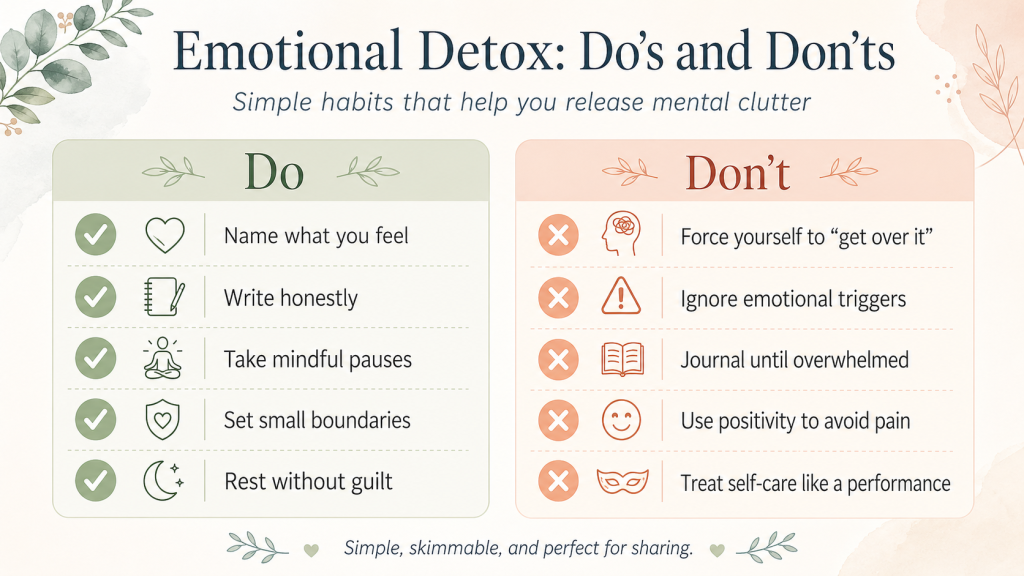
Avoid these common mistakes:
- Forcing yourself to “get over it”
- Using positivity to avoid pain
- Journaling until you feel worse
- Expecting instant peace
- Blaming yourself for having feelings
- Turning self-care into another performance
You are not a broken project. You are a person learning how to feel, release, and return to yourself.
That takes time.
Amazon Product Picks for Emotional Detox
These products can support journaling, emotional release, self-compassion, mindfulness, and stress relief. They are not replacements for therapy or professional care, but they can make your self-care routine easier to practice.
1. The Emotional Detox Deck: 50 Cards to Process Your Emotions and Release Toxicity
This card deck gives you guided prompts to help you process emotions and release negativity. It is especially useful when you want to reflect but do not know where to start.
Features: 50 cards, reflection prompts, emotional processing themes.
Best for: Beginners, journal lovers, and anyone who likes quick self-care prompts.
2. Emotional Detox: 7 Steps to Release Toxicity and Energize Joy
This book offers a structured approach to releasing fear, worry, anger, doubt, and emotional heaviness.
Features: Step-by-step guidance, emotional release exercises, mindset support.
Best for: Readers who want a deeper emotional healing framework.
3. The Mindful Self-Compassion Workbook
This workbook helps you soften self-criticism and build a kinder relationship with yourself through practical exercises.
Features: Guided exercises, self-compassion practices, reflective tools.
Best for: People who struggle with guilt, perfectionism, or harsh self-talk.
4. Calm Collective 52 Anti-Anxiety Journal Cards
These CBT-inspired journal cards offer simple prompts for stress relief, mindfulness, and emotional check-ins.
Features: 52 prompt cards, CBT-style questions, portable format.
Best for: Busy people who want quick emotional support without a long routine.
5. 90-Day Mindfulness Journal for Anxiety, Stress Management, and Wellness
This guided journal gives you daily space for reflection, gratitude, and mindfulness.
Features: 90-day format, gratitude prompts, mindfulness exercises.
Best for: Anyone who wants a steady emotional reset routine.
What Research Says About Emotional Release
Emotional Detox may sound personal and gentle, but many of the practices behind it are supported by research on emotional processing, stress management, journaling, and mindfulness.
The important thing is to use these tools with care. You are not trying to force your feelings out. You are giving them somewhere safe to go.
Expressive Writing Can Help You Process Difficult Emotions
Research on the emotional and physical health benefits of expressive writing suggests that writing about stressful or emotional experiences may support psychological well-being for some people.
A 2005 review by Baikie and Wilhelm noted that expressive writing has been linked with improvements in emotional processing, mood, and overall health outcomes.
That does not mean journaling is a magic cure. It means writing can help you move tangled thoughts out of your head and onto the page. Once you can see what you are carrying, it often feels less like a storm and more like something you can understand.
Mindfulness Supports Emotional Regulation
A 2024 review on mindfulness, emotional regulation, and stress resilience found that mindfulness-based practices, including Mindfulness-Based Stress Reduction, may help reduce anxiety, improve emotional regulation, and support stress resilience.
That is why simple tools like slow breathing, mindful pauses, body scans, and quiet reflection can be helpful during an Emotional Detox.
They give your nervous system a chance to settle before your emotions take the wheel.
A Simple 7-Day Emotional Detox Plan
You do not need to change your whole life overnight.
Try this gentle plan for one week:
Day 1: What is it that you are carrying?
Day 2: Write an unsent letter.
Day 3: Take a 20-minute digital break.
Day 4: Set one small boundary.
Day 5: Move your body for 10 minutes.
Day 6: Practice a mindful pause during stress.
Day 7: Reflect on what feels lighter.
Keep it simple. You are not trying to become a perfectly healed mountain sage by Sunday.
You are just giving yourself room to feel a little clearer, calmer, and more honest.
FAQs About Emotional Detox
What is an Emotional Detox in simple terms?
An Emotional Detox is the process of noticing, processing, and releasing emotional clutter. It can include journaling, mindfulness, boundaries, rest, honest reflection, and small daily reset habits.
How can I determine whether I require an emotional detox?
You may need an Emotional Detox if you feel emotionally drained, easily irritated, stuck in old thoughts, overwhelmed, numb, or unable to relax even when nothing urgent is happening.
Can journaling help with emotional detoxing?
Yes, journaling can help you process emotions, notice patterns, and release thoughts you have been holding inside. Keep it gentle. If writing makes you feel worse, pause and return when you feel safer.
How much time is needed for an emotional detox?
Depending on what you are carrying, yes. Some people feel lighter after one honest journal session or conversation. Deeper emotional healing may take weeks, months, or support from a therapist.
Is an Emotional Detox the same as therapy?
No. An Emotional Detox is a self-care practice. Therapy is professional mental health support. If your emotions feel intense, unmanageable, or unsafe, reaching out to a licensed professional is a wise and caring step.
Conclusion
An Emotional Detox is not about becoming calm every minute of the day. It is about learning how to stop carrying what keeps hurting you.
Start by naming what you feel. Write honestly. Pause before reacting. Set boundaries. Release what was never yours to hold. These small practices can create real emotional space over time.
Be patient with yourself. Healing is rarely one dramatic breakthrough. More often, it is a quiet choice you make again and again.
Sometimes it is choosing not to replay the same painful thought. Sometimes it is saying no. Sometimes it is taking one deep breath before you answer.
That counts.
You are allowed to feel lighter. Start with one small release today.