
Emotional Self Awareness: Signs, Benefits, and Tips

We may earn a commission for purchases made using our links. Please see our disclosure to learn more.
Have you ever snapped at someone, then realized ten minutes later that you were not really angry at them? Maybe you were tired. Maybe you felt ignored. Maybe your brain had too many tabs open and one of them started playing emotional elevator music.
That is where emotional self awareness comes in.
Emotional self awareness is the ability to notice, name, and understand what you feel before those feelings start driving the bus. It does not mean you become perfectly calm all the time. You are human, not a scented candle. It means you get better at catching your inner signals, understanding your emotional triggers, and responding with more intention.
In this guide, you will learn what emotional self awareness looks like, why it matters, how to build it, and which simple tools can support your personal growth.
What Is Emotional Self Awareness?
Emotional self awareness is the skill of recognizing your feelings and understanding how they shape your thoughts, choices, and behavior.
It sounds simple until life gets spicy.
You may know you feel “bad,” but bad is a suitcase word. It can mean disappointed, lonely, embarrassed, worried, resentful, overstimulated, or just hungry enough to become a tiny thunderstorm.
When you build emotional clarity, you move from:
“I’m fine.”
To:
“I’m overwhelmed because I said yes to too much.”
That small shift can change how you talk, decide, rest, work, and connect with others.
Why Emotional Self Awareness Matters
Emotions are information. They are not always instructions.
That distinction matters.
Anger may tell you a boundary was crossed. Fear may tell you something feels uncertain. Sadness may show you what mattered. Jealousy may point toward an unmet desire or insecurity.
When you understand your emotional patterns, you can pause before reacting. You can make better choices. You can also stop blaming yourself for having feelings in the first place.
Emotional self awareness supports:
- Better emotional regulation
- Healthier communication
- Stronger relationships
- Clearer decision-making
- More self-compassion
- Deeper personal growth
It is like turning on the lights in a messy room. The mess may still be there, but now you can stop stepping on emotional Legos.
Signs You Have Strong Emotional Self Awareness
You may already have more inner awareness than you think.
Common signs include:
- You can name what you feel with some detail.
- You notice how stress changes your tone or behavior.
- You can admit when you overreact.
- You understand some of your emotional triggers.
- You reflect before making big decisions.
- You can say, “I need a minute,” instead of exploding.
- You recognize patterns in your moods, habits, or relationships.
Strong emotional awareness does not make you emotionless. It makes you honest with yourself.

Signs You May Need More Emotional Clarity
No shame here. Most people were not exactly handed an emotional user manual at birth.
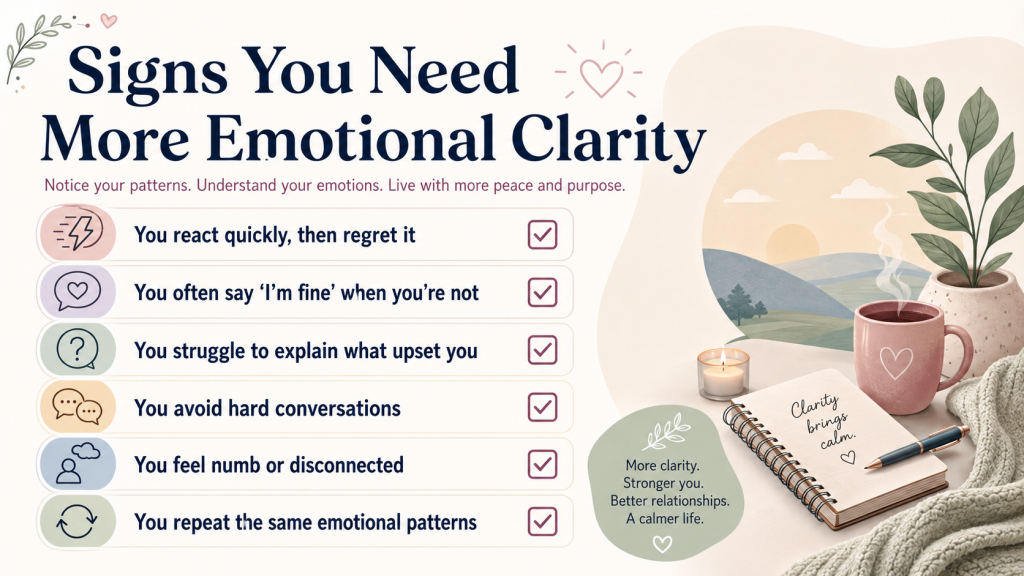
You may need more emotional clarity if:
- You often say “I don’t know” when asked how you feel.
- You react quickly, then regret it.
- You confuse anxiety with intuition.
- You avoid hard conversations until resentment builds.
- You feel numb or disconnected.
- You struggle to explain what upset you.
- You notice the same conflicts repeating.
The goal is not to judge yourself. The goal is to get curious.
Try asking, “What is this feeling trying to tell me?” instead of “Why am I like this?”
Much kinder. Much more useful.
The Difference Between Feeling and Understanding
Feeling an emotion is automatic. Understanding it takes practice.
Think of your emotions like phone notifications. Some are useful. Some are dramatic. Some are from apps you forgot you downloaded in 2017.
Emotional self awareness helps you check the notification before tapping it.
For example:
“I’m angry” is a feeling.
“I’m angry because I felt dismissed during that meeting” is understanding.
“I need to speak up clearly instead of shutting down” is self-regulation.
That is the growth path: notice, name, understand, respond.
How Emotions Show Up in the Body
Your body often notices emotions before your mind does.
Stress may show up as tight shoulders. Anxiety may feel like a buzzing chest. Sadness may feel heavy. Anger may bring heat to your face or tension in your jaw.
Before asking, “What am I feeling?” try asking:
“What is my body doing right now?”
You might notice:
- Shallow breathing
- Clenched hands
- Stomach tightness
- Head pressure
- Restlessness
- Low energy
- A sudden urge to withdraw
Your body is not being dramatic. It is sending you data.
Practical Tips to Build Emotional Self Awareness
You do not need a three-hour morning routine, a silent retreat, and a journal made from moonlight.
Start small.
Try this simple check-in once or twice a day:
- What am I feeling?
- Where do I feel it in my body?
- What happened before this feeling showed up?
- What do I need right now?
- What is one kind response I can choose?
This takes less than two minutes. Done consistently, it can help you build emotional intelligence without turning your life into a self-help boot camp.
Try the Pause-and-Name Method
When a strong emotion hits, pause and name it.
Say:
“I notice frustration.”
“I notice embarrassment.”
“I notice fear.”
This works better than saying, “I am angry,” because it creates a little space between you and the emotion.
You are not the storm. You are the person noticing the storm.
That space gives you power. It helps you respond instead of reacting.

Use Journaling to Catch Emotional Patterns
Journaling is one of the simplest self-awareness exercises because it helps you see patterns you may miss in the moment.
You do not need perfect grammar. You do not need poetic wisdom. You can write, “Today was weird and my brain felt like soup.” That counts.
Try these prompts:
- What emotion kept returning today?
- What triggered it?
- What did I need but not say?
- What did I assume?
- What helped me feel calmer?
- What boundary might I need?
Over time, journaling can reveal the emotional weather patterns of your life.
You may also find it helpful to define your values through a personal growth exercise like learning how to write a personal manifesto, especially if you want your choices to reflect who you are becoming.
Build an Emotional Vocabulary
Many people only use broad labels like happy, sad, mad, or stressed. That is a start, but emotional vocabulary gives you better tools.
Instead of “mad,” you might be:
- Irritated
- Disrespected
- Overlooked
- Protective
- Betrayed
- Impatient
Instead of “sad,” you might be:
- Lonely
- Grieving
- Disappointed
- Drained
- Tender
- Discouraged
The more precise the word, the clearer the need.
For example, “I feel rejected” points to a different need than “I feel exhausted.” One may need reassurance. The other may need rest.
How Emotional Self Awareness Improves Relationships
Relationships get easier when you understand your emotional reactions.
Not perfect. Easier.
When you know what you feel, you can communicate without turning every conversation into a courtroom drama.
Instead of:
“You never listen to me.”
You might say:
“I felt ignored earlier, and I’d like to talk about it.”
That one sentence can lower defensiveness. It also gives the other person something clear to respond to.
Emotional self awareness helps you:
- Own your feelings without blaming others
- Ask for what you need
- Notice when old wounds affect new conversations
- Apologize faster
- Choose honesty over silent resentment
That last one is huge. Silent resentment is basically emotional mold. It grows in dark corners.
Cultural and Personal Context Matters
Not everyone learns to express emotions the same way.
Some families encourage open talks about feelings. Others treat emotions like suspicious guests: “Why are you here, and how long are you staying?”
Culture, gender expectations, religion, upbringing, trauma history, and personality can all shape how you understand emotions.
For some people, emotional control means strength. For others, emotional expression means honesty. Neither is automatically wrong.
The key is asking:
“Did I choose this emotional pattern, or did I inherit it?”
That question can open a door.
You can honor where you came from while still choosing healthier emotional habits.
Tools That Can Support Emotional Self Awareness
Here are five relevant Amazon products that can support emotional self awareness, reflection, and emotional intelligence.
1. The Emotional Intelligence Workbook: Practical Exercises to Boost Self-Awareness, Manage Stress, and Cultivate Resilience
This workbook is a practical option for readers who want guided exercises instead of just theory. It focuses on self-awareness, stress management, and resilience.
Features:
- Practical exercises
- Emotional intelligence focus
- Self-awareness and stress support
Best for: Beginners who want structured reflection and simple action steps.
2. The New Emotional Intelligence by Travis Bradberry
This 2025 book focuses on improving EQ through self-awareness, self-management, social awareness, and relationship management. Amazon’s product page describes it as including 60 strategies and an emotional intelligence test access code.
Features:
- Modern EQ strategies
- Self-awareness section
- Online assessment support
Best for: Readers who want a current, skill-based guide to emotional intelligence.
3. Permission to Feel by Marc Brackett
This book is a strong fit for emotional literacy. Marc Brackett is connected with the Yale Center for Emotional Intelligence, and the book focuses on understanding and using emotions in healthier ways.
Features:
- Emotional literacy framework
- Useful for adults, parents, and educators
- Practical language for naming feelings
Best for: Anyone who wants to stop dismissing emotions and start learning from them.
4. The Language of Emotions by Karla McLaren
This book explores what different emotions may be trying to communicate. It is especially useful for readers who want to understand anger, sadness, fear, shame, grief, and joy with more nuance.
Features:
- Emotion-by-emotion guidance
- Reflective exercises
- Strong focus on emotional meaning
Best for: Readers who want deeper emotional vocabulary and self-reflection.
5. The Self Awareness Workbook: A Guided Journal for Self Discovery Towards a Life of Happiness and Inner Peace
This guided journal supports self-discovery and reflection. It works well for readers who prefer writing prompts and a slower, more personal approach.
Features:
- Guided journal format
- Self-discovery prompts
- Inner peace and reflection focus
Best for: Journal lovers, beginners, and anyone who processes emotions better on paper.
Research-Backed Insights on Emotional Self Awareness
Emotional self awareness is not just a feel-good self-help idea. Research suggests that the ability to notice, name, and understand emotions can play an important role in mental health and emotional regulation.
A Harvard Brain Science Initiative summary of research published in Clinical Psychological Science explains that people who struggle to identify and label emotions may face a higher risk of mental health challenges, including anxiety and depression. In one study of 120 children and adolescents ages 7–19, lower emotional awareness was linked with more severe mental health symptoms. In a second study of 262 children and adolescents ages 8–16, researchers found a similar connection, especially among young people exposed to violence. You can read more about how naming emotions may support better emotional regulation.
Another 2023 study published in Frontiers in Psychology looked at emotional self-awareness, emotion regulation, and diabetes distress among 262 Italian and Dutch adults with type 1 diabetes. The researchers found that “clarity of feelings” was significantly linked with lower diabetes distress. In simple terms, people who could better identify and distinguish their emotions tended to report less distress related to managing their condition. This supports the idea that clarity of feelings can strengthen emotional coping.
Common Mistakes to Avoid
Emotional growth can get weirdly perfectionistic if you are not careful.
Avoid these traps:
- Trying to analyze every feeling instantly
- Judging “negative” emotions as bad
- Using self-awareness as self-criticism
- Confusing emotional honesty with oversharing
- Expecting one journal entry to fix a lifelong pattern
Self-awareness should feel like turning toward yourself, not putting yourself on trial.
How to Practice Emotional Regulation After Awareness
Awareness is the first step. Regulation is what you do next.
Once you name the feeling, try one small response:
- Take five slow breaths.
- Step outside for fresh air.
- Drink water.
- Ask for a pause.
- Write the honest sentence you are afraid to say.
- Move your body.
- Choose a calmer time to talk.
You do not have to fix the emotion. Sometimes you just need to make room for it without handing it the microphone.
When Emotional Self Awareness Feels Hard
Sometimes self-reflection feels uncomfortable because it brings up old pain, shame, or fear.
Go gently.
If emotions feel overwhelming, intense, or connected to trauma, support from a licensed therapist can help. Self-awareness is powerful, but you do not have to do the hard parts alone.
Healing is not a solo sport. Even the strongest people need mirrors, guides, and safe places to be honest.
FAQs About Emotional Self Awareness
What is emotional self awareness in simple terms?
Emotional self awareness means noticing what you feel, naming it accurately, and understanding how it affects your thoughts and actions.
How do I improve emotional self awareness daily?
Start with short check-ins. Ask what you feel, where it shows up in your body, what triggered it, and what you need next.
Why is emotional self awareness important for personal growth?
It helps you understand patterns, manage reactions, communicate better, and make choices that match your values instead of your temporary mood.
Can journaling help with emotional self awareness?
Yes. Journaling helps you slow down, name emotions, spot triggers, and notice patterns that may be hard to see in the moment.
What is the difference between emotional self awareness and emotional intelligence?
Emotional self awareness is one part of emotional intelligence. Emotional intelligence also includes managing emotions, understanding others, and handling relationships well.
Conclusion: Start Listening Before You Fix
Emotional self awareness is not about becoming perfectly calm, endlessly wise, or suspiciously Zen in grocery store lines. It is about listening to yourself with more honesty and less judgment.
When you can name what you feel, you can understand what you need. When you understand what you need, you can choose your next step with more care.
Start small. Pause once today. Name one feeling honestly. Notice where it lives in your body. Ask what it is trying to show you.
That is how self-awareness grows: one honest moment at a time.