
The Only Weekly Reset Routine You Need

We may earn a commission for purchases made using our links. Please see our disclosure to learn more.
You know that strange Sunday-night feeling when your brain suddenly remembers everything you ignored all week? The laundry. The unread messages. The half-finished tasks. The appointment you forgot to write down. Your brain basically opens 37 browser tabs and then freezes.
That is exactly why a Weekly Reset Routine can feel so helpful. It gives you one simple rhythm for clearing mental clutter, organizing your schedule, checking in with yourself, and walking into the new week with a little more breathing room.
This guide will show you how to create a practical weekly planning routine that works for real life, not some perfectly edited productivity video where everyone owns matching linen storage bins.
What Is a Weekly Reset Routine?
A Weekly Reset Routine is a set time each week when you review, organize, clean up, and prepare for the days ahead.
Think of it like pressing the refresh button on your life. Not a dramatic reinvention. Not a “new me” speech in the mirror. Just a practical reset that helps you notice what needs attention before the week starts running around with scissors.
A strong weekly reset usually includes:
- Reviewing the past week
- Planning your priorities
- Updating your calendar
- Tidying your space
- Checking habits, meals, money, or errands
- Making time for rest
The goal is not perfection. The goal is direction.
Why a Weekly Reset Routine Helps You Feel Less Scattered
When life feels messy, your brain works harder to hold all the loose pieces together. A weekly reset gives those pieces somewhere to go.
Instead of carrying everything in your head, you create a simple system. You see what matters, what can wait, and what needs to be dropped like a hot potato.
A Weekly Reset Routine can help you:
- Reduce decision fatigue
- Feel more prepared
- Make room for self-care
- Keep weekly goals visible
- Catch small problems before they grow
- Build a calmer productivity reset ritual
It is less about doing more and more about reducing the chaos around what you already do.
Pick a Reset Day That Fits Your Real Life
Sunday is popular for a Sunday reset routine, but it is not the only option. If Sunday is family day, work day, church day, grocery day, or “please do not speak to me” day, choose another time.
Maybe Friday afternoon works better because it helps you close the workweek. Maybe Monday morning feels right because your weekend is too full. Maybe Wednesday night is your reset because your schedule is wonderfully weird.
Ask yourself:
- When do I naturally feel ready to reflect?
- When do I usually feel most overwhelmed?
- What day gives me at least 30 quiet minutes?
- Do I reset better in the morning, afternoon, or evening?
Your weekly routine should fit your life, not shame your life.

Start With a Brain Dump
Before you organize anything, empty your head. A brain dump is where you write down every task, worry, reminder, idea, and “oh no, I forgot that” thought.
Do not sort it yet. Just get it out.
Write down things like:
- Bills to pay
- People to text back
- Work tasks
- Cleaning jobs
- Meal ideas
- Appointments
- Personal goals
- Random reminders
- Emotional clutter
This step works because your mind is not a storage unit. It is more like a very dramatic assistant. Helpful, but easily overwhelmed.
Once everything is on paper, you can sort it into categories: urgent, important, later, delegate, delete.
Review the Past Week Without Beating Yourself Up
This part matters. A reset is not a courtroom where you prosecute yourself for being human.
Look back gently. What worked? What felt heavy? What kept getting postponed? What gave you energy?
Try these reflection prompts:
- What went well this week?
- What drained me more than expected?
- What am I proud of, even if it was small?
- What did I keep avoiding?
- What do I need more or less of next week?
Maybe you did not finish your workout plan, but you got through a tough week with your sanity mostly intact. That counts. Maybe you cooked twice instead of five times. Still counts. Progress does not need a marching band to be real.
Reset Your Space First
Your environment speaks to your nervous system. A messy room is not a moral failure, but it can make your brain feel like it is trying to think inside a junk drawer.
Start with a 15-minute tidy. Keep it simple.
Focus on:
- Clearing your desk or workspace
- Emptying trash
- Returning dishes to the kitchen
- Putting laundry in one place
- Resetting your nightstand
- Preparing your bag, keys, or work setup
You do not need to deep clean the whole house. This is a weekly reset, not an archaeological dig.
A clean enough space gives your week a softer landing.
Plan Your Top Priorities
Now choose your main weekly goals. Not 28 goals. Not a heroic list that would frighten a project manager. Pick three to five priorities.
These can include work, personal growth, home, relationships, health, or finances.
Use this simple format:
- Must do: tasks with real deadlines
- Should do: important but flexible tasks
- Nice to do: extras if energy allows
This keeps your weekly planning realistic. Some weeks are high-energy. Other weeks are “I am held together by coffee and hope.” Your plan should respect both.
Ask yourself: “If only three things get done this week, what would make the biggest difference?”

Organize Your Calendar and Appointments
After choosing priorities, open your calendar. Add appointments, meetings, deadlines, school events, workouts, errands, and social plans.
Then look for conflict points. Do you have three heavy days in a row? Is your grocery run scheduled after a long workday when you know you will be too tired? Did you accidentally plan a major task on the same day as a family commitment?
This is where time blocking helps.
You can block time for:
- Focus work
- Errands
- Meal prep
- Exercise
- Admin tasks
- Rest
- Family time
- Creative work
Leave white space, too. A calendar packed wall to wall is not organized. It is a trap wearing nice fonts.
Refresh Your Self-Care Routine
A good Weekly Reset Routine should not only help you get things done. It should help you feel like a person while doing them.
Self-care doesn’t have to be elegant. It can be deeply ordinary.
Try adding:
- One slow morning
- One earlier bedtime
- A walk outside
- A screen-free hour
- A therapy appointment
- Prayer, meditation, or journaling
- A simple meal you actually enjoy
- Time with someone who feels safe
Self-care is not a reward for finishing your list. It is part of the list because you are not a machine with cute stationery.
Prep the Little Things That Drain Energy
Some tasks are small, but they steal attention all week. Your weekly checklist should catch them early.
Try prepping:
- Outfits
- Lunches or snacks
- Grocery list
- Water bottle
- Vitamins or medications
- Work bag
- Kids’ school items
- Pet supplies
- Bills due this week
This is not about becoming hyper-organized. It is about removing tiny future annoyances.
Your future self deserves fewer “where are my keys?” moments.
Connect Your Reset to Bigger Lifetime Goals
A weekly reset becomes more powerful when it connects to your bigger life direction.
This does not mean every Sunday needs to become a dramatic vision board ceremony. But it helps to ask: “Is this week moving me toward the life I actually want?”
Maybe your bigger goal is better health, financial peace, deeper faith, stronger relationships, creative confidence, or a calmer home. Weekly goals become easier to choose when they connect to your values.
For deeper reflection, you can read this guide on setting lifetime goals that actually matter and use it to shape your weekly planning.
Small weekly choices become powerful when they point somewhere meaningful.
Create a Simple Weekly Reset Checklist
A checklist keeps your reset from turning into a vague “get my life together” cloud.
Here is a simple weekly reset checklist you can copy:
- Clear your main space
- Do a brain dump
- Review last week
- Check your calendar
- Choose three priorities
- Plan meals or groceries
- Prep outfits or supplies
- Review finances or bills
- Schedule movement and rest
- Set one personal intention
Keep it visible. Put it in your planner, notes app, habit tracker, or on a dry erase board.
The less you have to remember, the easier it is to repeat.
Tools That Can Support Your Weekly Reset Routine
You do not need products to reset your week. A notebook and pen can do the job. Still, the right tool can make the habit easier, especially if you like structure or visual planning.
Clever Fox Hourly Planner PRO Premium
This undated planner is useful for people who like time blocking, daily priorities, habit tracking, and detailed weekly planning.
Features:
- Hourly time slots
- Weekly and monthly layouts
- Habit tracker
- Goal-setting pages
- Large A4 format
Best for: Busy professionals, students, entrepreneurs, and anyone who wants a structured weekly planner.
Rocketbook Smart Reusable Everyday Planner
This reusable planner works well if you like handwriting but also want digital organization.
Features:
- Daily, weekly, monthly, and annual planning pages
- Reusable pages
- App scanning
- Cloud upload options
- Undated format
Best for: Digital note-takers, eco-conscious planners, and people who rewrite their plans often.
Intelligent Change 3-Month Productivity Planner
This planner focuses on mindfulness, priorities, and manageable productivity.
Features:
- Daily task planning
- Productivity prompts
- Space for notes
- Habit and water tracking
- Three-month structure
Best for: Anyone who wants a calmer, reflection-based productivity reset.
BestSelf 13-Week Self Journal & Goal Planner
This goal planner helps break bigger goals into a 13-week roadmap.
Features:
- Goal planning
- Daily intention setting
- Gratitude and reflection prompts
- Habit tracking
- Undated structure
Best for: Goal-driven readers, creatives, students, and people working on personal growth projects.
Post-it Dry Erase Whiteboard Film Surface
This peel-and-stick whiteboard surface is a helpful visual planning tool for families, teams, or big-picture thinkers.
Features:
- Dry erase surface
- Peel-and-stick installation
- Cut-to-fit design
- Works on walls, doors, and other smooth surfaces
- Reusable planning space
Best for: Family command centers, home offices, meal planning, content calendars, and shared weekly schedules.
Research-Backed Reasons Weekly Planning Helps
A weekly reset feels good, but it is not just a cozy productivity trend. There is research behind why planning and routines can support well-being.
A 2023 field experiment on weekly planning behavior examined how how work engagement, incomplete tasks, rumination, and cognitive flexibility are related to weekly planning. The takeaway: planning can help people approach work with more structure and reduce the mental drag of unfinished tasks.
A 2020 peer-reviewed article on regularizing daily routines for mental health also highlights the value of routines during stressful periods. While your weekly reset will not solve every problem, routines can create predictability, and predictability often helps people feel more grounded.
In plain English: your brain likes a map. Even a rough one.
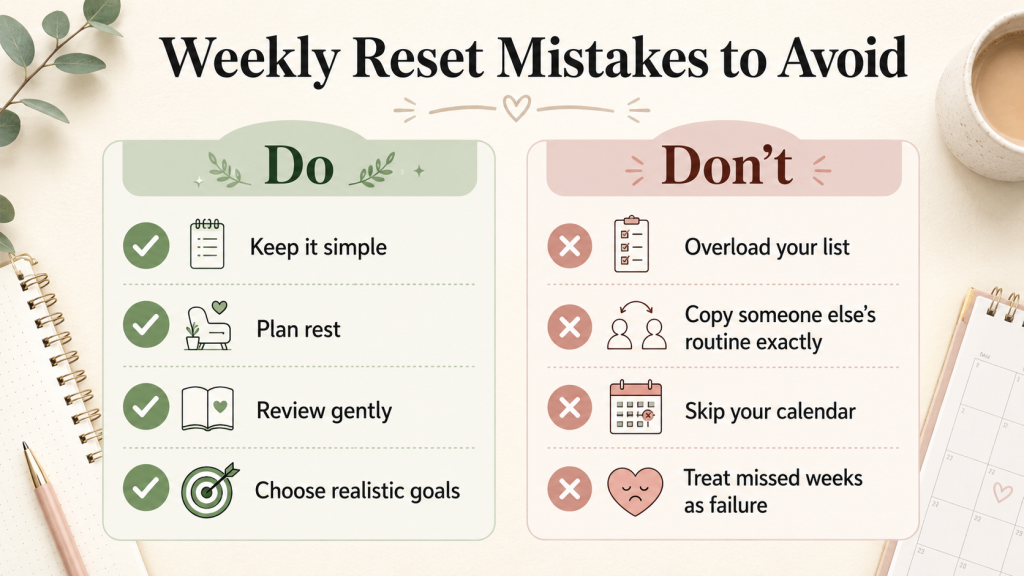
Common Weekly Reset Mistakes to Avoid
The biggest mistake is making your reset too complicated. If your routine takes four hours, requires five apps, and needs a ceremonial candle arrangement, you may avoid it by week two.
Avoid these common traps:
- Planning too many tasks
- Ignoring rest
- Using the reset to criticize yourself
- Copying someone else’s routine exactly
- Forgetting to check your actual calendar
- Making the routine too long
- Treating one missed week like failure
Keep your reset light enough to repeat. Consistency beats intensity almost every time.
FAQs About Weekly Reset Routine
What should be included in a Weekly Reset Routine?
A Weekly Reset Routine should include a brain dump, calendar review, priority planning, light cleaning, meal or errand prep, and a self-care check-in. Keep it simple enough to repeat every week.
How long should a weekly reset take?
A weekly reset can take 30 to 90 minutes. If you are busy, start with a 20-minute version: brain dump, calendar check, three priorities, and one small space reset.
Is Sunday the best day for a weekly reset?
Sunday works well for many people, but it is not required. The day you can regularly repeat is the best one. Friday, Monday, or midweek can work just as well.
How do I stay consistent with a weekly reset?
Attach it to an existing habit, such as morning coffee, Sunday laundry, or Friday desk cleanup. Also, keep your checklist short. The easier it feels, the more likely you are to continue.
Can anxiety be reduced with a weekly reset?
A weekly reset may help reduce some stress by creating structure and clearing mental clutter. However, it is not a replacement for therapy, medical care, or mental health support if anxiety feels intense or ongoing.
Conclusion: Make Your Weekly Reset Feel Like a Fresh Start
A Weekly Reset Routine is not about becoming a perfect person with a perfect schedule. It is about giving yourself a steady rhythm in the middle of real life.
Start small. Clear one space. Write one brain dump. Choose three priorities. Schedule one thing that supports your well-being. Then repeat next week.
Little by little, your reset becomes a quiet promise to yourself: “I can begin again.”
And honestly, that is a pretty beautiful way to start a week.