
Smart Plan Tips for Clear and Achievable Goals

We may earn a commission for purchases made using our links. Please see our disclosure to learn more.
You know the pattern: a goal feels exciting on Sunday, then quietly disappears by Wednesday. Ambition is rarely the problem. The goal simply has no clear route through work, family duties, and low-energy days.
A smart plan turns hope into practical steps. You will learn how to shape goals, measure progress, prepare for obstacles, and create a supportive action plan.
Affiliate note: This article includes Amazon product suggestions that may support goal planning and progress tracking.
What Is a Smart Plan?
A smart plan defines a goal as specific, measurable, achievable, relevant, and time-bound. It follows the SMART goals framework, connecting the result to milestones, actions, reviews, and backup strategies.
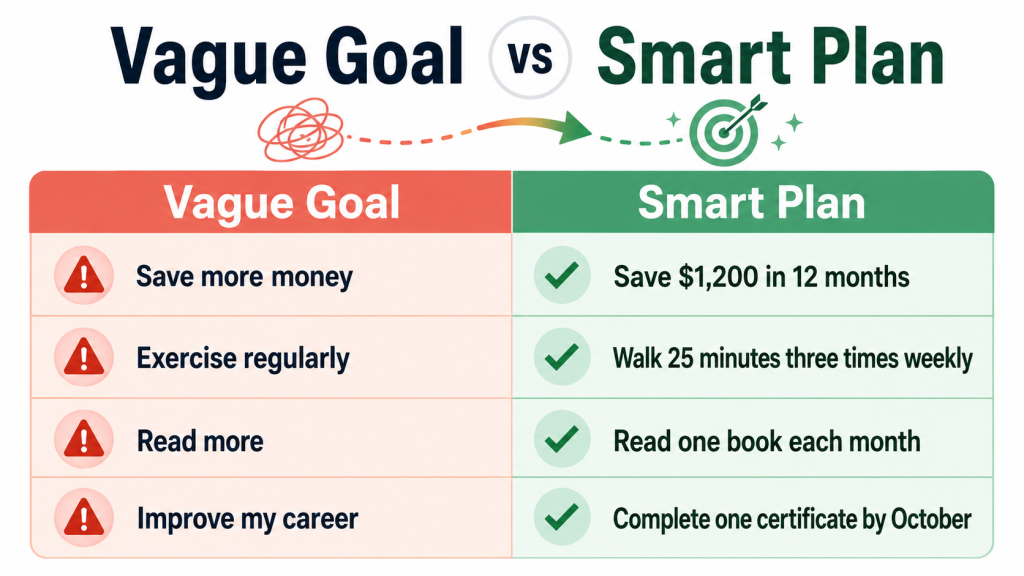
Think of the goal as your destination and the plan as your route. “Improve my finances” points in a direction. “Save $1,200 by transferring $100 each month for one year” gives you a pace and finish line.
It should explain what you want, how you will measure it, why it matters, and when you will act.
Why Vague Goals Are So Easy to Abandon
Vague goals force you to make new decisions every day. “Get healthier” could mean walking, sleeping more, changing dinner, or buying a suspiciously green smoothie.
That uncertainty creates friction. Compare “exercise more” with “walk for 25 minutes after dinner every Monday, Wednesday, and Friday.” The second is clear.
A useful goal-setting strategy does not remove effort; it removes avoidable confusion.
Choose a Goal That Matters to You
Before adding numbers and deadlines, ask why you want the goal. Many plans begin with someone else’s expectations or an impressive-looking trend.
Try completing this sentence:
I want to achieve this because it would help me __________.
Your answer might involve freedom, health, creativity, stability, connection, or confidence. A personal reason gives your smart plan emotional weight when motivation takes the week off.
A relevant goal should support the life you value.

Make Your Goal Specific Enough to Act On
A specific goal describes the desired result without leaving room for ten interpretations.
- Vague: “Read more.”
- Specific: “Read 12 books this year.”
- Actionable: “Read 10 pages before bed on weeknights and finish one book each month.”
Use clear verbs such as save, complete, practice, submit, walk, publish, or study. Avoid phrases like “be better at” unless you define what better looks like.
A smart plan should remain understandable on a busy Tuesday, not only during an inspired planning session.
Decide How You Will Measure Progress
Measurement gives your goal a scoreboard. Without one, steady effort may still feel invisible.
You could measure:
- Frequency: Three workouts per week
- Quantity: Save $100 per month
- Duration: Practice for 20 minutes
- Completion: Submit four applications
- Milestones: Finish one course module by Friday
Qualities such as confidence can be tracked through behavior. “Speak once in every team meeting” is clearer than “be more confident.”
Keep progress tracking simple. A checkbox you use regularly beats an elaborate dashboard you abandon after nine days.
Keep the Goal Achievable and Relevant
An achievable goal stretches you without requiring a completely different life. It respects your time, energy, finances, responsibilities, health, and access to support.
Test It Against Real Life
Ask what resources and support you have. If you work nights and care for children, five early workouts may be possible but poorly matched to your schedule. Three flexible sessions may produce better consistency.
Check Its Relevance
A relevant goal supports a wider priority. Your smart plan should serve your life, not turn your life into unpaid staff for the plan.
Add a Deadline Without Creating Panic
Time-bound goals create urgency and help you schedule the work. However, a deadline should guide action, not hover above you like a dramatic movie countdown.
Choose a completion date, then add smaller review dates. For a six-month goal, assess progress every two weeks and review the wider strategy monthly.
Work backward from the finish line. Ask what must happen by the midpoint, this month, and this week. Build in breathing room for illness, travel, busy seasons, and unexpected costs. Flexibility makes a deadline realistic, not weak.

Break Your Smart Plan Into Milestones
Large goals feel intimidating because you see the whole mountain at once. Milestones turn it into several reachable campsites.
For a three-month portfolio website, your milestones might be:
- Choose the platform and structure.
- Write the main pages.
- Gather work samples.
- Build and review the site.
- Publish it.
Give each milestone a date and a physical next action. “Draft the About page for 30 minutes on Thursday” is clearer than “work on website.”
Turn Milestones Into Weekly Actions
Goals live in the future, but progress happens inside ordinary weeks. At the start of each week, choose one to three actions that move your goal forward.
A simple rhythm could be:
- Monday: Choose the main priority.
- Midweek: Check whether the plan still fits.
- Friday or Sunday: Record progress and adjust.
Leave margin in your schedule. A week planned to full capacity collapses when something unexpected happens. Consistency is doing the next reasonable thing.
Prepare for Obstacles With If-Then Planning
A strong smart plan includes the moments most likely to derail it. Plan your response ahead of time.
- If I miss my morning workout, then I will walk after work.
- If I feel nervous about studying, then I will begin with five minutes.
- If an expense reduces my savings, then I will restart next payday.
A 2006 meta-analysis of implementation intentions and goal achievement reviewed 94 independent tests and found a medium-to-large positive effect on goal attainment. Deciding when, where, and how you will act can help close the gap between intention and behavior.
Track Progress and Review What You Learn
Tracking is not about policing yourself. It is about collecting useful information.
Record completed actions and look for patterns. Maybe you study better at a library, or Friday workouts fail because you are exhausted. These observations are data, not character judgments.
A 2016 meta-analysis of progress monitoring and goal attainment covered 138 studies with 19,951 participants. Monitoring improved goal attainment, with stronger effects when progress was physically recorded or shared.
Review your smart plan weekly or every two weeks, keeping what works and adjusting what does not.
Helpful Amazon Products for Goal Planning
Choose a tool that fits your planning style: detailed daily pages or one clean weekly view.
Clever Fox Planner PRO
The Clever Fox Planner PRO – Weekly & Monthly Life Planner to Increase Productivity, Time Management and Hit Your Goals, 8.5×11″ (Amber Yellow) includes vision prompts, goal pages, monthly and weekly planning, a quick-start guide, and stickers.
Best for: Visual planners connecting long-term goals with daily schedules.
Legend Planner PRO
The Legend Planner PRO – Deluxe Weekly & Monthly Life Planner to Increase Productivity and Hit Your Goals. Time Management Organizer Notebook – Undated – 7 x 10″ Hardcover + Stickers – Mystic Blue is an undated hardcover planner with goal-setting sections, weekly layouts, and stickers.
Best for: People balancing personal development goals with work priorities.
BestSelf 13-Week Self Journal & Goal Planner
The BestSelf 13-Week Self Journal & Goal Planner – Undated Daily ADHD-Friendly Journal for Men & Women | Productivity, Gratitude, Reflection & Habit Tracker | 2026 Life Organizer with Prompts, Black combines daily planning, gratitude, reflection, and habit tracking within a focused 13-week cycle.
Best for: Professionals, students, and creatives who enjoy structured prompts.
Panda Planner Pro A4 Daily Planner 2026
The Panda Planner Pro A4 Daily Planner 2026, 6 Month, Large 8.5×11, Black offers daily, weekly, and monthly layouts, habit tracking, gratitude prompts, goal reflection, and generous writing space.
Best for: Busy users managing several schedules and priorities.
Goal Crazy Undated Daily Planner
The Goal Crazy Undated Daily Planner to Achieve Your Goals – 90 Day Guided Journal & Productivity Organizer with Goal Setting, Habit Tracker, To Do List, Academic & Work Calendar, Leather Hardcover – Rose Gold is a 90-day guided journal with discovery prompts, daily and weekly pages, habit tracking, reflections, and long-term planning.
Best for: Beginners who prefer a guided planning system.
Smart Plan Examples for Everyday Life
Personal Finance
“I will save $1,500 by December 15 by transferring $125 into savings on the first payday of each month.”
Health and Movement
“I will complete three 25-minute walks each week for 12 weeks.” If weather interferes, use an indoor walking video.
Career Development
“I will complete an introductory data-analysis certificate by October 30 by studying twice each week.”
Personal Growth
“I will reduce decision-related rumination by writing down the facts, options, and next step whenever I feel stuck.” These practical ways to stop overthinking and clear your head may also help.
Each example combines a measurable outcome, deadline, and repeatable behavior.
FAQs About Creating a Smart Plan
How do I create a smart plan for a personal goal?
Define one clear outcome, choose a measurement, confirm that it fits your circumstances, connect it to a meaningful reason, and set a deadline. Then divide it into milestones and weekly actions.
What is the difference between a smart plan and a to-do list?
A to-do list records tasks. A smart plan connects those tasks to a result, progress measures, deadlines, priorities, and review points.
How often should I review my goal plan?
Review active goals weekly or every two weeks. Use a monthly review for larger adjustments so you can catch problems without constantly rewriting everything.
What should I do if I am falling behind?
Identify the cause, reduce or reschedule the next action, and continue. A small restart usually works better than an exhausting attempt to catch up all at once.
Can a smart plan change after I start?
Yes. Responsibilities, health, resources, or priorities can change. Adjusting your route is sensible when the goal still matters but the original plan no longer fits.
Conclusion: Build Momentum One Step at a Time
A strong smart plan does not demand perfect motivation. It gives you a clear outcome, meaningful measures, realistic milestones, weekly actions, and a response for setbacks.
Start with one goal rather than rebuilding your entire existence before lunch. Write the next step, place it on your calendar, and review what happens. Small actions may look ordinary, but repeated ordinary actions can carry you surprisingly far.
Your plan cannot control every result, but it can keep you moving.