
How to Set Life Goals and Stay Motivated

We may earn a commission for purchases made using our links. Please see our disclosure to learn more.
Some people know exactly what they want from life. The rest of us are standing in the kitchen at 11 p.m., eating cereal, wondering if “get my life together” counts as a plan.
The good news? You do not need a perfect five-year roadmap to start setting meaningful life goals. You only need a clearer picture of what matters to you, a few practical steps, and a system that helps you keep going when motivation gets moody.
In this guide, you’ll learn how to set life goals that feel realistic, personal, and inspiring—not like homework from your future self. We’ll cover values, SMART goals, habits, motivation, research-backed tips, examples, tools, and FAQs.
What Life Goals Really Mean
Life goals are the bigger outcomes you want to create in your personal, professional, emotional, financial, spiritual, or creative life.
They are not just fancy bucket-list items like “buy a villa in Italy” or “write a bestselling book while drinking matcha on a balcony.” Those can count, sure. But life goals can also be beautifully simple:
- Build stronger family relationships
- Feel healthier and more energetic
- Save money with less stress
- Start a small business
- Learn a new language
- Become more confident
- Create a calmer daily routine
The best life goals act like a compass. They do not control every step, but they help you choose your direction.
Why Life Goals Matter More Than Perfect Plans
A goal gives your energy somewhere to go. Without one, your days can feel busy but strangely blurry, like you did a lot but cannot name what actually moved forward.
Life goals help you:
- Make better decisions
- Say no without guilt
- Build self-discipline
- Measure personal growth
- Stay focused during setbacks
- Feel more connected to your future
That said, your goals should support your life—not bully it. A good goal gives you direction. A bad goal turns into a tiny life coach with a whistle.
Start With Your Values Before You Pick Goals
Before you ask, “What do I want to achieve?” ask, “What kind of life do I want to live?”
This matters because many people set goals based on pressure, comparison, or what looks impressive online. But a goal that does not match your values becomes heavy fast.
Questions to clarify your values
Ask yourself:
- What do I want more of in my daily life?
- What am I sick of acting as though nothing is wrong?
- What makes me feel proud in a quiet, honest way?
- What kind of person do I want to become?
- If there was no applause, would I still give a damn?
For example, if you value freedom, your life goals may include building flexible income, paying off debt, or creating a remote-work lifestyle. If you value connection, your goals may focus on family dinners, friendships, community, or better communication.

Use the Life Wheel to Spot What Needs Attention
A “life wheel” is a simple self-reflection tool. Picture your life divided into categories like health, career, money, relationships, spirituality, learning, fun, and home.
On a scale of 1 to 10, rate each area. No drama. No shame spiral. Just honesty.
Common life goal categories
You might set goals in areas such as:
- Health and fitness
- Career and education
- Finances
- Relationships
- Personal development
- Faith or spirituality
- Home and lifestyle
- Creativitylife goalsCreativity
- Travel and adventure
- Emotional well-being
The point is not to score a perfect 10 everywhere. Nobody is doing that, no matter how organized their fridge looks. The point is to notice where your attention would make the biggest difference.
Turn Big Dreams Into SMART Goals
Big dreams are wonderful, but they can feel slippery. “Be healthier” sounds nice, but what does it mean on a rainy Tuesday when you are tired and the couch is being very persuasive?
That is where SMART goals help.
A SMART goal is:
- Specific: clear and focused
- Measurable: easy to track
- Achievable: realistic for your season of life
- Relevant: connected to your values
- Time-bound: attached to a deadline
Instead of saying, “I want to get fit,” try: “I will walk for 25 minutes, four days a week, for the next eight weeks.”
That goal gives your brain something it can actually work with.
Write Life Goals You Can Actually Remember
If your goal needs three paragraphs and a motivational soundtrack to explain it, simplify it.
Strong life goals are usually clear enough to remember in one sentence.
Examples of clear life goals
Try wording like:
- “I will save $2,000 for an emergency fund by December.”
- “Every month, I’ll read one book about personal development.”
- “I will build a morning routine I can follow at least five days a week.”
- “I will spend one distraction-free evening with my family every week.”
- “I will complete an online course that helps me change careers.”
Writing your goals down also makes them feel more concrete. A goal floating in your mind is easy to negotiate with. A written goal has receipts.
Break Long-Term Goals Into Small Milestones
Long-term goals can feel intimidating because they ask you to believe in a version of yourself you have not met yet.
The trick is to shrink the timeline.
If your goal is to write a book, your milestones might be:
- Choose the topic this week
- Create the outline this month
- Write 500 words a day
- Finish the first draft in six months
- Edit one chapter per week
Small milestones turn a mountain into stairs. You still have to climb, but at least you know where to put your foot next.

Build Daily Habits Around Your Goals
A goal is the destination. Habits are the vehicle.
If your life goal is to improve your finances, your daily habit may be tracking spending for five minutes. If your goal is better mental health, your habit may be journaling before bed or taking a short walk after lunch.
Harvard Business Review has also emphasized that big goals often become more manageable when people focus on small habits rather than trying to overhaul everything at once.
Make habits easier to repeat
Try this:
- Keep the habit small at first
- Attach it to something you already do
- Track it visually
- Remove friction
- Celebrate completion, not perfection
For example: “After I make coffee, I will write my top three priorities.” Simple. Tiny. Surprisingly powerful.
Keep Motivation Alive When the Newness Fades
Motivation is lovely, but unreliable. It visits, gives you energy, then disappears for snacks.
That is why you need systems.
Ways to stay motivated
Use these strategies:
- Review your goals weekly
- Track visible progress
- Share your goal with a supportive person
- Reward milestones
- Reconnect with your “why”
- Keep reminders where you can see them
- Make the next step ridiculously clear
Also, expect your motivation to dip. That does not mean you picked the wrong goal. It means you are human. Keep going with a smaller version of the habit if needed.
Avoid Common Goal-Setting Mistakes
Most people do not fail because they are lazy. They fail because the goal was too vague, too big, too disconnected from real life, or built around guilt.
Mistakes to watch for
Avoid these:
- Setting too many goals at once
- Choosing goals to impress others
- Forgetting to define success
- Making goals unrealistic
- Ignoring your current schedule
- Quitting after one imperfect week
- Tracking outcomes but not habits
A better approach? Choose one to three meaningful goals per season. You can always add more later, but focus is kinder than overload.
Research-Backed Goal Setting: What Actually Helps
Research shows that goals work better when they are specific and paired with a clear action plan. A study on turning personal goals into action steps found that goal setting is more effective when you define what you’ll do, when you’ll do it, and how you’ll follow through.
That means “I want to be healthier” is too vague. A stronger version would be: “I’ll walk for 20 minutes after dinner three times a week.”
Self-belief matters too. A 2024 Frontiers in Psychology study on how confidence shapes goal achievement found that self-efficacy can influence the goals people set and how they respond to challenges.
The takeaway? Set clear life goals, break them into small steps, and build trust with yourself through consistent action.
Recommended Amazon Products for Goal Setting
The right tool will not magically change your life. But it can make your life goals easier to see, track, and review. Think of it like a gym bag for your intentions.
1. Legend Planner PRO – Deluxe Weekly & Monthly Life Planner
The Legend Planner PRO – Deluxe Weekly & Monthly Life Planner to Increase Productivity and Hit Your Goals is an undated planner designed for goal planning, time management, and weekly/monthly organization. Amazon’s listing describes it as a 7 x 10-inch hardcover planner with stickers.
Features:
- Weekly and monthly planning pages
- Goal-setting layouts
- Undated format
- Hardcover design
- Stickers for planning
Best for: People who want one planner for personal goals, work tasks, routines, and long-term planning.
2. Clever Fox Planner PRO – Weekly & Monthly Life Planner
The Clever Fox Planner PRO – Weekly & Monthly Life Planner to Increase Productivity, Time Management and Hit Your Goals is a larger 8.5 x 11-inch planner built for organizing goals, tasks, and schedules.
Features:
- Weekly and monthly planning
- Large writing space
- Goal and productivity sections
- Time management support
- Multiple color options
Best for: Visual planners, busy professionals, students, and anyone who likes room to map things out.
3. The High Performance Planner
The High Performance Planner includes daily pages with morning mindset prompts and evening scorecards, plus weekly pages for reviewing life areas such as health, learning, finances, relationships, and emotional energy.
Features:
- Morning reflection prompts
- Evening review questions
- Weekly life assessment
- Habit-focused structure
- Personal growth layout
Best for: People who want goal setting mixed with reflection, mindset, and daily self-check-ins.
4. BestSelf 13-Week Self Journal & Goal Planner
The BestSelf 13-Week Self Journal & Goal Planner is an undated daily planner with prompts for productivity, gratitude, reflection, and habit tracking. Amazon’s product page lists it as a 2026 life organizer with prompts.
Features:
- 13-week planning format
- Daily goal pages
- Gratitude and reflection prompts
- Habit tracking
- Undated design
Best for: Anyone who wants a shorter planning cycle instead of committing to a full-year planner.
5. The 12 Week Year Field Guide
The 12 Week Year Field Guide: Get More Done In 12 Weeks Than Others Do In 12 Months is a workbook-style companion for turning annual goals into focused 12-week execution plans.
Features:
- 12-week goal structure
- Action planning exercises
- Productivity framework
- Goal review support
- Workbook format
Best for: Entrepreneurs, creators, freelancers, and goal-setters who want urgency without waiting for January.
Life Goals Examples for Different Seasons
Your life goals should match your current season. A new parent, college student, caregiver, retiree, business owner, and burned-out employee should not have identical goal lists.
Personal growth goals
- Practice public speaking
- Read 12 books this year
- Build confidence through weekly challenges
- Learn emotional regulation tools
Career goals
- Update your resume
- Complete a certification
- Apply for five better-fit roles
- Start a portfolio website
Health goals
- Walk 8,000 steps a day
- Sleep seven hours most nights
- Drink more water
- Build a simple strength routine
Financial goals
- Save a starter emergency fund
- Pay off one debt
- Track spending weekly
- Start investing consistently
And if you like seasonal planning, this helpful New Year’s resolutions list can give you fresh ideas without forcing you into the “new year, new me, completely different human by February” trap.
FAQs About Life Goals
What are good life goals to set?
Good life goals are meaningful, realistic, and connected to your values. Examples include improving your health, building financial stability, strengthening relationships, growing your career, learning new skills, or creating a calmer daily routine.
How many life goals should I have at once?
One to three major life goals at a time is usually enough. Too many goals can split your focus and make progress harder. Start small, build momentum, then add more once your habits feel stable.
How do I stay motivated to achieve my life goals?
Stay motivated by tracking progress, reviewing your goals weekly, celebrating small wins, and remembering why the goal matters. Also, build habits instead of relying only on willpower.
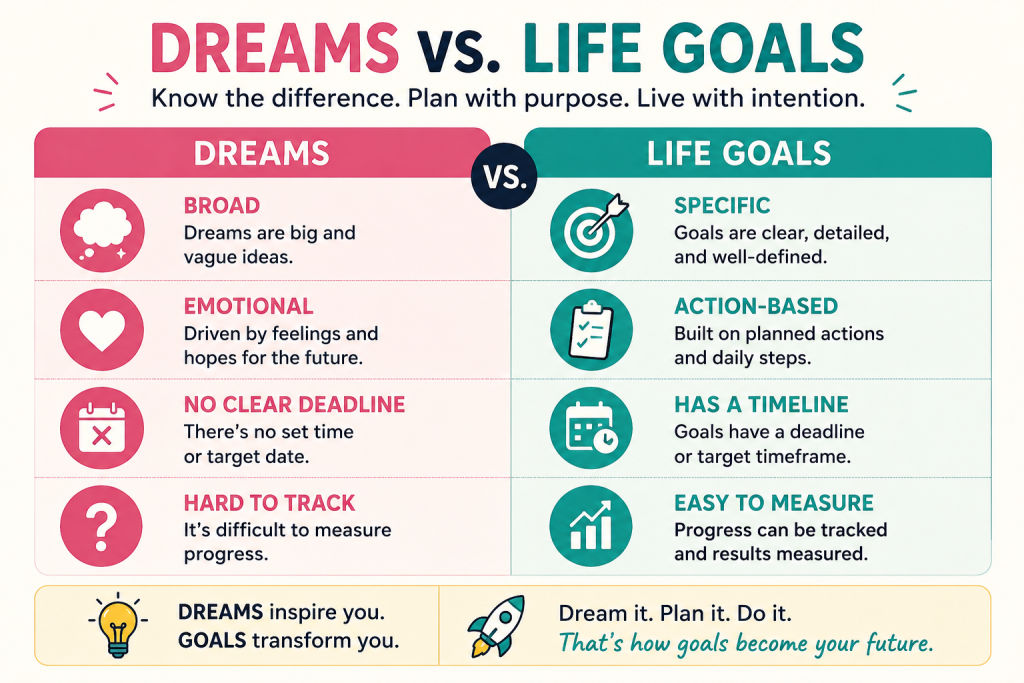
What is the difference between dreams and life goals?
Dreams are broad desires, while life goals turn those desires into specific plans. “I want to travel more” is a dream. “I will save $150 a month for a trip next year” is a goal.
Why do I keep giving up on my goals?
You may be setting goals that are too vague, too big, or not connected to your real values. Try making the goal smaller, clearer, and easier to repeat daily. Usually, consistency—rather than intensity—is what leads to progress.