
5 Shadow Work Prompts For Healing

We may earn a commission for purchases made using our links. Please see our disclosure to learn more.
Sometimes a reaction feels bigger than the moment. A friend cancels dinner, and you hear, “You do not matter.” A coworker gets praised, and jealousy arrives uninvited. These responses do not make you broken; they may point toward feelings, needs, and beliefs you learned to hide.
These Shadow Work Prompts For Healing offer a grounded way to meet hidden parts of yourself with curiosity rather than shame. You will learn what shadow work means, how to prepare, five prompts to explore, and how to turn insight into change. You will also find research context, safety guidance, and thoughtfully chosen resources without pretending a journal can replace therapy.
Affiliate disclosure: This article may contain affiliate recommendations. The website may earn a commission from qualifying purchases at no extra cost to you.
What Shadow Work Means—and What It Does Not
“Shadow” is a Jungian idea describing qualities and emotions outside your conscious self-image. You may reject anger because your family praised obedience or hide ambition because confidence was called arrogance.
Used carefully, Shadow Work Prompts For Healing bring disowned parts into awareness. They do not excuse harmful behavior or require endless digging through painful memories. You notice what was pushed away, understand why, and choose a healthier response—like opening a cluttered cupboard carefully instead of emptying it onto the floor.
Why Shadow Work Prompts For Healing Can Feel So Powerful
A thoughtful prompt can strengthen emotional self-awareness by slowing an automatic reaction long enough for you to examine it. Rather than saying, “I am ridiculous for feeling jealous,” you might ask what jealousy protects. Perhaps it points to an abandoned goal, fear of being overlooked, or unmet recognition.
Shame closes the conversation; curiosity keeps it open. Shadow Work Prompts For Healing can reveal patterns, connect current reactions with earlier learning, and separate responsibility from reflexive self-blame. Insight is not a reset button, but it shows where change belongs.
Prepare a Safe Space Before You Write
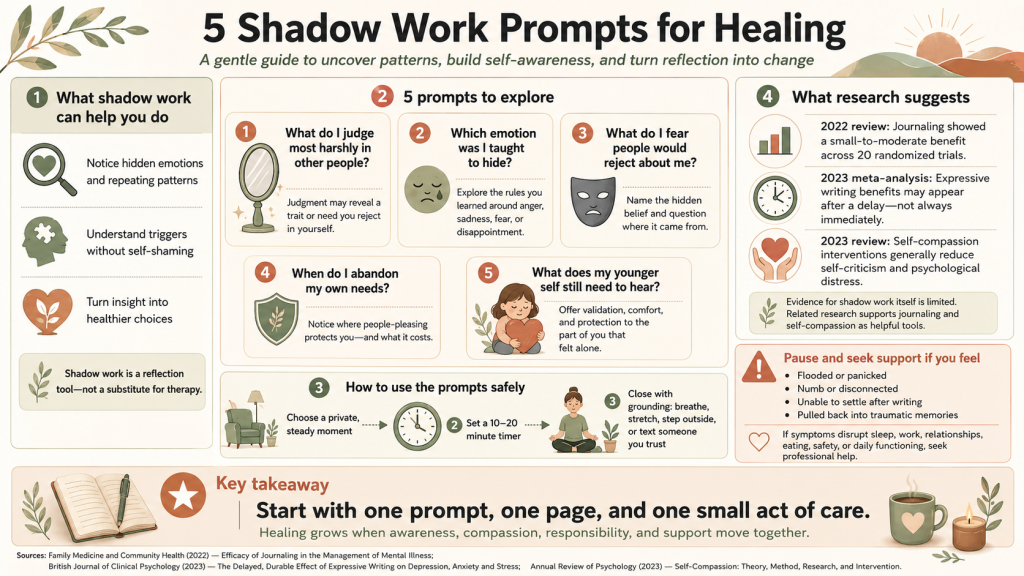
Choose a private time when you feel relatively steady. Set a ten- to twenty-minute limit and plan how you will close the session—perhaps by stretching, stepping outside, or texting someone trustworthy.
Stay present by noticing the chair beneath you and the room around you. If a prompt brings intense panic, numbness, dissociation, or an urge to harm yourself, stop. Grounding is part of responsible reflection. Return later, soften the question, or explore it with a licensed mental health professional.

Prompt 1: What Do I Judge Most Harshly in Other People?
Name one quality that reliably irritates you: neediness, laziness, loudness, selfishness, or indecision. Then ask, “What does this quality mean to me, and where did I learn that meaning?”
With Shadow Work Prompts For Healing, judgment may reveal either a valid boundary or a trait you forbid in yourself. You might resent “selfish” people because you never permit yourself to rest or say no.
Finish with: “I can dislike this behavior while asking what my reaction teaches me.” This keeps discernment and reflection together.
Prompt 2: Which Emotion Was I Taught to Hide?
Choose an emotion you struggle to express, such as anger, sadness, fear, or disappointment. What rules did you learn around it? Who could show this feeling? What happened when you did?
Someone raised to be “the calm one” may smile through resentment until it erupts over dishes. The dishes are rarely the whole story.
Give the emotion a useful role. Anger can signal crossed boundaries; sadness can mark loss; fear can request preparation. Then describe what respectful, proportionate expression would look like today.
Prompt 3: What Do I Fear People Would Reject About Me?
Complete this sentence several times: “If people really knew that I ______, they might ______.” Treat each answer as a feared judgment, not a prediction.
Look for themes involving appearance, culture, family expectations, identity, mistakes, or unmet needs. Then ask where the message came from. Was it taught directly, or absorbed through jokes, silence, comparison, or praise given only when you performed a certain role?
Finish with a reality check: Who has shown they can hold complexity, and what could you reveal gradually?

Prompt 4: When Do I Abandon My Own Needs?
Recall when you said yes while meaning no, stayed silent to prevent conflict, or ignored exhaustion. What did you fear would happen if you honored your need?
Create two columns: “What I protected” and “What it cost me.” Agreeing may protect you from disappointment while costing rest or creating resentment. People-pleasing often begins as a way to preserve safety or connection.
Choose one small repair this week: delay your answer, ask for help, leave earlier, or say, “I cannot commit to that.”
Prompt 5: What Does My Younger Self Still Need to Hear?
Picture yourself at an age connected to a recurring belief, such as “I am too much” or “I must earn love.” You do not need a clear memory; work with the feeling and meaning you carried.
Write a short letter from your present self. Name what happened, validate the younger person’s response, and offer what was missing: protection, comfort, permission, or freedom from misplaced responsibility.
Avoid promising that pain will vanish. Try something steadier: “You should not have handled that alone. I am learning to protect us now.”
How to Turn Insight Into Small, Visible Change
Underline one sentence that feels important, then translate it into an observable action. “I need stronger boundaries” becomes “I will pause before agreeing to requests.” “I hide anger” becomes “I will name irritation before it reaches boiling point.”
Review it after a week. Ask what worked and what support would help. Healing rarely arrives as one cinematic breakthrough; it resembles correcting the route one turn at a time.
Shadow Work Prompts For Healing become useful when reflection changes how you speak, choose, rest, apologize, or ask for care.
What Research Says About Reflective Writing and Self-Compassion
Evidence for Shadow Work Prompts For Healing remains limited. The strongest research covers related practices, including expressive writing and self-compassion.
A 2022 systematic review and meta-analysis of 20 randomized trials found a small-to-moderate journaling benefit and a 5% greater reduction in patient-health scores than control conditions. However, results varied widely, so journaling is better viewed as a supportive tool than a guaranteed treatment.
A 2023 meta-analysis of expressive writing found that improvements in depression, anxiety, and stress may appear after a delay rather than immediately.
Meanwhile, a 2023 Annual Review of Psychology paper reported that self-compassion interventions generally reduce self-criticism and psychological distress. The practical lesson: pair honesty with kindness, not punishment.
Recommended Products for Shadow Work Prompts For Healing
Choose based on whether you want direct prompts, compassion-focused exercises, private creativity, or deeper theory.
| Product | Best fit | Format |
| The Shadow Work Journal | Guided beginners | Interactive journal |
| Shadow Work Journal for Self-Love | Inner-child focus | Prompted workbook |
| Burn After Writing Expanded Edition | Candid reflection | Question journal |
| Self-Love Workbook for Women | Self-compassion | Exercises |
| Romancing the Shadow | Deeper study | Long-form guide |
The Shadow Work Journal: A Guide to Integrate and Transcend Your Shadows
Best for: Beginners who want a highly structured path
Keila Shaheen’s 272-page expanded journal combines prompts, reflections, and practical exercises. It suits readers who freeze in front of a blank page and want clear direction. Because it addresses emotionally weighty themes, work selectively instead of treating completion as a race.
Shadow Work Journal for Self-Love: Powerful Prompts and Exercises to Integrate Your Shadow and Embrace Your Inner Child
Best for: Readers seeking a gentler, compassion-led approach
This 144-page workbook by Latha Jay and Valerie Inez contains 75 prompts, guided exercises, and self-care practices. Its focus on self-love may feel more approachable than a confrontational style. It remains a personal-growth resource, not a replacement for clinical trauma care.
Burn After Writing Expanded Edition
Best for: Teens and adults who prefer candid, creative questions
Sharon Jones’s 192-page expanded edition adds thirty pages of questions about identity, memories, preferences, and private thoughts. Its informal format can reduce pressure to produce a profound answer right away. However, it supports broad self-discovery rather than structured trauma processing.
Self-Love Workbook for Women: Release Self-Doubt, Build Self-Compassion, and Embrace Who You Are
Best for: Women who want practical self-worth exercises
Written by licensed clinical social worker Megan Logan, this 174-page workbook includes prompts, assessments, affirmations, and mindfulness-based activities. It offers more direction than a blank journal and can complement Shadow Work Prompts For Healing. Its gendered framing will fit some readers better than others.
Romancing the Shadow: Break Unconscious Patterns and Create Conscious Relationships with Shadow-Work
Best for: Readers who want theory and relationship-focused depth
Connie Zweig and clinical psychologist Steve Wolf examine hidden patterns in love, work, family, and creativity. At 374 pages, it is the most substantial choice here. It offers rich context, although readers seeking quick daily prompts may find it dense.
Common Mistakes That Turn Reflection Into Rumination
Shadow Work Prompts For Healing become unhelpful when you write only to prosecute yourself. If every page ends with “This proves I am terrible,” you reinforce shame instead of awareness.
Another trap is repeating the same story. Shift from “Why am I like this?” to “What triggers this, what does it protect, and what would serve me now?”
Finally, do not treat every strong emotion as hidden truth. Feelings carry information, but they are not always accurate instructions. Reflection should widen your choices, not push you toward impulsive confrontation or major decisions.
When to Pause and Seek Professional Support
Stop if you feel flooded, detached, unable to settle, or preoccupied with traumatic memories. Orient to the room, drink water, move gently, and contact someone trustworthy.
Self-guided writing cannot replace assessment or treatment. Seek professional support when symptoms disrupt sleep, work, relationships, eating, safety, or daily functioning. The NHS Every Mind Matters guidance also states that self-help tools support general well-being rather than replace care from a doctor or therapist.
Frequently Asked Questions About Shadow Work Prompts For Healing
How often should I use shadow work prompts?
Use Shadow Work Prompts For Healing once or twice weekly for ten to twenty minutes. This pace lets you notice emotional aftereffects and practice an insight before opening another topic. Daily writing may suit lighter questions, but intense reflection does not earn extra credit for frequency. Staying grounded matters more than filling pages.
Can shadow work make me feel worse at first?
It can temporarily bring up sadness, anger, shame, or fatigue because you are focusing on material you usually avoid. That does not automatically prove the practice is helping. If distress stays intense, worsens, or interferes with daily life, pause and consult a qualified mental health professional.
Do I have to remember my childhood very well?
No. You can explore current triggers, beliefs, body sensations, and relationship patterns without forcing memories. Memory is reconstructive, so do not treat an image or feeling as proof that a specific event occurred. Label uncertainty honestly and seek professional guidance for trauma-related concerns.
Can I do Shadow Work Prompts For Healing without a journal?
Yes. You can type privately, record a voice note, draw, reflect while walking, or speak with a therapist. Writing is popular because it slows thoughts and creates a record, but it is not mandatory. Choose a method that feels accessible, confidential, and emotionally manageable.
What should I do after answering a difficult prompt?
Close deliberately. Name five things you see, breathe slowly, move your body, and complete one ordinary task that reconnects you with the present. Later, summarize the insight in one sentence and choose one small action. Avoid sending emotional messages or making major decisions while activated.
Begin Gently With Shadow Work Prompts For Healing
Useful shadow work is not the most dramatic; it is the kind you can integrate. Start with the prompt that feels slightly uncomfortable, not the one that sends your nervous system into a fire drill. Write briefly, stay curious, and finish with a concrete act of care or boundary-setting.
Choose The Shadow Work Journal for a structured guide or Shadow Work Journal for Self-Love for a softer, inner-child-centered approach. A plain notebook also works when these five prompts provide enough direction.
Use Shadow Work Prompts For Healing to understand yourself more honestly—not to build a new case against yourself. Healing grows when awareness, compassion, responsibility, and support move together.