7 Progress Tracking Tools For Personal Growth
We may earn a commission for purchases made using our links. Please see our disclosure to learn more.
You know that frustrating feeling when you swear you’re making progress… but when you stop and look around, everything feels fuzzy?
You’ve been reading more. Or trying to work out. Or spending less time doom-scrolling. Or becoming calmer, stronger, kinder, more disciplined, more “put together.” Yet because nothing is measured, it all starts to feel like trying to watch your own height change in the mirror.
That is exactly where Progress Tracking Tools can help.
They do not magically fix your life. They are not tiny plastic life coaches. But they do give your effort a shape. They help you see what is working, what keeps slipping, and where you need a gentler plan instead of more guilt.
And that matters, because personal growth is rarely one dramatic movie montage. Usually, it is more like watering a plant that looks suspiciously unchanged for three weeks and then suddenly grows a new leaf overnight.
This article will help you choose the right kind of tracking tool, use it without becoming obsessive, and build a personal growth routine you can actually stick with.
Affiliate note: This article includes product suggestions that may earn a commission at no extra cost to you.
Why progress tracking tools matter more than motivation
Motivation is lovely when it shows up. It is also deeply unreliable.
Some mornings, you feel like rewriting your life story. Other mornings, brushing your teeth feels like enough ambition for one day. That is normal.
Tracking helps because it gives you proof. Instead of asking, “Do I feel productive?” you can ask, “Did I do the habit four times this week?” That question is far less dramatic and far more useful.
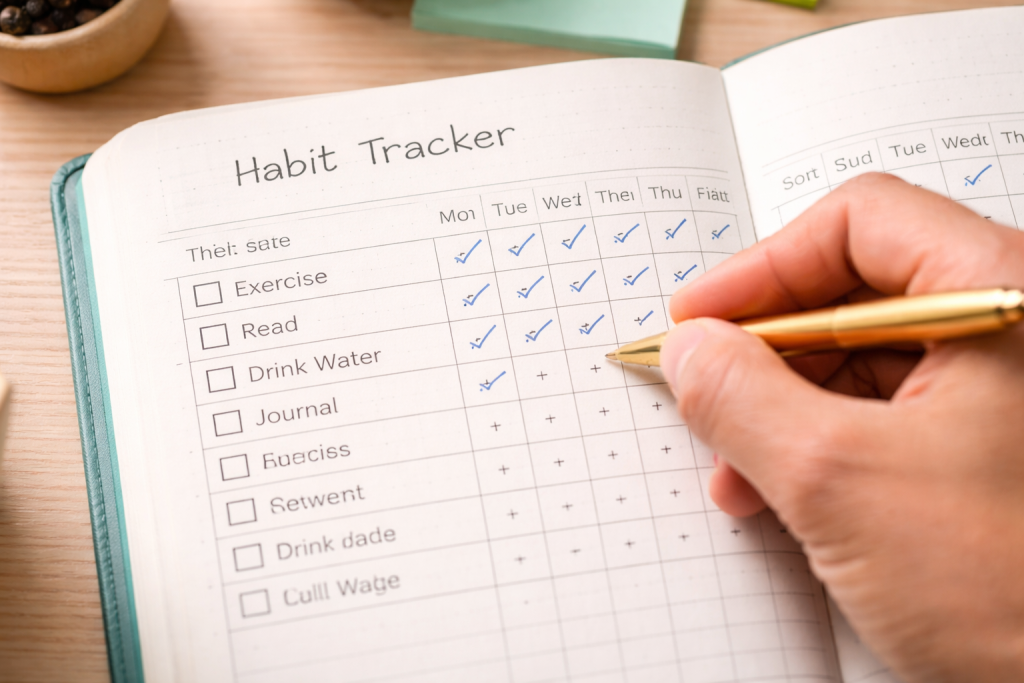
It also keeps small wins from disappearing. A skipped day feels huge in the moment. But when you see a month of checkmarks, one missed square stops looking like a personal tragedy and starts looking like… Tuesday.
What counts as a progress tracking tool
A lot of people hear the phrase and imagine complicated dashboards, color-coded spreadsheets, and the kind of calendar system that requires a minor in engineering.
Nope.
A progress tracking tool can be:
- a paper planner
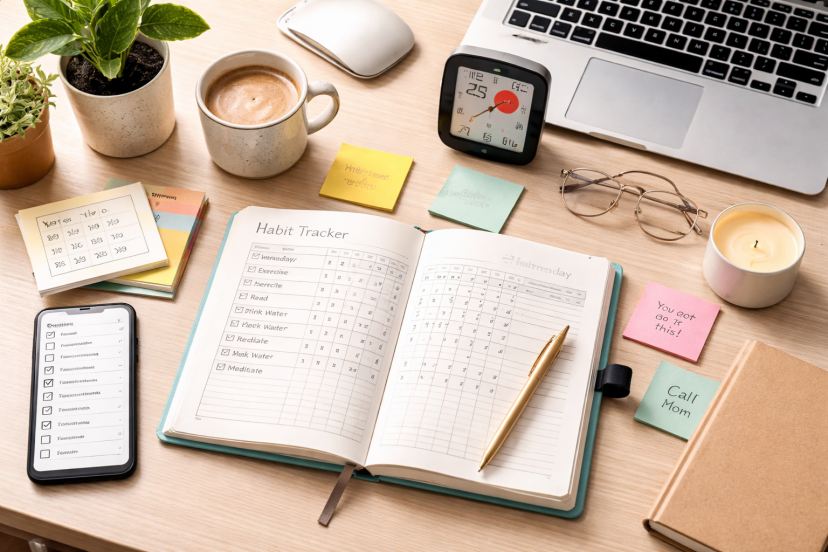
- a habit tracker
- a timer
- a reusable notebook
- a wall calendar
- a simple weekly review sheet
- a notes app on your phone
If it helps you notice effort, record actions, and review patterns, it counts.
The best tool is not the fanciest one. It is the one you will still use after the “new me” excitement wears off.
Start with one tiny goal, not ten
This is where many good intentions wander straight into chaos.
You buy a beautiful planner, write down 14 habits, map out your dream life, and then two days later you are tired, behind, and considering a full identity reset.
Try this instead: track one goal first.
Maybe it is:
- walking 20 minutes a day
- reading 10 pages
- journaling three times a week
- drinking more water
- getting to bed before midnight
One visible win creates momentum. Ten half-tracked goals usually create emotional clutter.
Small is not weak. Small is repeatable.
Pick the format you will actually use
Be honest here. Not aspirational-honest. Real-life-honest.
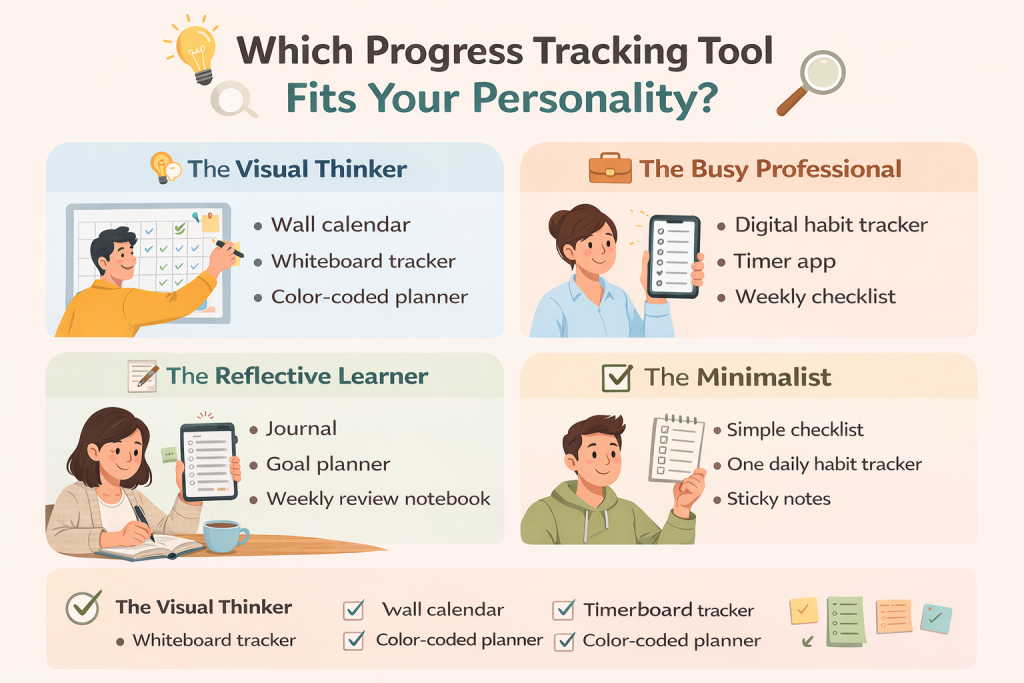
If you love writing things down by hand, paper may feel grounding. If you always have your phone nearby, a digital system might fit better. If you forget hidden tools, you may need something visual on your wall or fridge.
Ask yourself:
- Do I like writing or tapping?
- Do I need reminders?
- Do I want privacy or visibility?
- Do I enjoy detail, or do I need something super simple?
A tool should fit your life like a good pair of walking shoes. If it pinches, you will stop using it.
Keep your metrics ridiculously simple
A common mistake is tracking too much.
Instead of measuring your entire emotional evolution before breakfast, track something concrete.
Good examples:
- “Worked out: yes or no”
- “Pages read: 12”
- “Meditated: 5 minutes”
- “Spending under budget: yes”
- “Screen-free bedtime: 4 nights this week”
Simple metrics reduce friction. They also keep you from turning self-improvement into courtroom evidence.
You are not trying to build a case against yourself. You are trying to notice patterns.
Use a weekly review to notice patterns
Daily tracking shows action. Weekly review shows meaning.
This is the moment where you stop asking, “Was I perfect?” and start asking smarter questions:
- What felt easy this week?
- What kept getting skipped?
- What time of day worked best?
- What got in the way?
- What should I adjust instead of forcing?
Think of a weekly review like checking the map during a road trip. It does not mean you failed to drive. It means you care where you are going.
Even ten minutes every Sunday can save you from repeating the same avoidable mess all month.

Pair tracking with reflection, not judgment
This part matters more than people realize.
A tracker becomes helpful when it teaches you. It becomes harmful when it shames you.
If you miss a habit for four days, resist the old drama:
“I always do this.”
“I have no discipline.”
“I’ll never change.”
Try:
“What made this harder?”
“Was the goal too ambitious?”
“What version of this habit would feel easier to restart?”
Reflection creates room to move forward. Judgment closes that space off.
Personal growth works better when you talk to yourself like someone worth helping.
Create visible cues that keep you honest
Out of sight is often out of mind.
That is why visual trackers work so well. A notebook on your pillow reminds you to journal. A timer on your desk nudges you to focus. A magnetic board on the fridge quietly says, “Hey, remember that habit you claimed mattered?”
Visible cues reduce decision fatigue. They also make progress feel more real.
Sometimes the best accountability system is not an app notification. It is a tracker staring at you while you microwave leftovers.
Use milestones to make long goals feel real
Big goals can feel weirdly invisible.
You may be improving your confidence, health, discipline, or emotional resilience, but because the finish line is far away, your brain decides nothing is happening.
That is why milestones matter.
Instead of waiting to “become your best self,” track markers like:
- 7 days consistent
- 30 workouts completed
- 10 books finished
- 4 weeks under budget
- 3 difficult conversations handled calmly
Milestones break a mountain into stepping stones. And stepping stones are much less intimidating.
When digital tools help more than paper
Paper tools are great for reflection and memory. Digital tools are great for convenience and speed.
Choose digital when you need:
- recurring reminders
- quick updates on the go
- searchable notes
- automatic logs
- cross-device access
Choose paper when you need:
- less screen time
- deeper reflection
- a stronger sense of ritual
- fewer distractions
Neither is morally superior. This is not a personality test. It is logistics.
Use what helps you follow through.
7 Progress tracking tools worth trying
Clever Fox Planner Premium Edition – Undated Luxurious Weekly & Monthly Planner
A strong choice if you want one main hub for goals, habits, and weekly planning.
Features: weekly and monthly layouts, habit trackers, goal-setting sections, A5 size, hardcover, thick paper.
Best for: people who want structure without needing to start in January.
Rocketbook Core Reusable Spiral Notebook, Letter Size 8.5×11
This is great if you like writing by hand but hate wasting pages or juggling scattered notes.
Features: reusable pages, app-connected scanning, dotted pages, durable cover, erasable format.
Best for: thinkers, list-makers, and anyone who wants a flexible tracking notebook that can be reused.
Time Timer MOD – Home Edition – 60 Minute Visual Countdown Timer
A timer sounds simple, but it is secretly one of the most effective progress tools around.
Features: 60-minute visual countdown, silent operation, compact desk-friendly design.
Best for: people who struggle with focus, procrastination, or estimating how long tasks actually take.
Habit Tracker Calendar Magnetic Whiteboard for Refrigerator
This one makes your habits impossible to ignore in the best possible way.
Features: daily, weekly, and monthly tracking sections; magnetic design; reusable dry-erase format.
Best for: visual learners, families, and anyone who benefits from a tracker that stays in plain sight.
Panda Planner 2026 Undated Weekly Planner
This planner leans into productivity while still keeping habit tracking manageable.
Features: undated weekly format, weekly to-do lists, habit tracker, spiral binding, home/office/school-friendly layout.
Best for: busy people who want a planner that feels practical rather than overwhelming.
BestSelf 13-Week Self Journal & Goal Planner
A nice fit if you work best in shorter sprints instead of year-long planning.
Features: 13-week structure, productivity prompts, reflection, gratitude, and habit tracking.
Best for: people who like quarterly resets and want momentum without overcommitting.
Moleskine PRO Project Planner, Hard Cover, XL, 288 Pages
If your growth goals involve bigger projects, this is a more spacious and structured option.
Features: project-planning space, detachable to-do lists, numbered pages, contents list, notes pages.
Best for: creatives, professionals, and anyone balancing personal growth with complex work goals.
How to build your own progress tracking routine
Here is a simple rhythm that works well:
Step 1: Choose one goal
Not your whole personality. Just one goal.
Step 2: Choose one tool
Planner, notebook, timer, app, board. One is enough to start.
Step 3: Choose one metric
Make it obvious and easy to record.
Step 4: Track daily in under two minutes
If tracking takes longer than the habit itself, the system is too heavy.
Step 5: Review weekly
Notice what helped, what blocked you, and what needs adjusting.
This routine is boring in the same way brushing your teeth is boring. And that is actually a compliment. Reliable systems are rarely flashy.
What the research says about tracking and behavior change
Research backs up what many people discover through trial and error: tracking your progress really does help. A widely cited meta-analysis on progress monitoring and goal attainment found that regularly monitoring progress is an effective self-regulation strategy. It also showed that people tend to do better when they track more often, especially when progress is written down or shared in some way. In other words, putting your effort on paper is not old-school fluff. It can genuinely help you follow through.
That idea also shows up in newer research. A review of digital habit-building interventions found that the most common behavior-change techniques included self-monitoring, goal setting, and prompts or cues. That rings true in everyday life. The tools that work best usually are not the ones that rely on motivation alone. They give you a clear target, a way to measure progress, and a little nudge to keep going.
Common mistakes that make tracking feel exhausting
Tracking too many habits at once
Your system should support your life, not become a second job.
Choosing tools that are too complicated
A beautiful setup is useless if it takes 20 minutes to update.
Treating missed days like failure
A missed day is data, not destiny.
Never reviewing what you track
Recording without reflection is like collecting receipts and never checking your bank account.
Using someone else’s perfect system
Your tool should match your brain, schedule, and energy level.
Frequently asked questions about progress tracking tools
What are the best progress tracking tools for personal growth?
The best ones are the tools you will actually use consistently. For most people, that means a planner, habit tracker, simple journal, timer, or visible calendar.
Are digital or paper progress tracking tools better?
Neither is better for everyone. Digital tools are convenient and portable. Paper tools feel more reflective and distraction-free. Choose the one that fits your habits.
How frequently should you update your progress tracker?
Daily works best for simple habits. Weekly works best for reflection. A mix of quick daily updates and a short weekly review is usually ideal.
Can progress tracking tools really improve motivation?
Yes, because they make effort visible. Seeing proof of progress often creates motivation after action, not before it.
What should I track for self improvement first?
Start with one behavior that is small, meaningful, and easy to measure, like sleep time, reading, workouts, journaling, or screen-free evenings.
Conclusion
Personal growth gets a lot easier when you stop relying on vibes alone.
That is the real gift of Progress Tracking Tools. They turn fuzzy effort into visible progress. They help you catch patterns, celebrate small wins, and restart faster when life gets messy. And life will get messy. That part is not a bug. That is the human experience.
So start simple. Pick one goal. Pick one tool. Track one honest metric.
Then keep showing up.
Small marks on a page can lead to very big changes in a life.
And if you want to build more resilience alongside better habits, read this guide on what it means to become a strong person.