Strong Person Characteristics That Set Them Apart

We may earn a commission for purchases made using our links. Please see our disclosure to learn more.
Most people do not dream of becoming “strong” because they want to be intimidating.
They want to stop falling apart every time life gets hard. They want to handle stress better. They want to stop overthinking every mistake, stop chasing approval, and stop feeling like one bad day can knock them flat for a week.
That is usually what people mean when they think about becoming a strong person.
Not cold. Not emotionless. Not impossible to hurt.
Just steadier. Wiser. Harder to shake.
If that sounds like what you want too, you are in the right place. This article will walk you through the real traits that make a strong person stand out, the habits that help those traits grow, and a few practical tools that can help along the way.
Affiliate note: This article includes suggested books and tools, and I may earn a small commission if you buy through links at no extra cost to you.
A strong person is not who most people think
A lot of people grow up with a strange idea of strength.
They think a strong person never cries, never doubts themselves, never needs help, and never lets anything get to them. Basically, a strong person is supposed to be a brick wall with a calendar and a job.
But real strength is not that.
A strong person still feels things deeply. They still get tired. They still mess up. The difference is that they do not let every emotion drag them around by the ankle.
Strength is more about steadiness than toughness
That is the part people miss.
You do not become strong by pretending nothing hurts. You become strong by learning how to carry hard things without letting them define you.
That is a very different skill.
Self-improvement starts with telling yourself the truth
You cannot grow if you keep performing a polished version of yourself.
A strong person gets honest. Not cruelly honest. Not the kind of honesty that turns into self-bullying. Just honest enough to say, “This habit is hurting me,” or “I keep avoiding the thing I know I need to face.”
That is where self-improvement gets real.
A question worth sitting with
What part of your life feels heavier than it should?
Sometimes the answer is your schedule. Sometimes it is a relationship. Sometimes it’s simply tiring to act like everything is okay when it really isn’t.
A strong person is willing to notice that.
A strong person knows how to pause
This sounds simple, but it changes everything.
When life pokes at your sore spots, your first reaction is not always your best one. You lash out. You pull back. You start to unravel. You send the message. You regret the message.
A strong person learns how to pause before reacting.
The pause is where your power lives
That little moment between feeling and reacting is where so much growth happens.
It is where you decide not to make things worse.
It is where you choose clarity over chaos.
It is where maturity starts to look real.
You do not need to become perfectly calm overnight. You just need to buy yourself a few extra seconds.

They keep promises to themselves
This is one of the clearest signs of a strong person, and honestly, it does not get enough attention.
A lot of people want confidence. Very few people realize confidence grows from self-trust.
And self-trust grows when you do what you said you would do.
Not always. Not perfectly. But often enough that your own mind starts believing you.
Tiny promises matter more than dramatic ones
It helps to think small.
Wake up when you planned to and get out of bed right away.
Take the walk.
Drink the water.
Finish the page.
Make the call.
These things seem boring. They are not. They are the bricks.
A strong person is usually built out of very ordinary days handled well.
They do not confuse responsibility with shame
Here is something healthy people learn sooner or later: taking responsibility and attacking yourself are not the same thing.
A strong person can admit when they were wrong without turning it into a full personality crisis.
They can say, “I handled that badly,” without spiraling into, “I am a failure and probably doomed forever.”
Growth needs honesty, not humiliation
Shame can make you feel dramatic and intense, but it rarely makes you better.
Responsibility does.
Responsibility says:
I did that.
I can learn from it.
I can repair what I can.
I can do better next time.
That is strength.
A strong person has boundaries, even when it feels awkward
This is where a lot of good people struggle.
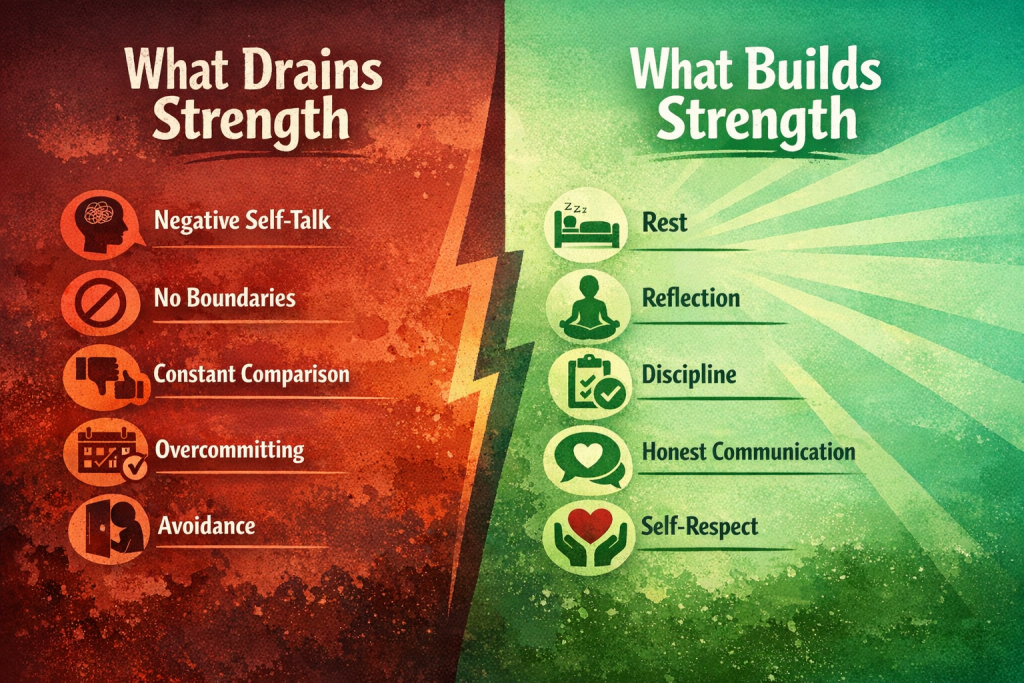
They care a lot, want to be there for others, and hate letting people down. So they keep saying yes when every part of them is screaming no.
That is not strength. That is self-abandonment wearing a nice outfit.
Boundaries are not selfish
A boundary is not punishment. It is not coldness. It is not you becoming “difficult.”
It is simply a clear line around what you can and cannot carry.
A strong person knows that if they never protect their time, energy, or peace, somebody else will happily spend it for them.
And yes, setting boundaries can feel uncomfortable at first. So does wearing new shoes. That does not mean they are wrong.
They stop treating failure like a personal identity
Everybody fails. Everybody gets embarrassed. Everybody has a season where nothing seems to click.
A strong person is not someone who avoids all of that. A strong person is someone who does not turn every setback into a definition of who they are.
Failure is information
That is the shift.
Weak thinking says, “I failed, so I must not be capable.”
Strong thinking says, “That did not work. What can it teach me?”
One mindset closes the door. The other one leaves it cracked open.
That crack is where progress gets in.

They can hear feedback without falling apart
Not every opinion matters. Let’s start there.
Still, a strong person can hear useful feedback without collapsing into defensiveness or shame. They do not have to enjoy criticism. Nobody lines up for that. But they can sort through it like an adult.
Not all feedback deserves equal weight
A good rule is this:
Keep feedback that is clear, specific, and helpful.
Drop feedback that is vague, cruel, or performative.
You are not supposed to become available for everybody’s opinion. You are supposed to become wise enough to know what deserves your attention.
That is a big difference.
A strong person watches the way they speak to themselves
This part is quieter than boundaries or discipline, but it matters just as much.
Some people are carrying around an inner voice that sounds like a bully with excellent attendance. It comments on everything. It exaggerates every flaw. It acts like every mistake is proof that you are behind in life.
That kind of inner voice drains you.
Better self-talk is not cheesy
You do not need forced positivity.
You do not need to stare into a mirror and announce that you are a warrior made of light unless that genuinely works for you.
You just need to talk to yourself in a way that does not make growth harder than it already is.
Try this:
Instead of “I always ruin everything,” say, “That went badly, but I can handle what comes next.”
That is a much stronger sentence.
They choose consistency over motivation
Motivation is lovely. It is also unreliable.
It shows up on random Tuesdays, disappears when you need it most, and acts like it is doing you a favor by existing at all.
A strong person stops waiting around for perfect motivation.
Routine beats intensity
That is why strong people lean on habits.
Not glamorous habits. Not dramatic life-overhaul habits. Just repeatable ones.
A ten-minute walk.
A few pages of reading.
A daily journal check-in.
Going to bed a little earlier.
Taking a breath before reacting.
If you want help making those tiny actions stick, these micro habits that can change your life are a smart place to begin.
They protect their attention like it matters
Because it does.
A strong person understands that attention is not a free resource. If you pour it into drama, noise, endless comparison, and people who constantly pull you off center, you will feel drained even if nothing is technically “wrong.”
Peace needs protection
Sometimes becoming stronger has less to do with adding more and more to your life.
Sometimes it means removing things.
Less doom-scrolling.
Less reacting.
Less explaining yourself to people committed to misunderstanding you.
Less saying yes from guilt.
That is not avoidance. That is energy management.
They know how to ask for help
This one matters more than most people admit.
A strong person is not someone who drags everything alone until they finally collapse in a spectacular heap. That is not noble. That is just unsustainable.
Strong people know when getting support is the smart thing to do.
Support is not a shortcut
It is part of the process.
That support might look like therapy. It might look like a mentor, a coach, a sibling, a friend, a faith community, or one honest conversation that you have been avoiding.
Needing help does not cancel your strength. Sometimes it proves it.
They keep becoming, instead of trying to “arrive”
One of the healthiest things you can understand is this: a strong person is not finished.
They are not complete, polished, and done.
They are still learning. Still adjusting. Still getting better at carrying life without letting life harden them.
Growth is usually less dramatic than you expect
You may not wake up one morning feeling transformed.
More often, you notice it later.
You notice you stayed calmer in a stressful moment.
You notice you stopped begging for the bare minimum.
You notice you recovered faster after a setback.
You notice you trust yourself more.
That is how strength usually shows up. Quietly at first.
Small daily moves that help you become a stronger person
If all this sounds good but also a little overwhelming, keep it simple.
Here are a few grounded ways to start:
- Keep one promise to yourself today
- Say no once without overexplaining
- Pause before replying when you are upset
- Write down one thing you learned from a hard moment
- Replace one cruel thought with a fairer one
- Protect ten quiet minutes for yourself
That is enough.
You don’t need to reinvent everything overnight. You need repetition.
Helpful tools for becoming a strong person
These are not magic fixes. They are useful tools for reflection, mindset, discipline, and emotional growth.
Atomic Habits by James Clear
A great choice if you want to build discipline without relying on willpower. The book focuses on small, repeatable changes that help you build good habits and break bad ones. Best for: beginners, habit-builders, and anyone who keeps waiting for a “fresh start.”
The Mountain Is You by Brianna Wiest
This one is especially helpful if your biggest obstacle is self-sabotage. It explores how inner conflict can block growth and how self-mastery can replace destructive patterns. Best for: overthinkers, deep feelers, and people ready to stop getting in their own way.
The Let Them Theory by Mel Robbins
A practical mindset tool for people who waste too much energy trying to control other people’s reactions. The core idea is simple but powerful: let others be who they are, and put your energy back where it belongs. Best for: people-pleasers, anxious communicators, and anyone working on boundaries.
The Five Minute Journal by Intelligent Change
If you want a simple daily reflection habit, this journal makes it easy. It is built around short gratitude, mindfulness, and reflection prompts, so it works well even on busy days. Best for: people who want structure without writing pages and pages.
The Daily Stoic by Ryan Holiday and Stephen Hanselman
This is a steady companion for people who want perspective and discipline in daily life. Its 366 meditations focus on wisdom, perseverance, and living with intention. Best for: reflective readers, leaders, and anyone who wants a calmer mental framework.
What research says about real inner strength
Here is the part where some self-improvement articles start acting like suffering automatically turns people into wise forest elders.
Real life is more nuanced than that.
What the research actually points to is not emotional suppression, but skills like self-compassion and resilience training.
A 2023 meta-analysis of 56 randomized controlled trials found that self-compassion interventions can reduce stress, anxiety, and depressive symptoms. That matters because a lot of people still treat self-compassion like it is soft or indulgent, when it is actually one of the things that helps people regulate better under pressure.
Another major review found that resilience training can improve coping and mental health outcomes. The authors were careful about the limits of the evidence, which honestly makes the takeaway more trustworthy, not less. The point is not that resilience is effortless. The point is that it can be strengthened.
So no, a strong person is not simply “born that way.” A lot of what we call strength is built through repeated choices, better coping, and healthier habits over time.
FAQs About Becoming a Strong Person
How do you become a strong person emotionally?
You become stronger emotionally by learning how to pause, regulate your reactions, speak to yourself more fairly, and recover from setbacks without turning them into your identity.
Can a strong person still be sensitive?
Yes. In fact, many strong people are very sensitive. The difference is that they learn how to manage what they feel instead of letting every feeling run the whole day.
What is the biggest habit of a strong person?
One of the biggest is consistency. A strong person keeps small promises to themselves and builds self-trust over time.
Does setting boundaries make you a stronger person?
Yes. Boundaries protect your time, energy, and peace. They help you stay kind without becoming easy to use.
How long does it take to become a stronger person?
Usually longer than a weekend and faster than your fear tells you. You may not notice it right away, but steady daily choices add up more than dramatic bursts ever do.
Final thoughts
A strong person is not the loudest one in the room. Not the coldest one either.
Usually, a strong person is the one who knows themselves, keeps showing up, learns from hard things, and stays soft enough to care without becoming fragile.
That kind of strength is not reserved for a special few.
You can build it.
Not all at once. Not perfectly. But piece by piece, choice by choice, day by day.
And honestly, that is how the real version of strength is made anyway.