Smarter Goals: A Practical Guide to Setting Goals That Adapt With You

We may earn a commission for purchases made using our links. Please see our disclosure to learn more.
A goal can look perfectly sensible on paper and still fall apart when real life gets involved. Deadlines move, energy dips, priorities change, and sometimes the plan simply turns out to be wrong. That is why smarter goals can be more useful than a one-and-done checklist. They keep the familiar clarity of SMART goal setting while adding two important habits: evaluating progress and readjusting when needed.
This guide explains what the framework means, how to write a strong goal, how to turn it into weekly action, and how to choose planning tools that fit different working styles. You will also see what research says about specificity, progress tracking, and if-then planning so you can build goals that are clear without becoming rigid.
Affiliate disclosure: We may earn a commission from qualifying purchases made through links on this site, at no additional cost to you.
What Smarter Goals Mean
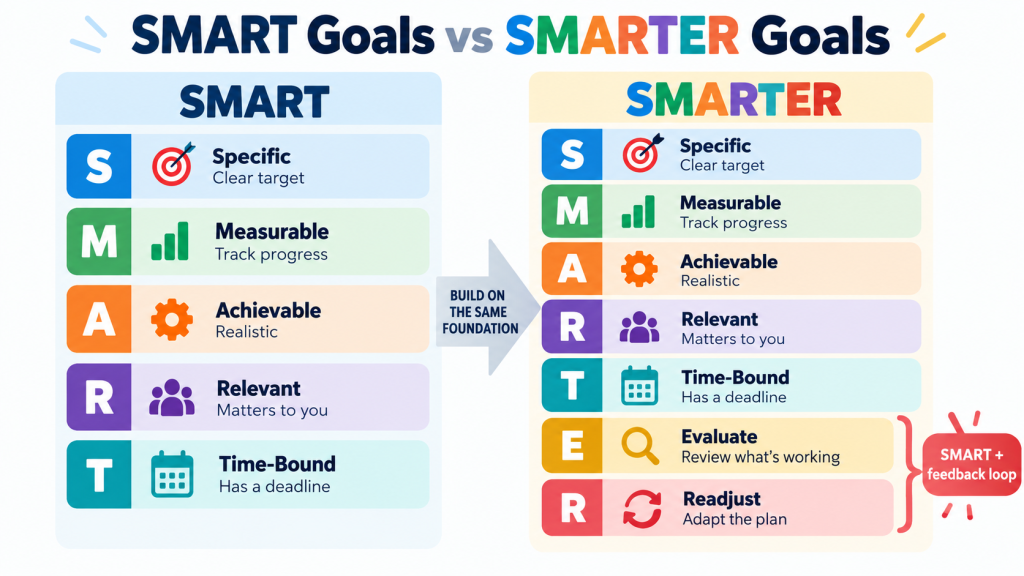
In this guide, smarter goals use seven criteria: Specific, Measurable, Achievable, Relevant, Time-bound, Evaluated, and Readjusted. The final two words vary across organizations, so the acronym is not fully standardized. Ohio State University, for example, uses “Evaluated” and “Revised” in its SMARTER model.
For example, replace “get better with money” with “save $1,200 for an emergency fund by December 31, review progress monthly, and adjust the contribution if income changes.”
Why Smarter Goals Work Better Than Vague Intentions
Vague goals create too many decisions. “Exercise more” leaves you deciding what counts and when to do it. A clear goal makes those choices earlier.
If the original target stops fitting, smarter goals encourage you to review the evidence and adjust instead of forcing an outdated plan or abandoning the goal.

Build a Goal Around One Clear Outcome
Ask what will be different when the goal is complete. “Grow my business” might become “sign five recurring clients by March 31.” Specificity gives your attention a target.
Avoid packing several outcomes into one goal. “Lose weight, sleep better, cook daily, and train for a race” is really four. A guide to goal-setting methods compares SMART, WOOP, OKRs, backward planning, and implementation intentions.
Make Progress Measurable Without Obsessing Over Numbers
Measurement answers, “How will I know I am moving?” The metric may be dollars saved, pages written, applications submitted, or workouts completed.
You can also pair an outcome with one behavior measure. A writer might track a completed draft and four writing sessions per week. If tracking becomes more work than the goal, simplify it.
Keep Goals Achievable but Meaningfully Challenging
“Achievable” does not mean effortless. A useful target should require focused work while respecting your time, skills, money, and responsibilities.
Separate what you control from what you influence. A job seeker cannot guarantee an offer but can control targeted applications, networking, portfolio improvements, and interview practice. That keeps smarter goals grounded in action.
Make Every Goal Relevant to Your Real Life
A goal can be well written and still be wrong for you. Relevance asks whether the outcome supports something you genuinely care about now.
Try the “why now?” test. Why does this matter now? What will it improve, and what will you need to say no to? Every goal competes for attention, so fewer meaningful goals often work better than a crowded list.

Add a Deadline and a Review Rhythm
A deadline gives the goal edges. Pick a date that reflects the work involved, then work backward into milestones.
Next, choose a review rhythm. Weekly checks suit many habits and projects; monthly reviews may suit savings or longer-term plans. This is where smarter goals become an active system instead of a statement you forget.
Evaluate and Readjust Instead of Starting Over
Evaluation should feel like diagnosis, not judgment. Ask what moved, what stalled, what helped, and what changed.
Then adjust the smallest useful thing: the deadline, scope, schedule, support, or tactic. If you planned four workouts but consistently manage three, three sustainable sessions may be the better plan. Smarter goals let you steer using evidence rather than loyalty to the first draft.
Turn Smarter Goals Into Weekly Actions
A goal becomes useful when it tells you what to do next. At the start of each week, choose one to three actions that directly advance the target and place them on your calendar.
Make each step concrete. “Work on course” is vague; “draft lesson two for 45 minutes Tuesday at 7 p.m.” is clear. Projects need milestones and next actions, while recurring habits benefit more from frequency tracking.
Use If-Then Plans for Common Obstacles
Good goals often fail at predictable moments: meetings run late, energy drops, or another obligation takes over. Plan for those moments before they happen.
Use a simple if-then sentence: “If my evening workout gets canceled, then I will walk for 25 minutes at lunch the next day.” These backup plans pair well with smarter goals because you can later evaluate which responses worked and replace the ones that did not.
Research-Backed Lessons for Better Goal Setting
The Ohio State University SMARTER Goals Model (2025) presents the framework as Specific, Measurable, Achievable, Relevant, Timely, Evaluated, and Revised, reinforcing the idea that review and revision belong inside the process rather than only at the end.
The evidence is stronger for the individual components than for the SMARTER acronym as a single tested package. Locke and Latham’s 2002 review of 35 years of goal-setting research found broad support for clear, challenging goals when commitment, ability, and feedback are present. Task complexity still matters, so “harder” is not automatically better in every situation.
Progress monitoring has especially useful evidence. A 2016 Psychological Bulletin meta-analysis on progress monitoring covering 138 studies and 19,951 participants found that interventions designed to increase progress monitoring improved goal attainment, with larger effects when progress was physically recorded or reported. A 2006 meta-analysis of implementation intentions also found that specific if-then plans had a medium-to-large positive effect on goal achievement across 94 independent tests.
The practical takeaway is straightforward: make the target clear, track meaningful progress, create concrete action cues, and revise the plan using feedback instead of relying on motivation alone.
Recommended Products for Smarter Goals
A planner cannot choose the right goal for you, but it can make milestones, reviews, and next actions easier to see.
| Product | Best for | Format |
| Full Focus Gray Linen Planner | Structured daily planning | Hardcover daily planner |
| BestSelf Self Journal | 13-week goal cycles | Undated goal journal |
| Rocketbook Fusion | Reusable planning | Reusable planner/notebook |
| Clever Fox Planner Premium | Yearlong weekly overview | Undated weekly/monthly planner |
| Panda Planner Classic | Daily routine tracking | Undated daily planner |
| Intelligent Change Productivity Planner | Priority-focused planning | 3-month undated planner |
Full Focus Gray Linen Planner by Michael Hyatt – The #1 Daily Planner to Increase Focus, Eliminate Overwhelm, and Achieve Your Biggest Goals – Hardcover
Best for: Readers who want a highly structured daily system
This hardcover planner connects daily planning with broader goals, helping detail-oriented users keep priorities visible. Its guided format suits smarter goals that need regular review and next-step planning. However, people who prefer a simple weekly view may find the daily structure more demanding than necessary.
BestSelf Self Journal – Undated 13-Week Goal Planner & Tracker (Black)
Best for: Readers who prefer short, focused goal cycles
The undated 13-week format combines goal tracking, daily prompts, gratitude, and weekly reflection. It suits readers who want to test, evaluate, and adjust a goal before starting another cycle. Because it asks for frequent written reflection, it works best for people willing to review progress consistently.
Rocketbook Fusion Hybrid Reusable Planner Notebook, Letter 8.5×11, Black
Best for: Digital-minded users who still like handwriting
Rocketbook Fusion combines reusable pages with planning, goal, project, and note templates. Pages can be scanned through the companion app before being wiped and reused, which suits people who dislike storing paper planners. The reusable surface and compatible erasable pens, however, feel different from ordinary notebook paper.
Clever Fox Planner Premium, Undated Weekly & Monthly Planner, Black
Best for: Readers who want a full-year planning view
This undated A5 planner combines weekly and monthly spreads with goal-planning sections. It suits users who want long-range priorities, routines, and appointments in one place without dated pages. Readers who need detailed hour-by-hour scheduling, however, may prefer a planner with more dedicated time-blocking space.
Panda Planner Classic A5 Undated Daily Planner 2026-2027, 8.25×5.75 Purple
Best for: Readers who want daily planning plus habit tracking
Panda Planner Classic combines daily scheduling, task lists, habit tracking, gratitude prompts, and broader planning pages. That mix can connect smarter goals with everyday routines. It works best for people who enjoy daily check-ins; minimalist planners may find the number of prompts more structured than they want.
Intelligent Change – 3-Month Productivity Planner, Productivity Tools for Time-Management and Mindfulness, Daily To-Do List, A5 Undated Quarterly Planner, Beige (Beige)
Best for: Readers who need help narrowing daily priorities
This three-month undated planner emphasizes prioritization, scheduling, focus sessions, habit tracking, and review. Its short cycle suits readers who want to concentrate on a limited set of goals instead of planning a whole year. The guided method may feel restrictive, though, if you prefer free-form journaling.
Common Mistakes That Make Good Goals Fail
One mistake is measuring too much. Track only what helps you decide what to do next.
Another is confusing ambition with control. “Get promoted by June” depends partly on other people; “complete the leadership project, document results, and request a promotion discussion by June” gives you controllable actions.
Finally, do not wait until the deadline to discover the plan stopped working. Smarter goals are meant to be reviewed while there is still time to change course.
Smarter Goals FAQ
What does SMARTER stand for in goal setting?
A common version is Specific, Measurable, Achievable, Relevant, Time-bound, Evaluated, and Readjusted or Revised. The final words vary across organizations, so there is no single universal expansion. The useful distinction is that smarter goals add a feedback loop: you review results and change the plan when new information shows that an adjustment would help.
Are smarter goals better than SMART goals?
Not automatically. SMART already helps clarify an objective. SMARTER adds evaluation and revision, which can help when a goal lasts several weeks or months and conditions may change. For a simple, short task, SMART may be enough. For longer projects, the review step can make the plan more adaptable without making it less specific.
How often should I review a goal?
Match the review interval to how quickly useful information appears. Weekly reviews work well for habits, study plans, writing, or fitness routines. Monthly reviews may be enough for savings or larger career projects. Review often enough to catch problems early, but not so often that ordinary day-to-day variation makes you constantly rewrite the target.
Should I change a goal if I fall behind?
Sometimes, but first identify why you are behind. A temporary disruption may only require a scheduling change. A repeated problem may signal that the timeline, scope, resources, or strategy needs revision. Do not change a goal simply to escape discomfort, but do not protect an unrealistic plan just because it was the original version.
Can I use smarter goals for personal and work goals?
Yes. The same structure can support career projects, study plans, savings targets, household routines, creative work, or personal development. The measurement will differ by goal. A work target may use deadlines and deliverables, while a personal goal may track sessions or habits. Choose measures that reflect genuine progress rather than activity that is merely easy to count.
Final Recommendation: Build Smarter Goals You Will Revisit
The strongest goal is not necessarily the most ambitious one. It is the one you can understand, measure, act on, and revise intelligently. Start with one clear outcome, choose a meaningful measure, check that the target fits your resources and priorities, and give it a realistic deadline. Then schedule the review before you begin.
If you like detailed structure, the Full Focus Planner can keep goals visible at the daily level. If you prefer a shorter experiment, the BestSelf Self Journal’s 13-week format may fit the evaluate-and-adjust rhythm well.
Most importantly, treat smarter goals as working plans rather than promises carved in stone. Write the goal clearly, take the next action, review the evidence, and adjust when the evidence says you should.