The Habit Loop Explained: How to Build Habits That Stick

We may earn a commission for purchases made using our links. Please see our disclosure to learn more.
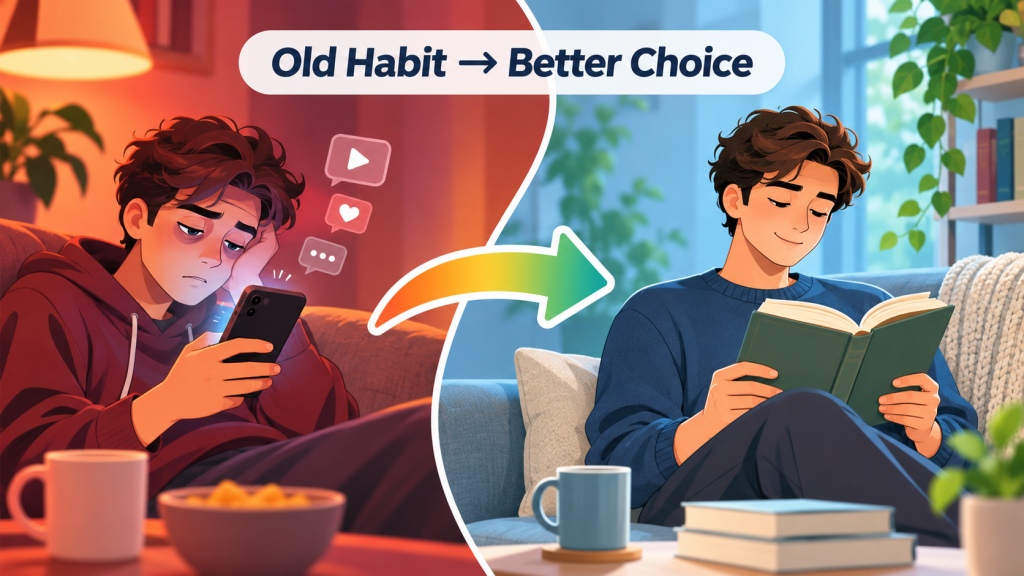
Ever promise yourself you’ll stop checking your phone first thing in the morning, only to reach for it before you’re fully awake? That familiar pattern is easier to understand when you look at the habit loop. Behaviors often follow cues we barely notice, especially when an action has felt rewarding before.
Understanding that pattern gives you a practical way to change it. You can make a helpful action easier to start, uncover unwanted patterns, and prepare for disrupted days. This guide explains the three parts of a habit, how to design your own routine, what research actually shows, and which simple tools can help.
What Is a Habit Loop, and Why Does It Matter?
A habit loop models how repeated behavior starts and becomes reinforced. It describes a cue that prompts an action, the routine itself, and a reward or outcome that makes repeating the action appealing.
Real habits involve learning, context, motivation, and sometimes emotions that do not fit neatly into three boxes.
Rather than blaming your discipline, you can investigate which part needs to change.
The Three Parts of the Habit Loop: Cue, Routine, Reward
Cue: A signal that comes before the behavior. It might be a place, a time, another action, an emotional state, or an object in sight.
Routine: What you do next. This can be a physical action, such as opening an app, or a brief mental response, such as worrying about tomorrow.
Reward: What makes the action worth repeating, at least in the moment. Relief, convenience, pleasure, or a sense of completion can all play that role.
For example, an unfinished task creates discomfort (cue), you check social media (routine), and the distraction briefly eases that discomfort (reward).
How to Identify the Cues Behind Your Habits
Notice what happens immediately before an unwanted habit for a few days. Record the time, location, what you were doing, and how you felt.
Look for patterns rather than assuming the first explanation is correct. Maybe you snack whenever you enter the kitchen after work, or scroll whenever a difficult assignment stalls.
Ask, “What happened just before I started?” Find a trigger you can recognize or pair with a different response.

Why Rewards Can Make Behaviors Repeat
A reward does not have to be a treat. Sometimes a behavior persists because it removes an annoyance, offers reassurance, or makes the next step feel easier.
If checking your phone helps you escape boredom, substituting a difficult task may not satisfy the same immediate need. A short stretch or a quick conversation might be a more realistic alternative.
Test your explanation by noticing how you feel after trying different responses.
How to Build a Positive Habit Loop From Scratch
Start with one behavior you can describe clearly, such as reading two pages or taking a short walk. Then decide what will prompt it and what immediate sense of completion you can attach to it.
A basic plan might look like this:
- Cue: Put your book beside your coffee mug before bed.
- Routine: Read two pages after making coffee.
- Reward: Mark the session complete and enjoy a few quiet minutes.
Repeat the action in a similar setting when practical. Make the first version small enough to manage on a busy day, then increase it only when the starting routine feels dependable.
Use Habit Stacking to Make Triggers More Reliable
Habit stacking connects a new action to something you already do regularly. You might stretch after brushing your teeth or write tomorrow’s priority after closing your laptop.
Choose a specific anchor. “After dinner” can be vague; “after I put my plate in the sink” gives you a clearer moment.
For more examples of linking actions together, explore these habit stacking trackers and routine examples.
One small addition is easier to remember, evaluate, and adjust.
How to Change an Unwanted Habit Loop
Changing an unwanted habit begins with recognizing the trigger and understanding what the behavior provides. Then experiment with an alternative that is accessible when the same cue appears.
If you check messages when a task becomes frustrating, try standing up for two minutes before returning to the task.
Sometimes replacing the routine is not enough. You may need to silence notifications, leave the room, or change when the cue appears. Strong compulsive behaviors or substance-related problems can require more support than a self-help strategy.

Make Your Environment Work With Your Goals
An environment can make an action obvious or inconvenient before you consciously decide what to do. Place walking shoes near the door, leave a water bottle where you work, or keep your phone outside the bedroom.
For an unwanted habit, add friction: sign out of distracting apps or silence unnecessary alerts.
Together, these changes reduce avoidable decisions when you are tired, hurried, or distracted.
Track Progress Without Obsessing Over Streaks
Tracking can show whether your chosen cue and routine actually fit your life. A calendar checkmark, short journal entry, or simple tally is often enough.
Did the habit happen more often after breakfast than before work? Did a longer version become difficult to sustain?
A streak can be satisfying, yet it is not the same as automaticity. A missed day is information, not proof that your effort has failed. Review the pattern weekly and adjust the setup if necessary.
What to Do When Your Routine Gets Interrupted
Travel, illness, and deadlines can interrupt familiar routines. Decide in advance what the smallest acceptable version looks like during those periods.
For exercise, that might mean a short walk instead of a full workout. If that is impractical, rest and restart when possible.
When a familiar cue disappears, deliberately choose a temporary replacement. A morning practice normally attached to your kitchen table might instead follow brushing your teeth while away from home.
Common Habit Loop Mistakes to Avoid
One mistake is setting a goal without choosing the moment you will act. “Read more” describes an ambition; “read after breakfast” gives that ambition a place in your day.
Another is rewarding yourself in ways that undermine your goal. Rewarding a study session with an hour of avoidable distraction may make it harder to resume working.
Start with the one that would make your day noticeably easier, and change its setup before adding another commitment.
Recommended Products to Support Your Habit Loop
You need no special equipment, but these tools can clarify cues and make starting easier.
Atomic Habits: An Easy & Proven Way to Build Good Habits & Break Bad Ones by James Clear
Best for: Readers who want a practical framework.
This hardcover book explores small behavioral changes, habit stacking, and adjustments to your environment. Its examples can help you design a routine rather than depend on reminders alone. The book cannot do the repetition for you. Some readers may prefer a shorter checklist instead of a full-length guide.
Clever Fox Weekly Planner Undated, Monthly & Daily Notebook, Forest Green
Best for: Planning habits alongside weekly responsibilities.
This undated planner includes space for goals, monthly and weekly planning, and habit tracking. Because the pages are not tied to a particular year, you can restart after a break without wasting dated spreads. Its structured layout offers helpful prompts, although it may feel too detailed if you only want to track one daily action.
TIME TIMER Home MOD 60-Minute Visual Timer, Fern Green
Best for: Starting short reading or focus sessions.
This compact timer shows remaining time with a shrinking colored disk and runs quietly, with an optional end alert. It gives a clear starting boundary for a manageable work or reading block. The maximum countdown is one hour, and the timer cannot choose the right task or protect you from unrelated distractions.
Post-it Super Sticky Notes, 3 x 3 Inches, 654-5SSNO
Best for: Low-tech reminders placed at the point of action.
These repositionable notes can hold short prompts on a desk or another visible surface. A message such as “Drink water after logging in” makes the intended response easier to remember in context. Notes are inexpensive to use, but once they blend into the background, you may need to move or refresh them.
Kasa Smart Plug Ultra Mini 15A, EP10, 1-Pack
Best for: Creating scheduled environmental cues.
The EP10 connects to 2.4 GHz Wi-Fi and lets you schedule a compatible plugged-in device, such as a lamp. A lamp turning on at a chosen time can signal that it is time to read or wind down. It needs a suitable electrical setup and network, and should only control appliances within its stated ratings.
What Research Shows About Habit Formation
Research supports repeating actions in consistent contexts, but it does not promise a universal timetable. In a 2010 real-world habit-formation study, Phillippa Lally and colleagues followed people practicing a chosen behavior over 12 weeks. Among participants whose data fit their model, the median estimated time to approach maximum automaticity was 66 days, with wide variation.
A 2006 meta-analysis of implementation intentions found that specific if-then plans improved goal achievement across many studies. Such planning can help you act when the intended cue appears, although goal achievement and automatic habit formation are not identical outcomes.
In a 2024 research review on habits and goals, psychologist Wendy Wood emphasized context cues, rewarding repetition, and reducing friction. These findings support designing your surroundings rather than expecting motivation to carry the entire routine. Results still depend on the behavior, person, and circumstances.
Frequently Asked Questions About the Habit Loop
How much time does it usually take to establish a habit loop?
There is no fixed number of days. Simple actions repeated in a stable setting may become easier sooner than complex or infrequent behaviors. The often-quoted 66 days comes from a median estimate in one study, not a deadline. Judge progress by how reliably the cue starts the behavior, not just by the calendar.
Can a habit loop work without a reward?
A habit does not require a deliberate prize after every repetition. An action may feel convenient, relieving, satisfying, or simply familiar. Rewards can support learning, especially early on, but established habits may continue even when the original payoff matters less. If a new routine feels pointless, consider whether it fits a goal you actually value.
Is habit stacking the same as the habit loop?
No. The habit loop is a general model describing a cue, behavior, and reinforcing outcome. Habit stacking is one planning technique for choosing a cue: it places a new action immediately after an established one. You can build a habit without stacking, and a stack still benefits from a realistic routine and useful feedback.
What should I do if I miss a day while building a new habit?
Resume at the next realistic opportunity. One missed practice does not automatically erase earlier learning, although repeated interruptions can weaken consistency. Instead of starting an entirely new challenge, examine why the action did not happen. You may need a more reliable cue, a shorter routine, or a backup plan for demanding days.
Can the habit loop help with procrastination?
It can help with recurring patterns of avoidance. Identify the moment you turn away from a task, then choose an easier first action and reduce nearby distractions. However, procrastination can also involve stress, unclear priorities, or attention difficulties. A cue-and-routine plan may help, but it will not address every underlying cause by itself.
Conclusion: Make the Habit Loop Fit Your Life
A useful habit loop starts with a cue you can recognize, a routine small enough to repeat, and an outcome that gives the action meaning. The most effective changes are often practical: prepare your environment, connect a new behavior to an established moment, and adjust your plan when life changes.
The Clever Fox Weekly Planner can help organize your practice. If getting started is the sticking point, a Time Timer may make a short session feel more approachable. Neither is necessary, and both work best as supports for a realistic plan.
Choose one behavior, one dependable cue, and one manageable first step. Practice that combination before trying to change everything else.