
How to Create a Self-Reflection Routine You’ll Actually Stick To

We may earn a commission for purchases made using our links. Please see our disclosure to learn more.
You may want more self-awareness yet still find your journal untouched after three enthusiastic days. That usually does not mean you lack discipline. More often, the practice asks for too much time, has no clear purpose, or turns reflection into another task you can “fail.” A sustainable Self-Reflection Routine should fit your real schedule, reveal useful patterns, and end with a practical next step—not a page of self-criticism. This guide shows you how to choose a workable format, use prompts that create clarity, build consistency without perfectionism, and select supportive tools for different budgets, preferences, and living situations.
Affiliate disclosure: We may earn a commission from qualifying purchases made through links on this site, at no extra cost to you.
Why Most Reflection Habits Fade Quickly
Many routines begin with an imaginary perfect evening. Then real life arrives.
The problem is usually not reflection but friction. “Journal every day” leaves you deciding when, where, how long, and what to write. A lasting Self-Reflection Routine needs a small minimum version that still counts on busy or low-energy days. Two honest sentences beat waiting for the next ideal session.
Decide What You Want to Notice
Give the routine one main job for its first month. You might want to understand emotional triggers, make clearer decisions, improve relationships, or review progress toward a goal.
Write a simple intention such as, “I reflect to notice patterns and respond more deliberately.” Choose prompts that support it: a goal-focused practice asks what moved forward, while an emotional practice asks what feeling kept returning.
Choose a Realistic Frequency
Daily reflection can work, but it is not automatically better than a thoughtful weekly review. Begin with three short check-ins per week or one ten-minute weekend session.
After two weeks, make adjustments based on what happened. If evenings keep failing, try lunch; if weekdays are packed, protect Sunday morning. Consistency means returning regularly, not maintaining a perfect streak.

Build a Five-Minute Core
Create a minimum session that takes five minutes or less. Answer three questions:
- What stood out?
- What did I feel, need, or learn?
- What is one small next step?
This sequence moves from event to meaning to action. Keep it visible inside the journal cover or in a saved digital template. On difficult days, write only: “Today I noticed ____. Tomorrow I will ____.” The small version is complete, not a consolation prize.
Use Prompts That Lead Somewhere
Useful prompts are specific enough to start a thought but open enough to reveal something new. Rotate among a few:
- What gave me energy, and what drained it?
- Where did my actions reflect my values?
- What did I avoid saying?
- What mistake contains useful information?
- What deserves less attention tomorrow?
Choose one question, not ten. Repeating it can reveal patterns that changing prompts may hide.
Attach Your Self-Reflection Routine to a Cue
Link reflection to something that already happens: closing your laptop, brushing your teeth, finishing coffee, or charging your phone.
Make the plan concrete: “After I put my mug in the sink on Monday, Wednesday, and Friday, I will write for five minutes.” A dependable cue removes the daily negotiation about when to begin. Choose an ordinary event you control; “after everyone is asleep” may be too unpredictable for a stable Self-Reflection Routine.
Reduce Friction in Your Environment
Keep the journal and pen together, bookmark the next page, or pin a digital template. If privacy matters, use a secure drawer or password-protected note.
Match the setup to your space. A large journal may not suit a shared room, while a pocket notebook might. Attractive supplies can help, but preparation is not practice.

Separate Reflection From Rumination
Reflection widens perspective and supports choice. Rumination repeats the same painful interpretation without creating movement. Curiosity asks, “What influenced my reaction?” Self-attack asks, “Why am I always like this?”
Use a timer, record observable facts, and finish with a compassionate or practical question. If repetitive thinking keeps taking over, these practical ways to stop overthinking can help interrupt the loop. A healthy Self-Reflection Routine should create room to move, not build a courtroom in your notebook.
Turn Insight Into One Next Step
End each session with one action small enough to complete within twenty-four hours. You might send a clarifying message, ask for help, schedule a neglected task, or pause before an important response.
Use action language: “At 10 a.m., I will…” rather than “I should be better about…” During the next entry, note what happened and what you learned. A missed step is useful information about timing, difficulty, or support—not proof that you failed.
Review Patterns Once a Week
Short entries capture moments; a weekly review reveals themes. Scan recent notes for repeated emotions, situations, needs, and helpful responses.
Ask: What kept showing up? What improved? What felt misaligned? What experiment will I try next week?
Treat the answers as clues, not verdicts. Reviewing keeps your Self-Reflection Routine from becoming an archive you never revisit.
Recommended Products for Your Self-Reflection Routine
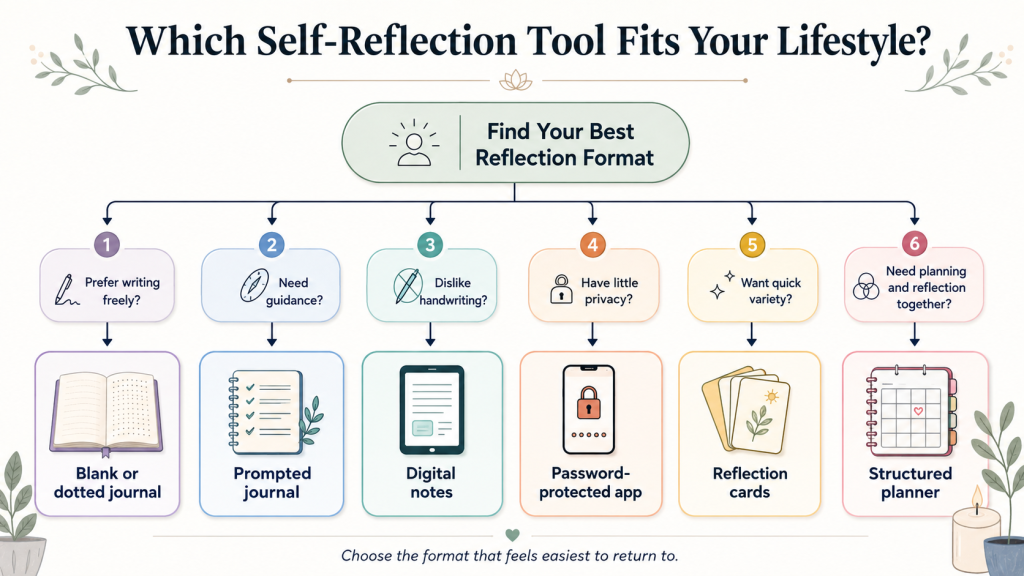
The best tool reduces friction for your preferred style. Guided pages help when blank space feels intimidating; flexible notebooks suit people who dislike prescribed prompts.
| Product | Best for | Format |
| The Five Minute Journal | Busy beginners | Guided daily prompts |
| LEUCHTTURM1917 A5 Notebook | Free-form writers | Dotted hardcover |
| Empowering Self Care Questions | Prompt variety | 52-card deck |
| Rocketbook Core | Digital organizers | Reusable notebook |
| Panda Planner A5 | Reflection plus planning | Undated 90-day planner |
Intelligent Change The Five Minute Journal – Original Daily Gratitude Journal for Women & Men – Mindfulness, Happiness & Daily Reflection – Undated Planner – Affirmation Journal – Gifts for Women
Best for: Busy beginners who want firm structure
Brief morning and evening prompts cover gratitude, intentions, affirmations, daily highlights, and reflection. The predictable format lowers the effort of deciding what to write, so it suits a first Self-Reflection Routine. However, the limited writing space may frustrate readers who prefer long, exploratory entries.
LEUCHTTURM1917 – Notebook Hardcover Medium A5-251 Numbered Pages for Writing and Journaling (Black, Dotted)
Best for: Independent writers who want flexibility
This A5 hardcover notebook has dotted, numbered pages, a contents section, page markers, labeling stickers, and an expandable pocket. It supports custom prompts, weekly reviews, mood charts, or free writing. Because it provides no reflective guidance, beginners may need to copy a simple template onto the first page.
Allura & Arcia Empowering Self Care Questions – 52 Stress Relief Cards for Meditation, Mindfulness, Yoga & Gifts
Best for: People who freeze at a blank page
This 52-card deck offers one self-care question at a time, making it useful for a quick check-in, conversation, or journal prompt. Its portable format works well in small spaces and irregular schedules. The trade-off is continuity: cards create variety, but they do not preserve dated answers unless you record them elsewhere.
Rocketbook Core Reusable Spiral Notebook, Letter Size 8.5×11, Black – Dotted Pages, App-Connected, Erasable, Durable Cover, Ideal for School, Work, and Creative Projects
Best for: Digital organizers avoiding paper buildup
This reusable dotted notebook works with an included compatible pen, wipes clean, and uses an app to send page scans to selected cloud destinations. It offers handwriting without storing stacks of completed journals. You must scan anything worth keeping before erasing, so the workflow adds one maintenance step.
Panda Planner A5 Undated Daily Spiral Notebook 2026–2027, 5.75 x 8.25 Pink – 90-Day Planner, Spiral Binding, Hourly Schedule, Monthly Calendar, 80 GSM Paper, ADHD-Friendly
Best for: Readers combining reflection with planning
This undated 90-day planner includes daily, weekly, and monthly layouts, schedules, priorities, notes, and project tracking. It helps connect reflection to upcoming actions and makes progress visible. The structured pages suit goal-focused readers, although they may feel crowded to someone who wants only a quiet emotional check-in.
What Research Says About Reflection and Habit Formation
In a real-world study, habit automaticity developed gradually, with a median of 66 days among participants whose data fit the model and a wide 18-to-254-day range. The 2010 habit-formation study suggests expecting uneven progress instead of treating one missed session as failure.
A review of 94 studies found that “if-then” plans had a medium-to-large overall effect on goal attainment. The National Cancer Institute paper on implementation intentions explains how linking a specific situation with a response can support starting and staying on course.
A 2016 meta-analysis of 138 studies involving 19,951 participants found that increasing progress monitoring improved goal attainment, with stronger effects when progress was physically recorded. See the goal-progress monitoring meta-analysis.
Journaling research is more mixed because methods and populations vary. A 2018 randomized trial of positive-affect journaling reported reduced mental distress and some well-being improvements among adults with medical conditions. That supports writing as a modest self-management tool, not a replacement for therapy or medical care.
Adapt the Routine When Life Changes
When life changes, shrink your Self-Reflection Routine to one sentence, one voice note, or one prompt twice a week.
You can also change the focus while keeping the cue. A career transition might call for questions about energy and boundaries; a relationship-focused month may track communication. Review the system monthly and remove what feels burdensome. Your Self-Reflection Routine is a living tool, not a contract signed by your most motivated self.
Frequently Asked Questions About a Self-Reflection Routine
How long should a self-reflection session last?
Five to ten minutes is enough for a regular check-in. Longer sessions may help with complex decisions, but they are harder to sustain and can encourage overanalysis. Start with a short minimum, stop after one meaningful observation and one next step, and continue only when extra writing feels useful.
Is it better to reflect in the morning or in the evening?
Neither time is universally better. Morning reflection can clarify intentions, while evening reflection captures recent events and reactions. Choose the time attached to your most dependable cue. If evenings are chaotic or you are exhausted, a lunch break or weekend review may support better consistency.
Do I need to write by hand?
No. Handwriting, typing, voice notes, and prompt cards can all support reflection. Choose a format that feels private, accessible, and easy to revisit. Paper may reduce digital distractions, while digital notes offer search, templates, and backups. The useful format is the one you will reliably open.
What should I do after missing a few days?
Restart with the smallest version and skip the guilt-filled catch-up session. Write what you notice now, identify why the routine became difficult, and adjust the cue, frequency, or length. Missing days may show that the plan did not fit your schedule; use that information to redesign it rather than abandon it.
Can a Self-Reflection Routine replace therapy?
No. A Self-Reflection Routine can support awareness, pattern recognition, and preparation for difficult conversations, but it cannot provide diagnosis or individualized care. Seek professional support when distress persists, writing intensifies painful thoughts, daily functioning is affected, or you feel unsafe. Reflection works best as one tool within appropriate support.
Final Recommendation: Keep Your Self-Reflection Routine Small and Honest
A sustainable Self-Reflection Routine does not require perfect consistency, expensive supplies, or pages of profound insight. Choose one purpose, attach a five-minute practice to a dependable cue, use focused prompts, and finish with one realistic action. Add a weekly review when you want to see broader patterns.
The Five Minute Journal offers guided brevity, while the LEUCHTTURM1917 notebook gives free-form writers room to build a personal system. Digital organizers may prefer the reusable Rocketbook Core. Judge any tool by whether it helps you return, notice, and respond—not by how impressive it looks. Start with three check-ins this week and let the routine earn its place in your life.