5 Goal-Setting Methods To Skyrocket Your Success

We may earn a commission for purchases made using our links. Please see our disclosure to learn more.
A goal can feel exciting on Monday and strangely negotiable by Friday. The problem is often the gap between wanting an outcome and having a repeatable way to pursue it. That is where Goal-Setting Methods help. A method gives your goal shape, a deadline, and a plan for messy weeks. That distinction matters when motivation stops feeling reliable.
Below, you will compare SMART goals, WOOP, OKRs, backward goal setting, and implementation intentions. You will also see what research says, how to choose a method, and which planning tools may help. The aim is to choose a structure you can keep using.
Why Goal-Setting Methods Matter More Than Motivation
Motivation changes with sleep, stress, workload, and family demands. A method gives you something steadier to follow.
Useful Goal-Setting Methods answer three questions: What am I trying to achieve? What will I do next? How will I measure progress? “Get healthier” is vague; “walk for 30 minutes after dinner three days a week for eight weeks” is observable. If progress stalls, you adjust the plan rather than guessing.
Method 1: SMART Goals for Clear Targets
SMART helps when your goal is vague. Make it Specific, Measurable, Achievable, Relevant, and Time-bound. Instead of “save more money,” aim to save $1,200 over six months by transferring $200 on payday.
SMART suits certifications, savings targets, publishing schedules, and work projects with clear milestones. Start with a result that matters, then sharpen it with the framework.
How to Make SMART Goals Flexible, Not Rigid
A deadline should create focus, not panic. One mistake with Goal-Setting Methods is treating the original plan as sacred after circumstances change.
For a 12-week project, review progress after weeks four and eight. Check whether the goal still matters, the timeline fits, and the next action is clear.
For extra structure, SelfCraftr’s goal setting planner guide shows how planners can connect bigger goals with weekly and daily actions.

Method 2: WOOP for Obstacles and Motivation
WOOP means Wish, Outcome, Obstacle, Plan. It helps when you know what you want but keep meeting the same internal barrier.
Choose a feasible wish, picture the desired outcome, identify the biggest obstacle inside you, then plan for it. That obstacle might be procrastination, distraction, or perfectionism.
For example: “If I wake up tired on a workout morning, then I will put on my shoes and do ten minutes.” WOOP helps because the obstacle becomes part of the plan.
Method 3: OKRs for Ambitious, Measurable Progress
OKRs pair an Objective with a few Key Results. The objective states what you want; key results define measurable evidence of progress.
A freelancer might choose “build a more stable client pipeline,” then track qualified pitches, discovery calls, and recurring clients.
OKRs fit business, team, and project goals because they separate direction from measurement and expose busywork. Still, not every personal goal needs a dashboard.
Method 4: Backward Goal Setting for Long Projects
Backward goal setting starts at the finish line and works toward today. It helps when the destination is clear but the middle feels foggy.
If an application is due December 1, schedule the final proofread for November 24, confirm recommendations by November 10, and finish the personal statement by October 20.
Working backward reveals dependencies early and turns a distant deadline into nearer commitments. Pair it with SMART milestones for measurable checkpoints.
Method 5: Implementation Intentions for Daily Follow-Through
Implementation intentions are “if-then” plans: if a specific cue occurs, you perform a specific action. They make follow-through easier to trigger.
“If it is 7:30 p.m. on Tuesday, then I will study for 25 minutes.” Or: “If I reach for social media while writing, then I will put my phone in another room.”
This is one of the most practical Goal-Setting Methods when execution slips. Use an obvious cue and a response small enough to start.

Research-Backed Evidence Behind Goal-Setting Methods
Research supports several Goal-Setting Methods, especially when goals are specific, monitored, and linked to clear actions.
A 2017 meta-analysis found that goal setting had a positive effect on behavior change. Another 2016 meta-analysis found that regularly monitoring progress improved goal attainment, particularly when people recorded their progress.
Research also supports “if-then” planning. A 2006 meta-analysis found that implementation intentions can significantly improve follow-through.
Overall, the evidence suggests that clear goals, regular tracking, and specific action plans can make goal setting more effective.
How to Choose the Right Method for Your Goal
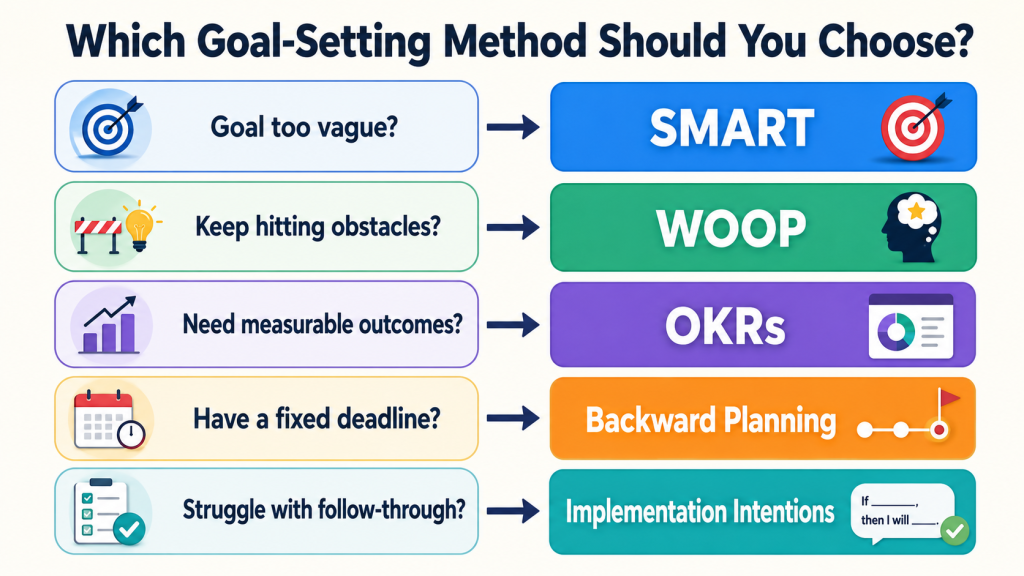
Choose the method that solves your bottleneck. Use SMART for a fuzzy goal, WOOP for recurring obstacles, OKRs for measurable quarterly progress, backward planning for dependencies, and implementation intentions when starting is the weak point.
Some people enjoy dashboards; others dislike turning hobbies into metrics. The best Goal-Setting Methods add structure without unnecessary administration. Try one for four weeks and judge it by clarity and follow-through.
How to Combine Methods Without Overcomplicating Things
You can combine systems. Use SMART to define an outcome, backward planning for milestones, and an implementation intention for a daily action. Or use WOOP to identify an obstacle, then turn its “Plan” into an if-then statement.
Keep the stack small. If several apps and a long review are required just to find your next action, the system is creating work. Goal-Setting Methods should simplify the next move.
Recommended Products for Using Goal-Setting Methods
A planner cannot choose your priorities, but the right layout can make Goal-Setting Methods easier to repeat.
| Product | Best for | Planning style | Main consideration |
| Clever Fox Planner PRO 2nd Edition | Overall structure | Long-to-short-range planning | Large format |
| Full Focus Gray Linen Planner | Professionals | Quarterly execution | Short planning cycle |
| BestSelf Self Journal | 13-week sprints | Daily accountability | Detailed pages |
| Rocketbook Smart Reusable Planner | Digital-paper hybrid users | Reusable planning | Special workflow |
| GoGirl Planner | Portability | Compact weekly/monthly | Smaller writing space |
| The High Performance Planner | Guided reflection | Daily scorecards | 60-day format |
Clever Fox Planner PRO 2nd Edition, Undated Weekly, 8.5 x 11 Mystic Blue
Best for: Readers managing several personal and professional goals.
This large undated planner combines monthly and weekly organization with daily tasks, life-goal planning, time management, and habit tracking. It suits people who want long-range goals and short-range actions in one place. Its 8.5-by-11-inch size offers generous space, but it is better suited to a desk than a small everyday bag.
Full Focus Gray Linen Planner by Michael Hyatt – The #1 Daily Planner to Increase Focus, Eliminate Overwhelm, and Achieve Your Biggest Goals – Hardcover
Best for: Professionals who prefer focused quarterly execution.
Full Focus uses a three-month structure with goal pages, weekly previews, and daily planning. The shorter horizon suits people who review priorities frequently and want a direct bridge from larger goals to today’s tasks. The tradeoff is duration: maintaining the system for a full year requires moving through multiple quarterly planners.
BestSelf Self Journal – Undated 13-Week Goal Planner & Tracker (Black)
Best for: A project, course, launch, or other 13-week sprint.
The Self Journal centers on a 13-week goal cycle with daily planning, habit tracking, gratitude, and weekly reflection. It fits readers who want accountability built into the page rather than a mostly open calendar. However, its detailed daily format asks for more writing time than a simple weekly planner.
Rocketbook Smart Reusable Planner, Undated Daily, Weekly & Monthly, For Motivational Journaling & Digital Organization, Executive Size 6×8.8, Black
Best for: Handwriters who also want digital organization.
This undated reusable planner includes daily, weekly, and monthly layouts in a compact executive size, with pages intended for an erasable, digitally organized workflow. It suits people who like writing by hand but dislike storing piles of notebooks. The main consideration is adapting to compatible pens and a reusable-page routine.
GoGirl Planner for Women, Undated Weekly Agenda Journal, Black
Best for: Beginners and commuters who value portability.
The GoGirl Planner uses a compact 5.3-by-7.7-inch format with weekly and monthly organization plus life-goal and productivity sections. It is easier to carry than desk-focused planners, making it useful between classes, commutes, or appointments. The tradeoff is writing space, especially for detailed notes or large handwriting.
The High Performance Planner [Green]
Best for: Readers who enjoy guided reflection and self-scoring.
Brendon Burchard’s planner uses a structured 60-day format with daily goal prompts, evening reflection, weekly assessments, and monthly planning. It suits people who like reviewing behavior as well as checking off tasks. Because it covers a short period and asks for frequent reflection, it is better for an intensive reset than low-maintenance annual planning.
A Simple Weekly Review That Keeps Goals Alive
Once a week, ask: What moved forward? What stalled? What changed? What is the next useful action?
Update milestones, calendar blocks, or if-then plans. If a goal has stalled for weeks, check whether it still matters, the next step is too large, or another commitment is taking its time.
Regular review keeps Goal-Setting Methods adaptive, letting you correct the route without losing the destination.
Common Goal-Setting Mistakes to Avoid
Avoid choosing too many major goals; every priority competes for attention. Also, do not confuse tasks with goals. “Answer email” is an action; “reduce client response time to one business day this quarter” is an outcome.
Track controllable behaviors alongside results you cannot command. You can influence getting hired or winning a contract, but you cannot guarantee either.
Finally, do not keep a dead goal out of guilt. Strong Goal-Setting Methods allow revision.
Frequently Asked Questions About Goal-Setting Methods
What are the most effective Goal-Setting Methods?
SMART clarifies targets, WOOP addresses internal obstacles, OKRs connect objectives to measurable results, backward planning organizes complex timelines, and implementation intentions support follow-through. The best choice is the one that matches your current problem and is simple enough to review consistently.
Are SMART goals better than OKRs?
SMART goals often work well for one clearly defined personal or project target, while OKRs suit a broader objective supported by several measurable results. You might set a quarterly objective, define three key results, then convert each result into a SMART milestone with a deadline.
How many goals should I work on at once?
There is no universal number because goal complexity and available time vary. Keep the list small enough that each major goal receives real weekly attention. If one goal repeatedly gets postponed because others consume all your time, that is useful evidence that your active list is too crowded.
How often should I review my goals?
Weekly reviews work well because they catch drift without creating constant administration. Longer projects may also benefit from monthly or quarterly reviews. Use the review to update actions, deadlines, obstacles, and priorities rather than simply rereading what you wrote at the beginning.
Do I need a planner to use Goal-Setting Methods?
No. A notebook, calendar, spreadsheet, or task manager can work. A dedicated planner helps only if its structure makes progress tracking and reviews easier. Select the tool with the least amount of friction. A beautiful system you avoid opening is less useful than a plain one you update every week.
Conclusion: Choose Goal-Setting Methods You Can Actually Repeat
The best Goal-Setting Methods solve the problem standing between you and action. Use SMART for clarity, WOOP for recurring obstacles, OKRs for measurable quarterly progress, backward planning for multi-step deadlines, and implementation intentions when starting is the weak point.
If you want a physical system, Clever Fox Planner PRO 2nd Edition offers broad structure, while BestSelf Self Journal suits a focused 13-week sprint. Still, the tool matters less than the review habit behind it.
Choose one meaningful goal, match it to one method, schedule your first review, and give the system time to show whether it genuinely helps you follow through.