
Lifetime Goals: How to Create a Clear Life Plan

We may earn a commission for purchases made using our links. Please see our disclosure to learn more.
You know that weird feeling when life looks “fine” from the outside, but inside you keep thinking, Is this really where I’m headed? Maybe you have dreams sitting quietly in the background. Maybe you want better health, deeper relationships, more financial peace, creative freedom, or a life that feels less random.
That’s where lifetime goals come in.
Lifetime goals help you turn vague wishes into a clear life plan. In this guide, you’ll learn what they are, why they matter, how to choose them, how to break them down, and how to stay flexible when life throws glitter, curveballs, and the occasional emotional banana peel.
Affiliate note: This article includes Amazon product recommendations that may help with planning and goal tracking.
What Are Lifetime Goals?
Lifetime goals are the big goals you want to achieve across your life, not just this week, this month, or this year.
They can include personal growth, relationships, career dreams, financial goals, health goals, spiritual goals, travel, learning, family, creativity, or contribution.
Think of them as your life’s compass. They do not control every step, but they help you stop walking in circles.
Why Lifetime Goals Matter
Without lifetime goals, it is easy to live on autopilot. You handle tasks, meet deadlines, answer messages, pay bills, and suddenly another year disappears like snacks during movie night.
Clear long-term goals give you direction. They help you choose what deserves your time, energy, and attention.
They also make smaller daily choices feel more meaningful. A morning walk is not “just exercise.” It becomes part of your health vision.
Start With the Life You Actually Want
Before you write goals, pause and ask a softer question:
What kind of life would feel honest for me?
Not impressive. Not trendy. Not what your family, friends, culture, or social feed expects. Honest.
Try reflecting on:
- What makes me feel alive?
- What do I keep postponing?
- What would I regret never trying?
- What type of individual do I aspire to be?
This is where goal setting becomes personal instead of performative.

Choose Goal Categories That Fit Your Season
A balanced life plan usually includes different types of lifetime goals. You do not need to master every area at once. That would be exhausting, and frankly, rude to your nervous system.
Common goal categories include:
- Health and wellness
- Career and business
- Money and financial freedom
- Family and relationships
- Spiritual growth
- Learning and education
- Travel and adventure
- Creativity and hobbies
- Community and service
Pick the categories that matter most right now.
Turn Big Dreams Into Long-Term Goals
A dream says, “I want to write a book someday.”
A long-term goal says, “I want to publish my first book within five years.”
See the difference? One floats. The other has shoes on.
To turn dreams into lifetime goals, make them clear enough to guide action.
Instead of “be successful,” try:
“I want to build a flexible career that lets me earn well, help people, and spend more time with my family.”
That goal has direction, values, and emotional meaning.
Make Life Interesting by Using SMART Goals
SMART goals are time-based, relevant, quantifiable, achievable, and specified. They are useful, but they can feel stiff if you treat life like a spreadsheet with feelings.
Use SMART goals as a tool, not a cage.
Example:
Lifetime goal: Build lifelong physical strength and energy.
SMART version: Strength train three times a week for the next six months and track progress monthly.
Simple. Clear. Human.
Build a Lifetime Goals List
Your lifetime goals list does not need to be perfect. Start messy.
Write down anything that matters to you:
- Learn a second language
- Buy a home
- Start a business
- Travel to Japan
- Build emotional resilience
- Raise kind children
- Become debt-free
- Create art regularly
- Mentor others
- Deepen your spiritual life
Then circle the goals that feel most meaningful, not just the ones that look impressive.

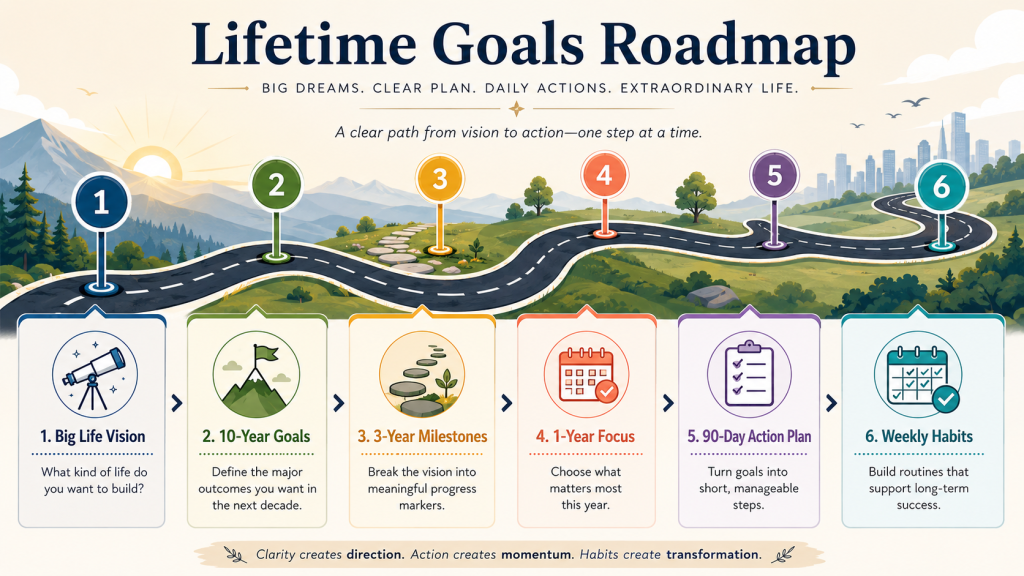
Break Lifetime Goals Into Milestones
Big goals can feel intimidating because your brain sees the whole mountain at once and says, “Absolutely not.”
So break the mountain into trails.
For each goal, create:
10-Year Vision
Where do you want to be long-term?
3-Year Milestone
What major progress would feel realistic?
1-Year Goal
What can you focus on this year?
90-Day Action Plan
What small steps can you start now?
This keeps lifetime planning inspiring without becoming overwhelming.
Create Habits That Support Your Life Plan
Lifetime goals are built through ordinary habits. Not glamorous, but true.
A financial goal may need weekly budgeting. A health goal may need better sleep. A relationship goal may need regular check-ins. A creative goal may need one quiet hour every Saturday.
Small habits are like tiny votes for the future you want.
Try this:
If my lifetime goal is important, what habit would support it this week?
Listen to Your Inner Direction
Not every goal comes from logic. Sometimes, you just feel pulled toward something before you can explain it.
Maybe you feel drawn to a new skill, a slower lifestyle, a creative project, or a different kind of work. That inner nudge matters.
If you want to build that kind of self-trust, this guide on strengthening your intuition can help you tune into your inner voice while still making grounded choices.
Research-Backed Goal Setting Tips
Goal setting is not just motivational fluff with a nice notebook. Research supports several practical strategies.
A major review by Locke and Latham summarized 35 years of empirical research and found that goals influence motivation, performance, feedback, and commitment. Clear, challenging goals tend to work better than vague “do your best” intentions. You can read the PubMed summary of this goal-setting theory research.
Another powerful idea is “implementation intentions,” also called if-then planning. A meta-analysis of 94 studies found that planning when, where, and how you will act can help bridge the gap between intention and action. In simple terms: “If it is 7 a.m., then I will walk for 20 minutes.” That beats “I should exercise more” by a mile. See the implementation intention meta-analysis.
Recommended Products for Goal Planning
Here are five useful products for organizing lifetime goals, weekly plans, and daily action.
Goal Planner | SMART Goal Setting Kit for the New You
Short description: A guided goal planner with SMART goal pages, vision boards, bucket list pages, long-term planning, habit tracking, and monthly reflections.
Features: A5 size, pastel design, SMART goal sections, long-term goal pages, and reflection prompts.
Use cases: Great for beginners, students, entrepreneurs, or anyone who wants a colorful, guided goal-setting system.
Amazon Basics Daily Planner and Journal
Short description: A practical weekly and monthly planner with space for productivity, goal setting, and task organization.
Features: Soft cover or hardcover options, weekly/monthly layouts, goal sections, and simple organization pages.
Use cases: Best for people who want a clean, no-fuss planner for daily routines and personal goals.
The High Performance Planner by Brendon Burchard
Short description: A 2-in-1 planner and journal with prompts, self-assessments, and calendars designed for focus and long-term success.
Features: Writing prompts, productivity tracking, self-reflection, and daily planning.
Use cases: Ideal for ambitious professionals, creators, coaches, and anyone who likes structured reflection.
Goal Planning Notepad – A5 Goal Setting Journal
Short description: A simple project action planner for breaking goals into tasks and tracking progress.
Features: A5 format, action planning pages, task management layout, and personal development tracking.
Use cases: Helpful for students, project planners, and people who prefer short-form planning over full journals.
Goal Planner Journal: 90 Day Goal Setting & Tracking
Short description: A focused 90-day planner that helps you organize goals, track progress, and build momentum.
Features: Goal planning pages, progress tracking, reflection space, and productivity prompts.
Use cases: Great for anyone who wants to test one goal for 90 days before committing long-term.
Common Mistakes That Keep People Stuck
The biggest mistake is setting goals you do not actually care about.
Setting too many objectives at once is another error. When everything is important, everything starts fighting for your attention like toddlers in a candy aisle.
Avoid these traps:
- Copying someone else’s life plan
- Making goals too vague
- Ignoring your current season
- Setting goals without habits
- Never reviewing your progress
- Giving up after one bad week
Progress is not ruined by a missed day. It is ruined by deciding one missed day means you failed.
How to Stay Motivated
Motivation comes and goes. That is normal.
Instead of depending on mood, build systems.
Try:
- Put your goals somewhere visible
- Review them every Sunday
- Track one small habit
- Celebrate small wins
- Share progress with someone supportive
- Adjust goals when life changes
Also, remember why the goal matters. A goal with emotional meaning lasts longer than a goal built only on pressure.
When to Update Your Lifetime Goals
Your lifetime goals should grow with you.
You are free to reconsider. You are free to outgrow your previous aspirations. You are allowed to want peace now, even if you wanted status before.
Review your life plan every six to twelve months. Ask:
- Does this still matter to me?
- Is this goal mine, or did I inherit it?
- What needs to change?
- What goal deserves more attention now?
A flexible life plan is stronger than a rigid one.
Lifetime Goals Examples for Real Life
Here are a few lifetime goals examples you can shape into your own:
- Build a healthy body that supports me as I age
- Create a loving, emotionally safe home
- Become financially stable and generous
- Learn skills that keep my mind sharp
- Travel to places that expand my worldview
- Build meaningful friendships
- Create work that feels useful and fulfilling
- Leave a positive impact in my community
Use these as inspiration, not rules.
FAQs About Lifetime Goals
What are good lifetime goals to set?
Good lifetime goals support the life you truly want. They may involve health, relationships, career, money, creativity, learning, family, faith, travel, or service.
How many objectives should I set for my life?
Start with 5 to 10 lifetime goals. Too many can feel scattered. You can always add more later as your life changes.
How do I write lifetime goals clearly?
Use simple language. Write what you want, why it matters, and what progress would look like. Clear beats fancy every time.
Are lifetime goals the same as long-term goals?
They are similar, but lifetime goals are broader. Long-term goals may cover five or ten years, while lifetime goals can guide your whole life direction.
What if my lifetime goals change?
That is completely normal. Your goals should evolve as you grow, learn, heal, and enter new life stages.
Conclusion
Lifetime goals are not about planning every minute of your future. They are about giving your life direction, meaning, and intention.
Start with what matters. Turn dreams into clear goals. Break them into milestones. Build habits that support them. Review often. Adjust with honesty.
You do not need a perfect life plan. You just need a thoughtful next step.
So grab a notebook, make a quiet cup of something warm, and ask yourself: What kind of life am I ready to build on purpose?