7 Micro Habits To Change Your Life

We may earn a commission for purchases made using our links. Please see our disclosure to learn more.
You do not need a dramatic reinvention to feel better about your life.
Most people are not failing because they lack ambition. They are failing because they keep choosing habits that are too big, too vague, or too easy to quit on a hard day. That is why Micro Habits To Change Your Life can be so powerful. They are small enough to start without a pep talk, yet meaningful enough to shift your mood, energy, focus, and confidence over time.
In this guide, you will learn seven micro habits that are realistic, science-backed, and easy to weave into ordinary life. Think less “new year, new me,” and more “tiny proof that I can trust myself again.”
Affiliate note: This article includes helpful Amazon products that may support your routine.
Why Micro Habits To Change Your Life actually work
A micro habit is a tiny action you can repeat with very little friction. It is small on purpose.
That matters because consistency beats intensity in habit-building. A 2024 systematic review found that habits can start forming in about two months, but the timeline varies widely from person to person. It also found that self-chosen habits and morning habits often build stronger automaticity.
The lesson is simple: the habit that looks “too small” is often the one you will actually keep.
What counts as a micro habit?
A micro habit should feel easy enough that you can do it even on a messy day.
That might be:
- drinking a glass of water after waking up
- reading one page
- taking five slow breaths
- writing one sentence in a journal
- resetting one small area for two minutes
You are not trying to impress anyone. You are trying to create a repeatable cue-and-action loop your brain can trust.
Why big self-improvement plans usually collapse
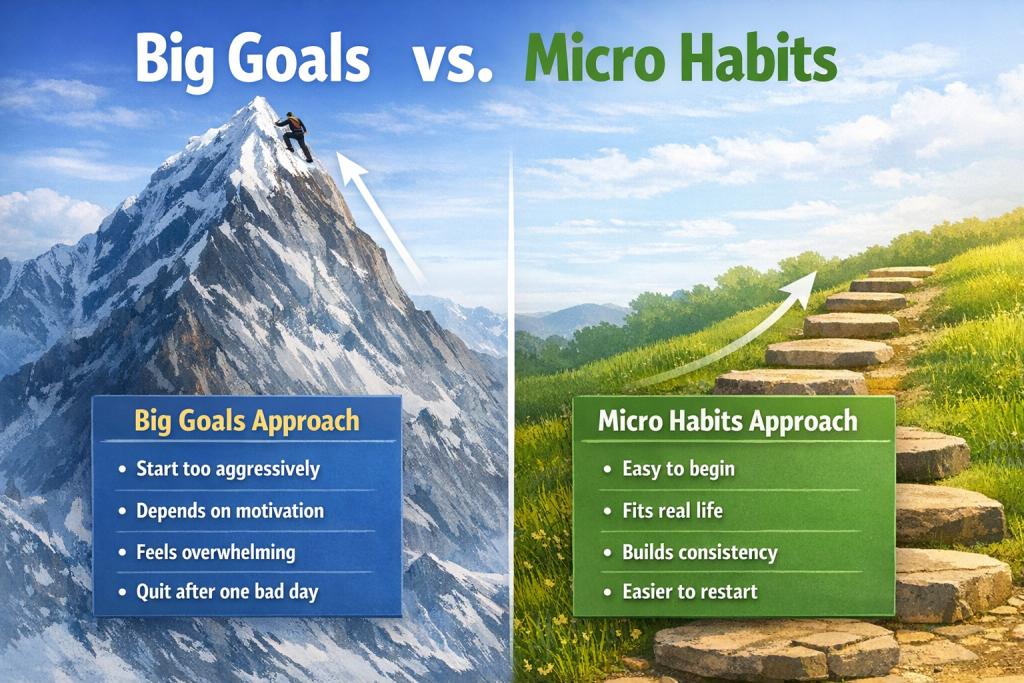
Here is the problem with giant habit plans: they depend too much on motivation.
And motivation is moody.
Some days you feel focused and disciplined. Other days you are tired, distracted, overstimulated, or just very done with everyone and everything by 3 p.m. A huge routine often breaks the moment real life shows up. A tiny one can survive.
That is why small daily habits are so underrated. They lower the bar for starting, and starting is usually the hardest part.

How to make tiny changes stick
The best micro habits are attached to real life, not fantasy life.
Use a cue you already have
Instead of saying, “I’ll remember,” tie the habit to something fixed:
- After I brush my teeth, I will drink water.
- After I sit at my desk, I will write my top task.
- After dinner, I will take a five-minute walk.
Reduce friction
Leave the book where you sit.
Put the water bottle in sight.
Set the shoes by the door.
Make the habit easy to begin.
Track proof, not perfection
A checkmark helps. So does a sticky note. So does a simple “done” in your notes app. The goal is not a flawless streak. The goal is evidence that you are showing up.
A 2020 longitudinal field study found that habit strength increased substantially over about three months, especially when people performed the behavior consistently in the same context.
Micro habit #1: drink water before you check your phone
This is one of the easiest self improvement habits because it gives you a quick win before the day starts pulling at you.
Before messages, notifications, or scrolling, drink one glass of water.
That tiny pause changes the tone of your morning. Instead of starting with outside noise, you start by taking care of your body first. It is not glamorous, but neither is being dehydrated and wondering why you feel like a raisin by noon.
Micro habit #2: do a two-minute reset
Set a timer for two minutes and tidy one tiny zone.
Not the whole house. Not the whole room. Just one counter, one shelf, one desk corner, one bag.
This habit works because it interrupts the “everything is a disaster” feeling. It tells your brain, “We are not stuck. We are moving.” Two minutes sounds almost laughably small, which is exactly why it works.
Micro habit #3: write one honest line in a journal
Not three pages. Not a perfect gratitude ritual with candlelight and a matching pen.
Just one line.
You can write:
- what felt good today
- what stressed you out
- what you learned
- what you want tomorrow to feel like
This is one of the best habits for personal growth because it helps you notice your patterns without turning self-reflection into homework.
Micro habit #4: take five calm breaths before reacting
Before replying to a frustrating text, opening a stressful email, or walking into a tense conversation, pause and take five slow breaths.
That tiny pause creates space between emotion and reaction. And sometimes that space is everything.
You do not need to become a meditation expert. You just need a tiny ritual that helps you respond with a little more intention and a little less emotional whiplash.
Micro habit #5: prep one thing for tomorrow tonight
Choose one small action that makes tomorrow easier.
That could be:
- laying out your clothes
- writing tomorrow’s top priority
- plugging in your devices
- putting your keys in the same place
- clearing one surface
This habit is like setting the table for your future self. Tiny effort tonight, less chaos tomorrow.
Micro habit #6: read one page
If you want to read more, stop making the entry point so dramatic.
Read one page.
That is it.
One page keeps the identity alive. You remain someone who reads, even on a busy day. And funny enough, one page often turns into five because once you start, the resistance usually drops.
Micro habit #7: take a five-minute walk
A short walk is one of the most practical daily routines for success because it helps your body and your mind at the same time.
Walk outside, around the house, through the hallway, or to the end of the block and back. It does not need to be impressive to count.
This habit is especially helpful when you feel mentally foggy, restless, or emotionally flat. Five minutes can reset more than you think.
Helpful tools that support micro habits
These are not magic fixes. They are just smart tools that make simple habits easier to repeat.
Atomic Habits: An Easy & Proven Way to Build Good Habits & Break Bad Ones by James Clear
This may seem like the most expected choice, but there is a good reason it stands out. Amazon’s listing currently shows a 4.8-star rating and about 146.1K reviews.
Features: practical behavior-change framework, simple language, habit-stacking ideas.
Use case: best for anyone who wants a clear mental model for tiny habits, especially beginners who keep starting over.
Intelligent Change The Five Minute Journal – Original Daily Gratitude Journal
Amazon’s listing currently shows a 4.7-star rating and 581 reviews.
Features: guided prompts, quick daily format, structured reflection.
Use case: great for people who want a journaling habit without staring at a blank page like it owes them money.
Antonki 2 Pack Digital Timer for Kids, Magnetic Countdown Kitchen Timers for Cooking, Egg, Classroom, Teacher, Exercise, Study, Oven – Battery Included
Amazon’s listing shows a 4.5-star rating with 43,731 reviews. The product page highlights count up and countdown modes, loud or silent settings, a strong magnet, and a built-in memory function.
Features: large display, loud/silent mode, magnetic back, memory timer.
Use case: ideal for two-minute resets, five-minute walks, short focus blocks, or “I’ll do it later” people who need a visible nudge.
Nalgene Sustain Tritan BPA-Free Water Bottle Made with Material Derived From 50% Plastic Waste, 32 OZ, Wide Mouth
Amazon search results show this bottle at 4.8 stars with about 25,000 reviews, and the product page highlights leak-proof design, BPA/BPS-free material, and easy everyday durability.
Features: wide mouth, durable Tritan material, leak-proof build, hydration markings on many versions.
Use case: perfect for anyone trying to make hydration automatic at work, at home, or on the go.
Hatch Restore 3 Sunrise Alarm Clock, Sound Machine, Smart Light
Amazon category results show Hatch Restore 3 at 4.2 stars with about 4.5K reviews, and the product page says it is designed to help users build a screen-free bedtime routine with sunrise alarm and sound features.
Features: sunrise alarm, sound machine, sleep routine support, lower-phone-use bedtime setup.
Use case: especially helpful if your micro habit goals involve sleeping earlier, waking more gently, or keeping your phone out of your face first thing in the morning.
What research says about habit formation
Two findings matter here.
First, the 2024 systematic review on habit formation found that health habits often begin forming around the two-month mark, but the range is wide, from 4 to 335 days in the included studies. Morning timing, repetition, and self-chosen behaviors were all linked with stronger habit formation.
Second, the 2020 longitudinal field study on good habits found that habit strength rose substantially over roughly three months, especially when people repeated the behavior consistently in the same context.
So if your micro habits feel “too small,” that is not a flaw. That is often what makes them sustainable.
FAQs about Micro Habits To Change Your Life
What are the best micro habits to start with?
Start with the habit that solves your most common daily problem. If mornings feel rough, begin with water or evening prep. If stress runs high, begin with breathing. If clutter overwhelms you, start with a two-minute reset.
How long do micro habits take to work?
You can feel a benefit right away, especially with habits like walking, hydration, or breathing. However, automaticity usually takes longer. Research suggests habit formation often unfolds over weeks to months, not just a few days.
Can tiny habits really lead to big life changes?
Yes, because tiny habits change your identity and routines. A small action repeated daily becomes a pattern, and patterns shape outcomes. Big change usually looks small while it is happening.
What if I miss a day?
Nothing is ruined. Just restart fast. Missing one day is normal. The trick is to avoid turning one miss into a full stop.
How many micro habits should I build at once?
Start with one or two. More than that can feel exciting at first, then weirdly exhausting by Thursday. Build slowly so the habits feel natural instead of heavy.
Final thoughts
You do not need a whole new life plan. You just need one small step you can actually take.
That is the power of micro habits. They are simple, realistic, and easier to stick with than big dramatic changes. And if you are not sure where to start, this guide on what to do when you don’t know what to do can help.