Top 10 Time-Blocking Planners
We may earn a commission for purchases made using our links. Please see our disclosure to learn more.
Time-Blocking Planners turn task lists into realistic daily schedules. They help professionals, students, entrepreneurs, and busy households protect focused work, remember appointments, and make room for breaks. Format matters: large desk planners provide writing space, while compact books travel easily; some emphasize goals, others precise calendars. I compared these products using verified layouts, planning horizons, portability, materials, ease of use, specialization, limitations, and broad value—not popularity alone. The evaluations favor products whose page structure clearly supports time allocation instead of ordinary notebooks marketed vaguely as productivity tools. A clear layout also makes daily adjustments faster when priorities inevitably shift.
Time-Blocking Planners Comparison
| Product | Best for | Key feature | Main limitation | Price category | Recommendation |
| Clever Fox Hourly Planner PRO Premium | Overall planning | Full planning hierarchy | Bulky | Premium | Best balanced pick |
| The Time-Block Planner, Second Edition | Deep work | Four-month method | Specialized | Mid-range | Focused professionals |
| Refine Days ADHD Planner | ADHD structure | 180 undated pages | Small writing areas | Mid-range | Specialized support |
| Sweetzer & Orange Daily Planner | Budget buyers | Two-page days | Limited long-range view | Budget | Affordable organizer |
| Panda Planner Pro A4 2026 | Beginners | Guided prompts | Large, dated | Mid-range | Structured start |
| Legend Planner Hourly Edition | Portability | A5 format | Compact slots | Mid-range | Best travel pick |
| Intelligent Change Productivity Planner | Focus intervals | Ninety-day cycle | Prompt-heavy | Premium | Intentional routines |
| Full Focus Gray Linen Planner | Leaders | Daily Big Three | Ongoing cost | Premium | Executive planning |
| BestSelf Self Journal | Goal sprints | Thirteen-week system | Learning curve | Premium | Measurable goals |
| AT-A-GLANCE 2026 DayMinder | Appointments | Quarter-hour grid | Expiring edition | Mid-range | Booked calendars |
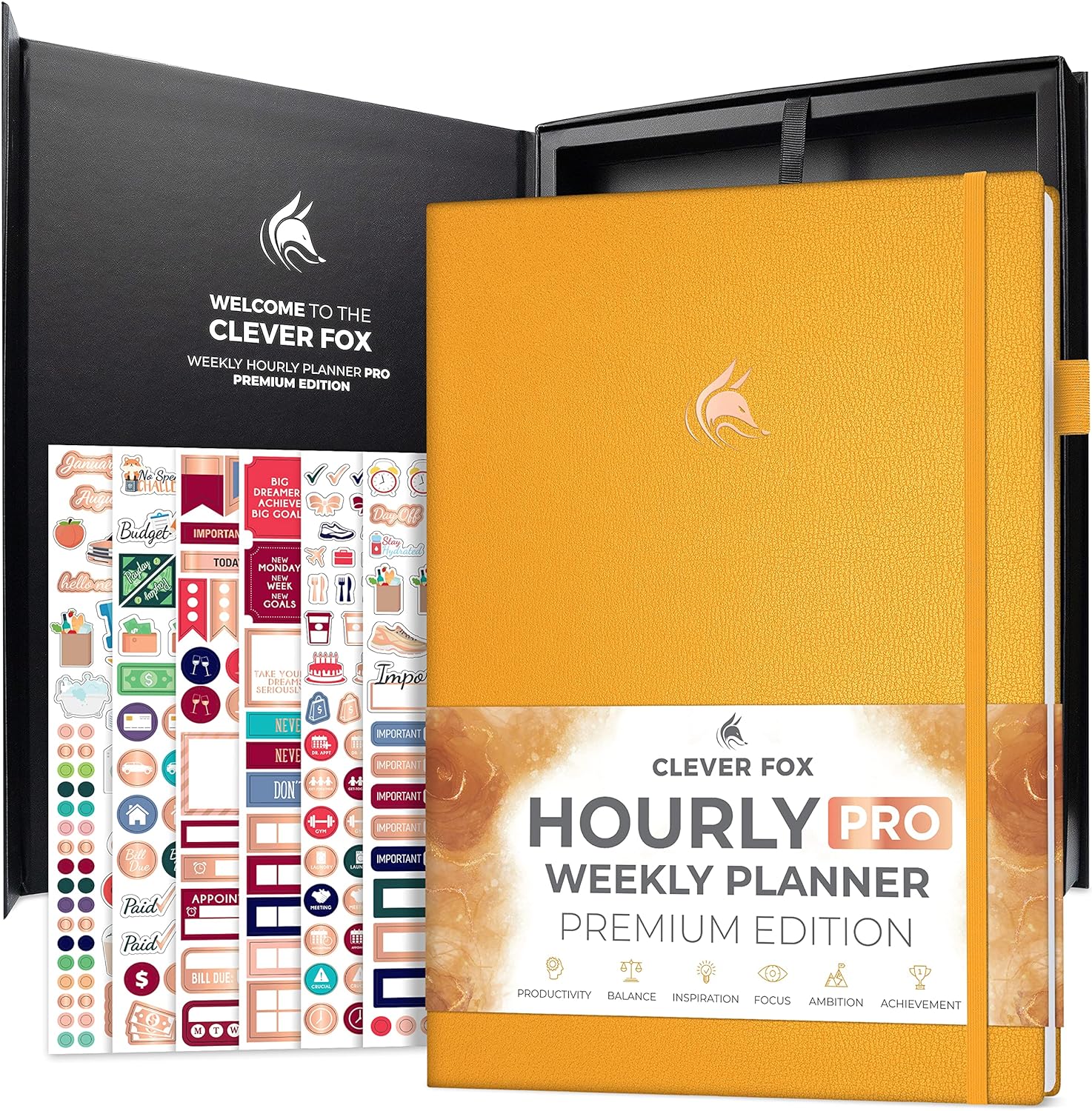
1. Clever Fox Hourly Planner PRO Premium — Best for Balanced Planning
Overview: This large undated planner combines detailed scheduling with work, personal, and long-range planning.
Key Features: A4 pages; 6 a.m.–9 p.m. slots; weekly and monthly layouts; task lists; habit tracking; 120gsm paper; lay-flat hardcover.
Pros: Spacious and comprehensive.
Cons: Bulky for commuting; visually busy.
Best For: Professionals managing projects and routines.
Verdict: Its flexible dates and complete planning hierarchy make it the strongest all-around choice.
2. The Time-Block Planner, Second Edition — Best for Deep Work
Overview: Cal Newport’s planner applies a specific paper method for protecting concentrated work.
Key Features: Spiral binding; four months of pages; daily time-block grids; revision space; updated instructions.
Pros: Clear method and easy schedule changes.
Cons: Short planning horizon; minimal lifestyle tracking.
Best For: Writers, analysts, developers, and researchers.
Verdict: Choose it when you want a focused time-blocking operating system rather than a general lifestyle planner.

3. Refine Days Time Blocking and ADHD Planner — Best for ADHD-Friendly Structure
Overview: This A5 planner externalizes priorities through visible schedule, task, and agenda areas.
Key Features: 180 undated pages; hourly schedule; to-do list; daily agenda; monthly planning.
Pros: Flexible, portable, and approachable.
Cons: Tight space for large handwriting; daily repetition requires consistency.
Best For: Adults seeking ADHD-aware structure or relief from unbounded lists.
Verdict: It combines time blocks and tasks without demanding a digital system.

4. Sweetzer & Orange Daily Planner Notebook — Best for Budget Buyers
Overview: This spiral notebook gives each planned day a roomy two-page layout without premium extras.
Key Features: Undated pages; hourly schedule; priorities; notes; tasks; 160 pages; 6.5-by-9.5-inch size.
Pros: Affordable and easy to keep open.
Cons: Limited weekly or monthly context.
Best For: Students, freelancers, and first-time time blockers.
Verdict: It covers daily planning essentials without charging for elaborate goal frameworks.

5. Panda Planner Pro A4 Daily Planner 2026 — Best for Beginners
Overview: Guided sections connect scheduled work with priorities, habits, gratitude, and reflection.
Key Features: Six-month format; 8.5-by-11-inch pages; daily, weekly, and monthly planning; habit tracker; 100gsm paper; vegan-leather cover.
Pros: Clear prompts and generous space.
Cons: Not portable; buyers must verify the remaining 2026 date range.
Best For: Beginners wanting instructions on every page.
Verdict: Its prompts reduce blank-page uncertainty and encourage useful review.

6. Legend Planner Hourly Schedule Edition — Best for Compact Portability
Overview: This undated A5 hardcover puts yearly, monthly, and weekly planning in a bag-friendly book.
Key Features: Twelve-month horizon; 52 weekly spreads; hourly areas; 120gsm paper; lay-flat binding; pen loop; bookmarks.
Pros: Portable, durable, and start-anytime.
Cons: Narrower notes and time slots.
Best For: Commuters, students, hybrid workers, and travelers.
Verdict: It preserves long-range context without becoming a desk-only planner.

7. Intelligent Change Productivity Planner — Best for Focus Intervals
Overview: This 90-day system combines time blocking, priorities, habits, and weekly reviews.
Key Features: Two-page layout; 6 a.m.–9:30 p.m. schedule; three undated monthly calendars; habit trackers; weekly reviews; 256 A5 pages.
Pros: Strong reflection loop and detailed hours.
Cons: Prompt-heavy; requires frequent replacement.
Best For: Users who prefer structured focus sessions.
Verdict: It turns focused intervals into an intentional, repeatable routine.

8. Full Focus Gray Linen Planner — Best for Premium Leadership Planning
Overview: This system centers each day on three high-value outcomes plus appointments and supporting tasks.
Key Features: Ninety-day cycle; Daily Big Three; two-page days; schedule timeline; weekly preview; hardcover.
Pros: Strong priority discipline and polished construction.
Cons: Higher ongoing cost; regular reviews take time.
Best For: Executives, managers, owners, and project leaders.
Verdict: It connects daily scheduling with deliberate leadership priorities instead of simple activity tracking.

9. BestSelf Self Journal — Best for Thirteen-Week Goal Sprints
Overview: The Self Journal connects a 13-week objective to weekly milestones and daily time blocks.
Key Features: Undated system; daily planning; time-block schedule; reflections; 240 pages; 110gsm FSC paper; fabric hardcover; lay-flat binding.
Pros: Clear goal-to-day connection and durable materials.
Cons: Dense framework; one-quarter lifespan.
Best For: Anyone pursuing a measurable short-term goal.
Verdict: Few planners link strategic goals and calendar decisions so explicitly.

10. AT-A-GLANCE 2026 DayMinder G5200026 — Best for Appointment-Heavy Schedules
Overview: This weekly appointment book prioritizes precise calendar control over journaling.
Key Features: Dated 2026 calendar; quarter-hour increments; 8-by-11-inch pages; professional cover; model G5200026.
Pros: Detailed spacing and fast weekly visibility.
Cons: Shrinking date window; little goal guidance.
Best For: Consultants, clinicians, tutors, salons, and meeting-heavy managers.
Verdict: Consecutive appointments benefit more from quarter-hour granularity than motivational prompts. Confirm dates before ordering.

How to Choose the Best Time-Blocking Planners
Start with schedule resolution. Hourly lines suit project work; half-hour or quarter-hour grids better serve appointments. Check the visible daily range, especially if you work early or late. Also inspect whether the grid uses lines, boxes, or open columns. Dense lines improve appointment precision, whereas open space accommodates flexible project notes and rescheduling.
Match the planning horizon to your habits. Undated books prevent waste. Dated editions provide immediate context but expire. Ninety-day systems support focused goals, while annual weekly planners reveal longer patterns.
Size affects usability. A4 or letter pages fit meetings, notes, and categories but usually stay on a desk. A5 books travel well yet require concise handwriting. Spiral and lay-flat bindings keep the active spread accessible. If you carry the planner, compare closed dimensions and weight rather than relying on labels such as large or portable.
Choose only as much guidance as you will use. Beginners may appreciate prompts, reviews, and priority sections. Experienced planners often prefer an uncluttered grid. A complicated framework fails when filling it becomes another project.
Check paper, cover, closures, bookmarks, and replacement frequency. A premium 90-day book may cost more annually than an annual planner.
Once you choose a planner, these practical productivity tips for using time blocks without overplanning can help you build a workable daily system. Leave buffers rather than filling every line, and confirm the current edition, dimensions, binding, seller, and warranty information before purchasing.
Frequently Asked Questions About Time-Blocking Planners
1. Are paper Time-Blocking Planners better than digital calendars?
Paper makes priorities visible and reduces app distractions. Digital calendars handle reminders, sharing, and rapid changes better. Many users plan intentionally on paper while storing fixed commitments digitally.
2. How long should each time block be?
Match the block to the task. Thirty to ninety minutes suits many focused projects; calls and administration may need shorter slots. Always include transitions.
3. Should beginners choose dated or undated pages?
Undated pages prevent waste when the habit is new. Dated planners supply instant calendar context, but the starting month and remaining range matter.
4. Can one planner manage work and personal tasks?
Yes, when the layout has enough space or separate categories. Use simple color coding, but keep buffer room for delays and recovery.
5. What happens when planned blocks change?
Cross out, arrow, or rewrite the block, then move the task deliberately. Review repeated disruptions weekly and improve future estimates.
Final Verdict
Among these Time-Blocking Planners, Clever Fox Hourly Planner PRO Premium is best overall for balanced planning. Sweetzer & Orange is the best budget choice. Full Focus is the best premium system for leaders. Panda Planner Pro is best for beginners who appreciate prompts. Refine Days is the best specialized option for ADHD-friendly structure.
Compare dimensions, horizon, time-slot detail, portability, and replacement cost. Amazon inventory and editions change, so confirm current specifications, date range, seller, warranty details, and availability on Amazon.com before buying. The best planner is the one you can read at a glance, update without friction, and continue using after the initial excitement fades during a busy week.