Taking Accountability: The Habit That Builds Trust

We may earn a commission for purchases made using our links. Please see our disclosure to learn more.
You know that moment when you realize you messed up… and your brain immediately starts speed-running excuses like it’s an Olympic sport?
“Technically, I wasn’t wrong.”
“They started it.”
“I didn’t mean it like that.”
Yep. Been there (and if you’re human, you’ve been there too).
Taking accountability isn’t about becoming a perfect person who never makes mistakes. It’s about becoming the kind of person people can trust—including future-you. In this guide, you’ll learn what taking accountability really means, why it’s so hard sometimes, and how to do it in a way that’s honest, calm, and actually sustainable (no self-hate required).
What “Taking Accountability” Actually Means
At its simplest, taking accountability is this:
“I own my part, I learn from it, and I make it right.”
That’s it. Not “I’m a terrible person.” Not “I must punish myself.” Not “Everyone else is innocent and I’m the villain.”
Accountability is ownership + action. It’s a growth mindset in real life.
And here’s the underrated part: you can take accountability even when your intentions were good. Because impact still matters.
Why It Feels So Hard (Even for Good People)
If taking accountability is so healthy, why does it feel like swallowing a cactus sometimes?
Because your brain treats blame like a shield.
Accountability can trigger:
- Fear of rejection (“If I admit this, they’ll leave.”)
- Fear of being seen as “bad” (“I’ll lose respect.”)
- Loss of control (“Now I’m exposed.”)
So your nervous system tries to protect you. It’s not you being “weak.” It’s you being wired for survival.
The goal isn’t to never feel defensive. The goal is to notice it… and choose a better move anyway.
Accountability vs Blame, Shame, and Guilt
Let’s separate a few things that get mashed together:
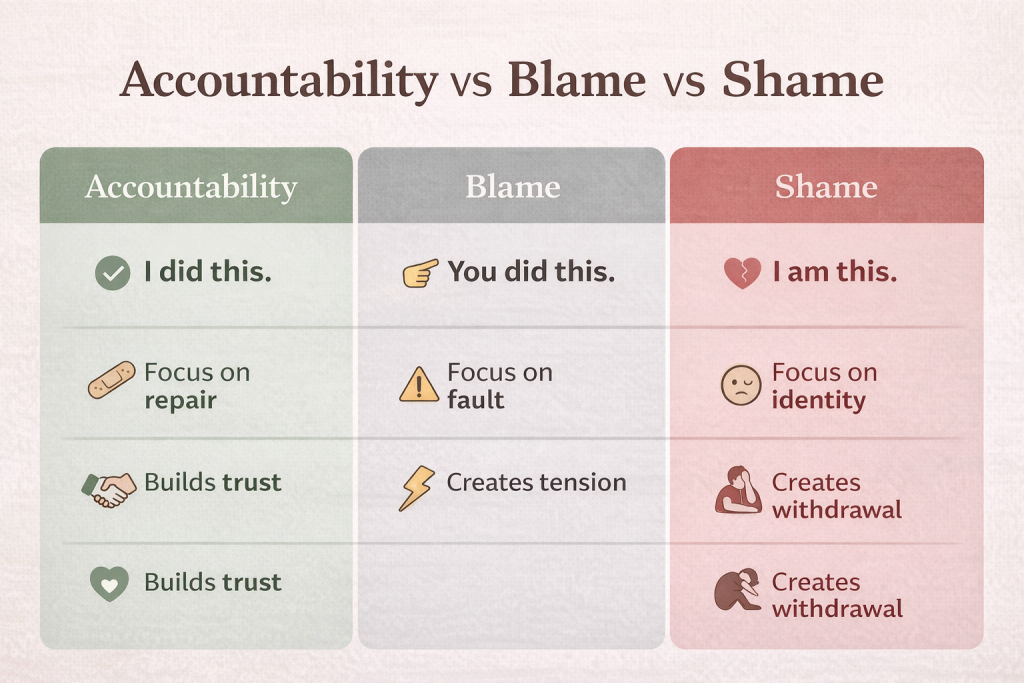
- Blame: “This is your fault.” (often ends the conversation)
- Shame: “I am the problem.” (attacks your identity)
- Guilt: “I did something wrong.” (points to behavior, not identity)
- Accountability: “I did my part. Here’s what I’ll do next.” (creates repair)
Accountability isn’t a personality trait. It’s a skill.
And like any skill, it gets easier with reps.
The Trust Loop: How Accountability Builds Safety
Trust isn’t built by never messing up. Trust is built by what happens after the mess-up.
Here’s the trust loop:
- You miss the mark.
- You own it without dodging.
- You repair it.
- People relax around you again.
That “relax” part matters. When people feel safe with you, they stop bracing for the next excuse, the next argument, the next emotional disappearing act.
Taking accountability tells people: “I won’t abandon you inside a problem.”

The 3-Step Method: Own • Learn • Repair
When you’re not sure what to say or do, use this simple framework:
Own it (clear and specific)
- “I raised my voice.”
- “I broke the agreement.”
- “I didn’t follow through.”
Learn it (what you understand now)
- “I see how that put you in a tough spot.”
- “I realize I made assumptions instead of asking.”
Repair it (what changes now)
- “Here’s how I’ll fix it.”
- “Here’s what I’ll do differently next time.”
If you do those three things, you’re practicing taking accountability in a way people can actually feel.
Words That Help (And Words That Quietly Wreck It)
Here are accountability phrases that land well:
- “You’re right. I missed that.”
- “That was on me.”
- “I understand why that hurt.”
- “Thank you for telling me—seriously.”
- “Here’s what I’m going to do next.”
And here are phrases that sound like accountability but aren’t:
- “I’m sorry you feel that way.” (translation: your feelings are the issue)
- “I’m sorry, but…” (that “but” is a trapdoor)
- “I didn’t mean to.” (intent ≠ impact)
- “I guess I’m just awful.” (now they have to comfort you)
A good rule: don’t make them manage your emotions while you “apologize.”
Taking Accountability With Yourself (Without Self-Attacking)
This is where a lot of people get stuck: they think accountability = being harsh.
But self-awareness works better than self-punishment.
Try this inner script:
- “Okay… what did I do?”
- “What was I needing in that moment?”
- “What did that cost me (or someone else)?”
- “What’s one small correction I can make today?”
Personal accountability is basically being your own wise coach instead of your own mean commentator.
And yes—sometimes you still need to feel the sting. But you don’t need to light yourself on fire to prove you’re sorry.
Taking Accountability in Relationships (Family, Friends, Partners)
Relationships don’t break from one mistake. They break from patterns—especially patterns of denial.
A few real-life examples:
- Partner: You forgot something important. Accountability is not “I was busy.” It’s “I didn’t prioritize it, and I see how that felt.”
- Friend: You went quiet for weeks. Accountability is “I disappeared when I got stressed. I’m sorry I left you guessing.”
- Family: You snapped during a tense moment. Accountability is “I took my stress out on you. That wasn’t fair.”
Also, cultural note: in some families or communities, “saving face” is a big deal. Accountability doesn’t have to be dramatic or humiliating. It can be quiet, respectful, and still real.
Taking Accountability at Work (Without Torching Your Confidence)
Workplace accountability is a superpower. It signals maturity, emotional intelligence, and reliability.
Try this structure:
- State the miss: “I sent the wrong file.”
- State the impact: “That slowed the review.”
- State the fix: “I’m resending it now and updating the checklist so it doesn’t repeat.”
You don’t need a TED Talk apology. You need clarity.
And if you’re worried about looking incompetent, remember this: leaders trust the person who owns problems early, not the person who hides them until they explode.

When You’re Confronted: Stay Calm, Stay Curious
When someone says, “We need to talk,” your body might instantly go into defense mode.
So give yourself a tiny pause:
- Unclench your jaw.
- Drop your shoulders.
- Breathe out longer than you breathe in.
Then try curiosity over combat:
- “Can you tell me what you experienced?”
- “What part bothered you most?”
- “What would have helped instead?”
This is how you turn confrontation into constructive feedback instead of a courtroom drama.
How to Apologize So It Actually Lands
A solid apology isn’t poetic. It’s clean.
Here’s a simple apology template:
- Name what you did: “I interrupted you.”
- Name the impact: “That made you feel dismissed.”
- Own it: “That was my mistake.”
- Repair: “Next time I’ll pause and ask if you’re finished.”
- Invite input: “Is there anything you need from me to make this right?”
Small tip: keep your voice steady. People trust calm ownership way more than emotional theatrics.
Boundaries and Shared Accountability (You Don’t Carry It All)
Taking accountability doesn’t mean taking all the blame.
Sometimes you did 20% of the mess. Own your 20%. Don’t adopt the other 80% out of guilt or people-pleasing.
A boundary-friendly accountability line:
- “I can own that I was late and didn’t communicate. I can’t agree that I ‘never care.’”
That’s honest. That’s grounded. That’s self-respect.
Accountability and boundaries aren’t enemies—they’re teammates.
Micro-Habits That Make Accountability Automatic
If you want taking accountability to become your default, don’t rely on motivation. Use small systems.
Try these micro-habits:
- The 2-minute review: “Where did I avoid ownership today?”
- The repair text: Send a quick message when you miss something. Don’t wait a week.
- The trigger swap: When you feel defensive, say: “Let me think for a second.”
And if you want a surprisingly effective “reset button,” add movement. A short walk lowers emotional intensity and helps you think more clearly. This morning-walk routine for mental clarity can be a simple way to build reflection time into your day: gentle morning walks that help you reset your mindset
Accountability becomes easier when your body isn’t in fight-or-flight.
Product Picks
These are practical tools that support reflection, habit-building, and follow-through—the stuff accountability is made of. (Ratings/review counts can change, so check the listing for the latest.)
Atomic Habits by James Clear
Short description: A simple, proven approach to building better habits—so your “I’ll do better” becomes real.
Features: habit stacking, identity-based habits, tiny changes framework.
Use cases: perfect if you want accountability systems instead of willpower.
Extreme Ownership by Jocko Willink & Leif Babin
Short description: A no-nonsense mindset shift: own your role, fix what you can, lead yourself first.
Features: clear principles, real examples, action-focused lessons.
Use cases: great for leaders, entrepreneurs, or anyone stuck in blame loops.
Crucial Conversations (Third Edition)
Short description: Helps you handle high-stakes conversations without melting down or shutting down.
Features: tools for staying calm, creating safety, speaking honestly.
Use cases: ideal for relationship repair, workplace conflict, and accountability talks.
The Mindful Self-Compassion Workbook
Short description: Learn to be kind to yourself without lowering standards—huge for sustainable accountability.
Features: exercises, guided practices, practical steps.
Use cases: best if shame is your default response after mistakes.
Intelligent Change: The Five Minute Journal
Short description: Quick daily prompts that build self-awareness and consistency over time.
Features: short guided entries, gratitude + reflection prompts.
Use cases: great if you want a low-friction daily accountability check-in.
Research-Backed: What Studies and Experts Say
Two research-backed ideas make taking accountability easier (and more effective):
Self-compassion can increase motivation to improve
A paper in Personality and Social Psychology Bulletin found that self-compassion after mistakes can increaseself-improvement motivation—including more desire to make amends and avoid repeating the behavior. In other words: being kinder to yourself can make you more accountable, not less.
Source: self-compassion increases self-improvement motivation (Breines & Chen, 2012)
The most effective apologies include responsibility + repair
An Ohio State write-up of research published in 2016 describes experiments testing how people respond to different apology components. The key takeaway: acknowledging responsibility and offering repair mattered most, and adding more components generally improved perceived effectiveness.
Source: taking accountability in apologies: responsibility and repair matter most (Ohio State, 2016)
FAQs (Taking Accountability)
How do I start taking accountability without feeling ashamed?
Start by naming the behavior, not your identity: “I did X” instead of “I am X.” Then add one repair action. Shame grows in vagueness—clarity shrinks it.
What’s the difference between taking accountability and blaming myself?
Accountability is ownership + next steps. Self-blame is punishment + stuckness. If your “accountability” leaves you hopeless, it’s probably blame wearing a disguise.
How can I take accountability in a relationship after I hurt someone?
Own the specific behavior, acknowledge the impact, and ask what repair would help. Don’t argue with their feelings. Don’t rush them to “move on.”
How do I take accountability at work without looking incompetent?
Be early, specific, and solution-focused: what happened, what it impacted, what you’re doing now, and how you’ll prevent repeat issues. That reads as trustworthy, not weak.
What if the other person won’t accept my apology even after I take accountability?
You can’t control their timeline. You can control your consistency. Keep your repair actions steady, give them space, and avoid pressuring them into forgiveness.
Wrap-up:
If you remember nothing else, remember this: taking accountability is a habit—not a personality type. To do it, you don’t need to be brave. All you need to do is be willing.
Start small. Own one thing today. Repair one thing. Learn one thing.
And then do it again tomorrow—not because you’re “bad,” but because you’re growing into someone solid.