
How To Overcome Fear Of Failure

We may earn a commission for purchases made using our links. Please see our disclosure to learn more.
You have an idea worth trying, but a familiar question stops you: What if it goes badly? Fear Of Failure can make ordinary decisions feel like tests of your worth. You may postpone applying for a job, avoid sharing your work, or spend hours preparing for something that only needs a first attempt.
The goal isn’t to convince yourself that everything will work out. Some plans won’t, and some mistakes carry real consequences. What helps is learning to judge risks fairly, tolerate uncomfortable feelings, and recover when results disappoint you.
This guide explains why fear gets so powerful and offers practical ways to move forward without ignoring your responsibilities. You’ll also find tools for reflection, research on avoidance, and advice on knowing when extra support makes sense.
Recognize How Fear Of Failure Shows Up
Fear doesn’t always look like panic. It may look like endless research, repeated edits, or abandoning a goal before trying.
Learn to recognize when you are preparing and when you are simply avoiding action. Preparation produces a decision, draft, or useful plan. Avoidance keeps moving the starting line.
Other clues include constant comparison, declining opportunities, and treating mistakes as proof of incompetence. Ask which situations bring out these patterns. Naming the behavior gives you something specific to change instead of blaming your personality.
Understand Why Failure Feels Personal
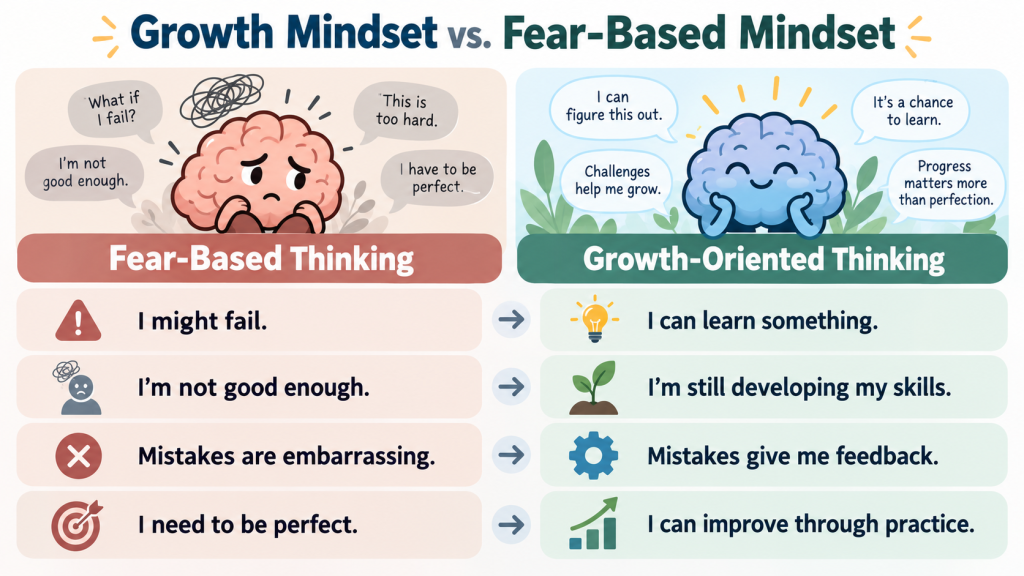
A disappointing result hurts more when you’ve tied it to your identity. Instead of thinking, “That presentation went poorly,” you might conclude, “I’m terrible at my job.” One event becomes a verdict.
Past criticism may contribute. Growing up with pressure to achieve can make an ordinary setback feel like losing approval. Fear can also be reasonable when money, health, or others are involved.
Separate events from their meaning and your self-judgment. Only the first is established fact. Examine the other two before accepting them.
Identify the Specific Outcome You’re Afraid Of
“I’m afraid to fail” is difficult to address because it’s vague. Name the feared outcome: rejection, wasted savings, disappointment, or embarrassment.
What follows realistically? Is it temporary? Who could help?
Pitching a freelance client might end in a polite no. Losing a major investment carries different consequences. Treating both as equally dangerous makes decisions harder. Match your response to the actual stakes, not just the intensity of your feelings.

Challenge Worst-Case Predictions
An anxious prediction can sound certain even when it isn’t. Ask: “If I request feedback, will my manager think I’m incompetent?” Check evidence for and against it.
Consider three outcomes: the best case, the worst plausible case, and the most likely case. Don’t insist nothing bad can happen. Ask what you could do if the difficult outcome occurred.
Doubt may remain, but the prediction becomes testable. Check afterward how closely your expectation matched reality.
Loosen Perfectionism Without Lowering Important Standards
Perfectionism can disguise itself as responsibility. Meeting a standard differs from endlessly polishing to avoid criticism.
Define “good enough” before starting. A tax return needs accuracy; an early creative sketch doesn’t need flawless execution. Set a reasonable review limit where the stakes allow it.
Share a solid draft without fixing every detail. Keep high standards where safety and accuracy require them, but don’t make perfection the entry fee for learning. The goal is responsible progress, not careless work.
Practice Small Risks Before Bigger Ones
Confidence can develop through manageable experience. Choose an uncomfortable but safe action: ask a question in a meeting, show a rough sketch, or attend a beginner class.
Repeat it, gradually increasing difficulty. For example, share one piece of work privately before presenting to a group. Notice what you actually learn from each attempt.
Avoid turning practice into recklessness. Financial, medical, and personal safety decisions deserve appropriate preparation. Approach worthwhile challenges steadily without ignoring danger. Small steps should still serve something you genuinely value.
Set Process Goals You Can Control
You can prepare for an interview, but you cannot guarantee an offer. Process goals center on the steps and behaviors you can directly control.
Replace “Get hired this month” with “Send three tailored applications and practice two interview answers each week.” Track actions and lessons.
These measures reveal progress and help you adjust without declaring defeat. Record completed actions even when the result hasn’t arrived yet. Choose a manageable number of commitments: consistent work beats an ambitious checklist you rarely complete.

Make a Recovery Plan for Setbacks
A setback feels less overwhelming with a response plan. Decide what you’ll do if an attempt goes poorly.
Allow disappointment, then record what happened, what you controlled, and one adjustment worth testing. For a simple structure, use a self-reflection routine that ends with a practical next step.
Decide when to retry, revise, or stop. Persistence isn’t always wise. Sometimes the lesson is to choose another approach rather than repeat an expensive mistake.
Learn to Handle Feedback Without Self-Attack
Criticism hurts when comments feel like judgments of character. Separate judgments about the work from judgments about your worth.
Ask for specific feedback: “Which part was unclear?” or “What would strengthen the opening?” Details suggest next steps, even when poorly delivered.
You don’t have to accept every opinion. Consider the person’s expertise, their evidence, and your objective. Keep what improves the work; leave insults behind. If criticism repeatedly triggers intense shame, seek support with that pattern.
Interrupt Avoidance and Begin Before You Feel Ready
Waiting to feel completely confident can become waiting forever. Choose a clear first action.
Instead of “Start my business,” choose “Describe my service in a rough draft for ten minutes.” Open the document, start the timer, and allow imperfection.
If stuck, identify whether the task is oversized, unclear, or emotionally threatening. Solve practical problems where possible, then allow manageable discomfort. You can start while feeling nervous; confidence needn’t come first.
Know When Fear Requires More Support
Self-help has limits when fear seriously affects your life. Consider a qualified mental health professional if avoidance disrupts work, relationships, sleep, or basic routines.
Support also helps with panic, persistent anxiety, or severe self-criticism. Therapy can identify patterns and offer an individualized approach.
If a situation involves abuse, danger, or genuine financial risk, prioritize safety and informed decisions. Being brave doesn’t mean forcing yourself into harmful circumstances. There is a difference between discomfort worth facing and risk worth avoiding.
Recommended Products for Working Through Fear Of Failure
Books and journals can provide structure, but no purchase is necessary. Pick a tool that matches the obstacle you’re facing rather than collecting resources you won’t use.
The Confidence Gap: A Guide to Overcoming Fear and Self-Doubt
Best for: People who want to act despite self-doubt.
Russ Harris uses an acceptance-and-commitment approach to explore how uncomfortable thoughts can coexist with meaningful action. It’s useful if you’re waiting to feel confident before speaking up or trying something unfamiliar. Expect reflective ideas and exercises rather than instant reassurance; readers wanting a simple daily checklist may prefer a journal.
The CBT Workbook for Perfectionism: Evidence-Based Skills to Help You Let Go of Self-Criticism, Build Self-Esteem, and Find Balance
Best for: People whose high standards lead to avoidance.
This workbook offers structured cognitive-behavioral exercises for examining rigid expectations and self-critical thinking. It suits readers who prefer written practice over broad inspirational advice. Working through the prompts takes patience, and a workbook cannot replace individualized treatment when perfectionism is causing serious distress.
Feel the Fear . . . and Do It Anyway
Best for: Readers seeking an accessible introduction to facing uncertainty.
Susan Jeffers explores how to take steps even when a decision feels intimidating. Its conversational approach may appeal to readers who want encouragement alongside practical reframing. Some ideas are broad rather than tailored to a particular challenge, so pair the reading with a realistic plan for your own circumstances.
The 5 Second Rule: Transform your Life, Work, and Confidence with Everyday Courage
Best for: People stuck at the moment of starting.
Mel Robbins presents a countdown technique intended to interrupt hesitation and prompt immediate action. It may help with small tasks such as starting a draft or making a routine phone call. It isn’t a substitute for planning decisions with serious consequences, and its motivational style may not suit everyone.
Intelligent Change The Five Minute Journal – Original Daily Gratitude Journal for Women & Men – Mindfulness, Happiness & Daily Reflection – Undated Planner – Affirmation Journal – Gifts for Women
Best for: Busy readers who want brief, guided reflection.
This undated journal uses short morning and evening prompts for gratitude, intentions, and reviewing the day. It offers a simple place to record small attempts and notice constructive moments after disappointment. However, its prompts aren’t designed specifically for fear of failure, and the limited space won’t suit detailed problem-solving.
What Research Says About Fear Of Failure and Avoidance
A 2024 study of 292 university students found links among fear of failure, difficulties regulating emotions, procrastination, and academic satisfaction. The design identifies associations and possible pathways, not proof that fear causes the same outcomes for everyone.
A 2018 systematic review of psychological treatments for procrastination combined 12 studies with 718 participants and found a small overall benefit. Cognitive behavioral therapy showed promising results in a smaller subgroup, although the authors warned about study quality and variation. These studies examined procrastination, not a guaranteed treatment for every person who fears failure.
For practical guidance, the NHS recommends gradually facing manageable fears rather than relying on avoidance. These findings support trying realistic actions and questioning unhelpful predictions. They do not establish a universal cure for fear of failure or prove that any self-help book works for every reader.
Frequently Asked Questions About Fear Of Failure
Is fear of failure the same as being afraid of success?
No. Failure fears concern rejection or loss. Success fears may involve increased expectations, visibility, or change. They can overlap, especially when change feels threatening regardless of the outcome. Write down what you expect would happen after success and after failure. Compare those concerns before choosing how to respond.
Can fear of failure cause procrastination?
Yes, it can contribute to procrastination when delaying a task offers short-term relief from the possibility of doing badly. Other causes include unclear priorities, fatigue, and practical barriers. Ask whether you fear judgment or need a clearer plan. The response will differ.
How do I overcome fear of failure at work?
Try requesting feedback or offering a prepared idea in a meeting. Define the standard the work needs to meet and avoid endless revisions beyond that point. Keep necessary checks for clients, compliance, and safety. Courage at work should improve judgment, not replace it.
How long does it take to become less afraid of failing?
There is no single timeline that works the same way for everyone. Progress depends on experience, distress, and practice. Notice whether you’re submitting work sooner, taking opportunities more often, or recovering faster after criticism. Some fears lessen gradually while others require additional support. If fear remains disabling, professional help may offer more targeted strategies.
Should I keep trying after repeated failures?
Not automatically. Review lessons, improvements, and the cost of continuing. Setbacks may require practice, feedback, a new strategy, or stopping. Choosing to stop can be sensible when the risks outweigh the benefits. Learning from failure also means knowing when to change direction.
Conclusion: Take Action Without Needing Certainty
Overcoming Fear Of Failure means making thoughtful decisions despite uncertainty. Identify the outcome you’re worried about, check the evidence behind your predictions, and take a manageable first step. Set process goals, protect important standards, and prepare a reasonable response if things don’t go to plan.
If self-criticism is your biggest obstacle, Sharon Martin’s CBT workbook offers structured reflection. If hesitation keeps you from beginning, Mel Robbins’s approach may provide a practical starting cue. Neither replaces action or needed professional support.
Pick one important task that you have been putting off. Define the smallest responsible step, give it a time on your calendar, and judge the attempt by what you did and learned—not only by the result.