5 Tips To Improve Your Communication Skills

We may earn a commission for purchases made using our links. Please see our disclosure to learn more.
You know that moment when you meant to sound calm… but somehow you came out sharp? Or when you walk away from a conversation thinking, “Why didn’t I say it like that?” Yep. That’s exactly why Communication Skills matter—because life is basically one long group project with feelings.
In this guide, you’ll learn practical, real-life ways to communicate more clearly, listen better, handle conflict without spiraling, and feel more confident whether you’re talking to a partner, a coworker, a friend, or a stranger who just cut you in line.
Affiliate disclaimer: If you buy through product recommendations, I may earn a small commission at no extra cost to you.
Communication Skills: what they really are (and what they’re not)
Let’s clear up a myth: Communication Skills aren’t about being “smooth” or sounding like a motivational speaker.
They’re about:
- Clarity (saying what you mean)
- Connection (making the other person feel safe enough to hear you)
- Timing (knowing when to speak, pause, or step back)
- Repair (fixing things when it gets messy—because it will)
And no, you don’t need a perfect personality to communicate well. You just need a few solid habits you can practice.
A quick self-check
Ask yourself:
- Do people often misunderstand what I’m trying to say?
- Do I avoid hard conversations until they explode?
- Do I over-explain when I’m nervous?
If you said “yes” to any of these, you’re not broken. You’re human. Let’s build the skill.
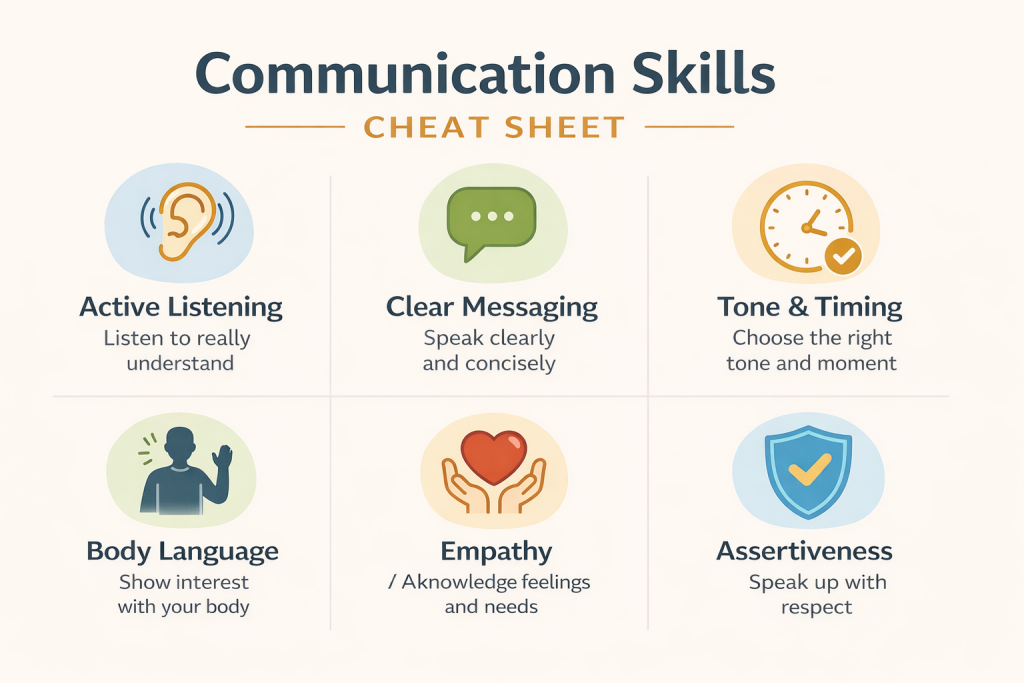
Tip #1: Listen like you’re trying to understand—not like you’re trying to win
Most people don’t listen. They just reload.
Real active listening sounds like:
- “Let me make sure I got you…”
- “So what I’m hearing is…”
- “That makes sense. Tell me more.”
And here’s the magic: when someone feels heard, they get less defensive. That alone can change the entire vibe of a conversation.
Try the “pause rule”
Before you respond, pause for one second.
It’s tiny, but it stops you from reacting on impulse (especially when your brain is yelling, “DEFEND YOURSELF IMMEDIATELY!”).
Tip #2: Use the “Say it in one sentence” clarity trick
If you can’t say it simply, it probably isn’t clear yet.
Try this formula:
“I feel ___ about ___, and I need/would like ___.”
Examples:
- “I feel overwhelmed about the house stuff, and I’d like us to split chores this week.”
- “I feel anxious about deadlines, and I need a clearer timeline.”
This is assertive communication without being aggressive. It’s also a fast way to reduce miscommunication in relationships and communication in the workplace.
The bonus move: remove extra blame
Instead of “You never…”
Try “I’ve been noticing…”
Same message. Way less fighting.

Tip #3: Manage tone like it’s part of the message (because it is)
Tone is the delivery truck. Your words are the package.
Even a great package shows up looking suspicious if the delivery truck is on fire.
If your tone is tense, rushed, sarcastic, or exhausted, people will react to that first.
Quick fixes:
- Slow down your pace (yes, even on Zoom)
- Drop your shoulders
- Speak 10% softer than your emotions want you to
And if you’re upset, you can literally say:
“I want to say this clearly, so I’m going to slow down.”
That’s emotional intelligence in action.
Tip #4: Nonverbal communication—read the room before you run the room
Nonverbal communication is everything you’re saying without speaking:
- facial expression
- eye contact (or lack of it)
- posture
- distance
- voice pitch
Two important truths:
- People notice your body language even when they pretend they don’t.
- Your body language affects your confidence, too.
A small reset that works anywhere
Put both feet on the ground.
Relax your jaw.
Unclench your hands.
You don’t need to look “dominant.” You just need to look present.
Side note: If you’ve heard the “7-38-55 rule,” it’s often oversimplified—Mehrabian’s research was about communicating feelings/attitudes in very specific situations, not a universal rule for all communication.
Tip #5: Build empathy without turning into a sponge
Empathy isn’t agreeing with everything. It’s understanding what’s happening in the other person.
Try:
- “That sounds frustrating.”
- “I can see why you’d feel that way.”
- “Help me understand what mattered most to you there.”
This does two things:
- It lowers defensiveness (theirs and yours)
- It keeps the conversation from turning into a courtroom drama
Empathy is also a learnable skill—communication training that includes empathy can improve measurable communication abilities, even though study quality varies.
Ask better questions (and watch your conversations level up fast)
Bad questions corner people. Good questions open doors.
Try these:
- “What would make this feel fair?”
- “What’s the main thing you want me to understand?”
- “What does a good outcome look like for you?”
The “curiosity pivot”
When you feel yourself getting defensive, pivot to curiosity:
“I might be missing something—can you walk me through your thinking?”
That one line can save relationships. Seriously.

Assertive communication: kind, clear, and not a doormat
Assertiveness is saying the truth without punishing people with it.
A simple structure:
- State the issue
- Name the impact
- Request a next step
Example:
“When meetings start late, I lose focus and I miss key details. Can we start on time or shorten the agenda?”
That’s boundaries. That’s professionalism. That’s Communication Skills paying rent.
And if you’re working on showing up more honestly in hard moments, pairing communication with personal responsibility helps a lot—this guide on taking accountability is a strong companion read.
Conflict resolution without “winning” (because winning can still cost you)
Conflict isn’t the enemy. Unspoken resentment is.
A helpful mindset:
- You’re not fighting each other.
- You’re fighting the problem—together.
Use the “shared goal” opener
Instead of: “We need to talk.”
Try: “I want us to feel closer after this conversation.”
That sets a totally different tone.
If you want a practical framework for high-stakes conversations, research-backed communication and dialogue skills are a big focus in Crucial Conversations.
How to give feedback without triggering a meltdown
Feedback lands best when it’s specific and forward-looking.
Try:
- “One thing that worked well was…”
- “One thing to improve next time is…”
- “Here’s what would help me moving forward…”
Avoid vague hits like “You’re unprofessional.”
That’s not feedback. That’s a punch in a sentence.
Receiving feedback (the underrated skill)
When someone gives you input, respond with:
“Thank you—can you give me an example so I can see it clearly?”
That keeps you in growth mode, not defense mode.
Written communication: texts, emails, and the curse of “Okay.”
Written communication has no tone, no facial expression, and no instant repair. So misunderstandings multiply.
Quick rules:
- If it’s emotional, don’t text it
- If it’s complex, call or meet
- If it’s sensitive, be extra clear
Instead of “Okay.”
Try:
- “Got it—thanks.”
- “Okay, I understand.”
- “Okay—can we talk about it later?”
Same word. Totally different feeling.
Communication Skills at work: the “clean update” method
If workplace communication stresses you out, use this simple update format:
1) What’s done
2) What’s next
3) Where I’m blocked
4) What I need from you
It makes you look organized and it prevents the dreaded “just checking in” email chain.
Cross-cultural communication: respect first, assumptions last
Different cultures (and even different families) have different communication norms:
- direct vs indirect speech
- high-context vs low-context cues
- what counts as “polite”
- how disagreement is expressed
The best approach isn’t walking on eggshells. It’s asking:
“What’s the best way to talk about this in your experience?”
That’s inclusive, emotionally aware communication—and it builds trust fast.
Product picks: 5 Amazon tools that build Communication Skills (without fluff)
If you want structured practice, these are popular, low-risk picks with clear use cases:
1) Crucial Conversations: Tools for Talking When Stakes Are High
Why it helps: Great for conflict resolution and tough conversations.
Key features: frameworks for dialogue, handling emotion, staying productive under pressure.
Best for: couples, managers, anyone who avoids hard talks until they explode.
2) How to Win Friends and Influence People (Dale Carnegie)
Why it helps: Classic interpersonal communication principles that still work.
Key features: practical human psychology, rapport building, relationship-friendly persuasion.
Best for: networking, leadership, social confidence, smoothing daily interactions.
3) Never Split the Difference (Chris Voss)
Why it helps: Teaches tactical empathy, active listening, and negotiation language you can use anywhere.
Key features: real negotiation tools, calibrated questions, handling “no.”
Best for: salary talks, sales, boundaries, high-stakes discussions.
4) Nonviolent Communication: A Language of Life (Marshall B. Rosenberg)
Why it helps: Builds empathy + clarity without blame.
Key features: needs-based language, conflict de-escalation, emotional awareness.
Best for: sensitive relationships, families, coaching, anyone who hates confrontation.
5) Talk Like TED (Carmine Gallo)
Why it helps: Practical structure for speaking with confidence and clarity.
Key features: storytelling techniques, presentation flow, audience connection.
Best for: public speaking, interviews, pitching ideas, leading meetings.
Research-backed proof
Here’s the encouraging part: communication isn’t a “personality thing.” It’s a trainable skill. A major meta-analysis on team communication and performance found that stronger communication is significantly linked to better results—especially when teams improve the quality (not just the amount) of communication. And a research review on communication skills training (including empathy) found these skills can be taught and improved in measurable ways, although outcomes depend on how the training is designed and delivered. In other words: you’re not “bad at communication.” You’re just under-trained.
FAQs (and a gentle push to practice)
How can I improve Communication Skills if I’m shy or introverted?
You don’t need to be loud—you need to be clear. Start with one habit: reflect back what you heard (“So you mean…”). That builds confidence without forcing you to perform.
What are the best Communication Skills for relationships?
Active listening, calm tone, and repair. The goal isn’t perfect conversations—it’s the ability to recover quickly after misunderstandings.
How do I communicate better during conflict?
Slow down, name the shared goal, and ask one clarifying question before you defend your point. Conflict becomes safer when both people feel heard.
How can I improve communication at work without sounding robotic?
Use the clean update format (done / next / blocked / need). It’s simple, human, and makes collaboration easier—especially across time zones and busy teams.
What’s the fastest way to practice Communication Skills daily?
Pick one “micro-skill” for a week: pause one second before replying, ask one better question, or summarize what you heard once per day. Tiny reps add up fast.
And here’s your pep talk: don’t wait until you feel “ready” to practice. Communication Skills grow the same way strength grows—through small, slightly awkward reps. One clearer sentence. One calmer pause. One brave, kind conversation at a time.