How To Let Go Of What No Longer Serves You

We may earn a commission for purchases made using our links. Please see our disclosure to learn more.
Some things do not leave your life loudly. They just sit there. A draining habit. A one-sided friendship. An old version of you that still wants a seat at the table.
That is why learning to Let Go Of What No Longer Serves You can feel so strange. You are not always dropping something dramatic. Sometimes you are simply noticing that what once fit now feels tight, heavy, or outgrown.
And that matters. Stress affects both the mind and body, and when it lingers, it can make it harder to think clearly, rest well, and feel like yourself again.
In this guide, you will learn how to recognize what is weighing you down, how to release it without turning the process into a guilt festival, and how to make space for more peace, stronger emotional boundaries, and real personal growth.
Affiliate note: This article includes product suggestions that may support your self-improvement routine.
Why letting go feels harder than it should
Letting go sounds simple in theory. In real life, not so much.
You do not just release the thing itself. You also release the meaning attached to it. That old job title may represent safety. That relationship may represent hope. That habit may feel like a tiny survival tool you built during a rough season.
So when you try to let go, your nervous system can act like you are throwing away oxygen instead of clutter.
That does not mean you are weak. It means you are human.
What no longer serves you actually looks like
Not everything harmful looks obviously harmful.
Sometimes what no longer serves you is:
- a routine that keeps you busy but never fulfilled
- a belief that says you must earn rest
- a friendship that leaves you smaller after every conversation
- people-pleasing dressed up as kindness
- perfectionism wearing a fake mustache and calling itself “high standards”
In self-improvement, this is often called emotional clutter. It is anything that keeps taking energy without giving wisdom, peace, or growth back.
Signs you are carrying emotional clutter
You do not need a dramatic breakdown to know something is off. Usually, the signs are quieter.
Maybe you keep replaying the same conversation. Maybe you feel resentful but cannot explain why. Maybe your calendar is full, yet your spirit feels underfed.
A few common signs:
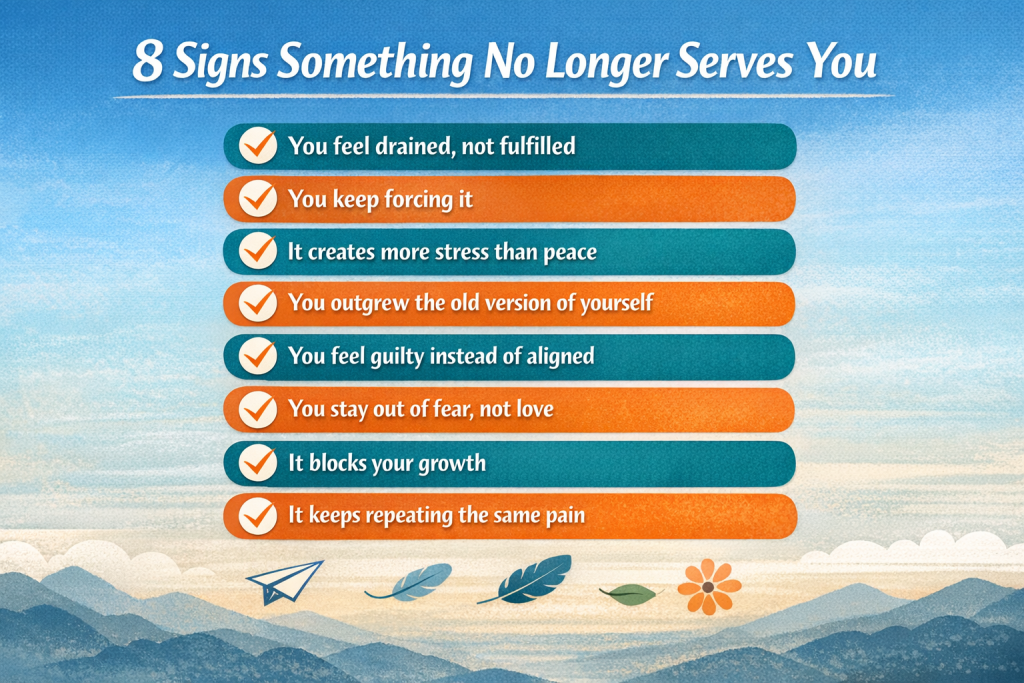
- you feel drained after things you used to enjoy
- you keep saying yes when your body is screaming no
- you are attached to a role that no longer feels true
- you feel stuck between who you were and who you are becoming
- you keep “managing” stress instead of actually reducing it
That tension is often your inner life asking for a reset.

The hidden cost of holding on
Holding on can feel safer than change. However, it comes with a price.
It steals mental peace. It crowds your decision-making. It can even make healthy opportunities feel suspicious because your hands are already full.
Think of it like trying to pour fresh water into a cup that still has stale coffee in it. You can keep adding good things, but until you empty the old stuff, everything tastes a little off.
When you Let Go Of What No Longer Serves You, you are not losing for the sake of losing. You are clearing space for something more honest.
Start with honesty, not shame
This part matters a lot.
You do not need to bully yourself into growth. You do not need a speech that sounds like an angry football coach living in your head. You just need honesty.
Try asking:
- What feels heavy right now?
- What am I maintaining out of fear?
- What am I tolerating because it is familiar?
- What would feel lighter if I trusted myself more?
Notice the tone of those questions. Curious. Gentle. Clear.
That is the energy that creates lasting mindset shifts. Shame might create a quick reaction. Self-awareness creates real change.
Separate your past from your identity
One of the hardest parts of healing is realizing that your past helped shape you, but it does not get final voting rights.
Maybe you were the fixer in your family. Maybe you got used to staying silent just to avoid conflict. Maybe being “the strong one” became your whole personality.
Those patterns may have protected you once. But protection and purpose are not always the same thing.
You are allowed to say, “That helped me survive, but it is not how I want to live now.”
That sentence alone can open a door.
Let go of habits that once helped but now hurt
Not all bad habits look reckless. Some look very responsible.
Overworking. Overexplaining. Overcommitting. Overthinking. Smiling when you want to cry. Saying “I’m fine” like it is a full-time job.
The tricky part is that these habits may have rewarded you before. They may have earned praise, safety, or approval. Still, if they now cost your peace, they no longer belong in the driver’s seat.
A helpful question is this: Is this habit helping me grow, or just helping me avoid discomfort?
That one stings a little. Which is usually a sign it is useful.

Reevaluate relationships, roles, and obligations
Not every relationship needs to end. But some definitely need a new address in your emotional house.
You can care about people and still need better emotional boundaries.
You can love your work and still outgrow a role.
You can be grateful for a season and still know it is over.
This is where many people get stuck. They think letting go must be dramatic. Often, it is quieter than that. It may mean fewer explanations, slower replies, more honest conversations, and less automatic self-sacrifice.
Healthy release does not always look like slamming a door. Sometimes it looks like gently closing one.
Stop rehearsing thoughts that keep you stuck
Some thoughts become so familiar that they feel factual.
“I am too late.”
“I always ruin good things.”
“If I disappoint people, I’m a bad person.”
“If I rest, I’m lazy.”
Those are not truths. They are repeated scripts.
When you Let Go Of What No Longer Serves You, you also need to let go of the stories that keep reinforcing old pain. That does not happen by pretending the thought never showed up. It happens by noticing it, naming it, and refusing to build a guest room for it.
Try this simple reframing practice:
- Old thought: “I failed, so I should stop.”
- New thought: “This did not work the way I hoped, but I can learn from it.”
That is not toxic positivity. That is emotional maturity.
Create a release ritual your body understands
Your mind likes insight. Your body likes ritual.
That is why small physical actions can help your healing journey feel real. You can write down what you are releasing and tear up the paper. Take a long walk without your phone. Clean out one drawer. Delete the number. Return the thing. Unfollow the account. Light a candle and say the hard truth out loud.
Simple rituals tell your brain, “We are not just thinking about change. We are practicing it.”
And yes, cleaning out one chaotic junk drawer absolutely counts as emotional symbolism. Your soul gets it.
Replace what you release with something better
Nature hates a vacuum, and so does your routine.
If you let go of a draining habit but do not replace it, stress will usually wander back in wearing different shoes.
So ask yourself what the new support looks like.
If you stop doom-scrolling, what helps you decompress instead?
If you stop people-pleasing, what sentence will help you set a boundary?
If you stop clinging to a painful story, what truth do you want to practice next?
Sometimes the replacement is a better question. Sometimes it is rest. Sometimes it is journaling. Sometimes it is something tactile and grounding.
If your body needs help calming down while your mind catches up, these stress-relief toys for everyday tension can be a simple place to start.
5 Tools that support the letting-go process
These are not magic fixes. However, they can make reflection, stress relief, and emotional release easier to practice consistently.
1. Intelligent Change The Five Minute Journal
A simple guided journal built around daily gratitude, mindfulness, happiness, and reflection in an undated format.
Features: quick prompts, low-pressure format, easy to keep beside your bed.
Who it’s for: anyone who wants a gentle daily ritual without writing three pages before coffee.
2. Pinch Me Therapy Dough – Holistic Aromatherapy Stress Relieving Putty – 10 Ounce Spa Scent
A tactile stress-relief tool that combines kneading with scent, which can be helpful when you need to regulate before you reflect.
Features: soft pliable putty, calming aromatherapy, hand exercise, sensory focus.
Who it’s for: people who process stress better through movement and touch than through sitting still.
3. QUOKKA Rethink 95 Positive Affirmation Cards for Mindfulness
A sturdy deck designed for mindfulness, self-reflection, and everyday encouragement.
Features: 95 cards, durable card set, useful for journaling, reflection, and routine-building.
Who it’s for: anyone trying to replace harsh self-talk with healthier inner language.
4. BEST 100 Mindful Prompts for Self Care & Stress Relief
A reflective card deck with day-and-night prompts that blends challenges, quotes, and questions.
Features: 50 double-sided cards, 6 categories, morning and evening use, portable format.
Who it’s for: readers who want structure and variety without staring at a blank journal page.
5. The DBT Skills Planner for Adults: A Guided Journal for Emotional Regulation, Mindfulness, and Daily Coping Skills
A guided planner built around emotional regulation and practical coping tools.
Features: DBT-inspired prompts, self-reflection structure, mindfulness focus, daily coping support.
Who it’s for: people who want a more skills-based approach to letting go of toxic patterns and building emotional resilience.
What research says about acceptance and emotional release
This idea is bigger than “just move on.”
One influential 2017 study found that people who more readily accepted their negative emotions tended to have better psychological health over time. In other words, fighting every painful feeling may backfire, while making room for it can reduce the extra suffering layered on top. That is why accepting negative emotions can support psychological health is such an important part of learning to let go.
A 2018 review on mindfulness, acceptance, and emotion regulation reached a similar conclusion: acceptance can function as a core emotion regulation skill, helping people relate to difficult inner experiences with less avoidance and reactivity. So when you pause, breathe, and name what is true, you are not being passive. You are practicing a skill backed by research on mindfulness, acceptance, and emotion regulation.
The big takeaway is simple: emotional release is not denial. It is honest acknowledgment without lifelong attachment.
A simple 7-day practice to begin now
You do not need a dramatic reinvention. You need a starting point.
Day 1: Write down one thing you are tired of carrying.
Day 2: Notice where it shows up in your body.
Day 3: Name the fear attached to releasing it.
Day 4: Set one small boundary.
Day 5: Remove one physical or digital reminder.
Day 6: Replace the old pattern with one supportive action.
Day 7: Reflect on what already feels lighter.
That is it. Small moves count.
The truth is, self-improvement is rarely one giant heroic leap. It is usually a series of brave little edits.
FAQs about letting go
How do I know when it is time to let go of something?
If it keeps draining your energy, shrinking your self-respect, or blocking your growth, it is probably time to reevaluate it. Repeated heaviness is information.
Can I let go of someone and still love them?
Yes. Letting go does not always mean you stop caring. It can mean you stop abandoning yourself to keep the connection.
Why does letting go feel like grief?
Because it often is. You are not only releasing what happened. You may also be grieving what you hoped would happen.
What if I keep going back to the same old pattern?
That is normal. Patterns built over years do not vanish in one brave Tuesday afternoon. Notice it, reset gently, and practice again.
Does choosing to let go mean you’ve given up?
No. Giving up comes from hopelessness. Letting go comes from clarity. One keeps you small. The other helps you move forward.