
Self-Reflection Questions That Lead To Real Growth

We may earn a commission for purchases made using our links. Please see our disclosure to learn more.
Have you ever ended a busy week feeling exhausted but unsure what actually changed? You might know something needs attention without knowing where to begin. Self-Reflection Questions help turn that vague feeling into observations you can use: what mattered, what drained you, and what deserves a different approach.
Useful reflection isn’t an interrogation or a hunt for everything you’ve done wrong. It’s a way to notice patterns, question assumptions, and decide what to do next. You don’t need perfect answers, an elaborate journal, or an uninterrupted hour. A few thoughtful minutes can be enough to uncover a useful next step. This guide offers practical prompts for your emotions, relationships, habits, and goals, plus a simple routine for turning insight into change.
Why Self-Reflection Matters for Personal Growth
Self-reflection means deliberately examining your experiences, responses, and choices. After an awkward conversation, ask, “What could I communicate more clearly next time?” That shifts judgment toward learning.
Compare what you intended with what happened. Sometimes change your behavior; other times adjust an unrealistic expectation. Your first interpretation may be incomplete, so treat it as a hypothesis rather than a verdict.
How to Answer Self-Reflection Questions Honestly
Choose one or two questions that relate to something happening now. Describe a specific situation before interpreting it: “I postponed the conversation twice” is more informative than “I’m terrible at communication.” Next, identify what you were feeling, what you wanted, and how you responded.
Write freely, but don’t confuse honesty with cruelty. Replace “lazy” with “I avoided starting because I didn’t know the first step.” Skip questions that feel too personal.
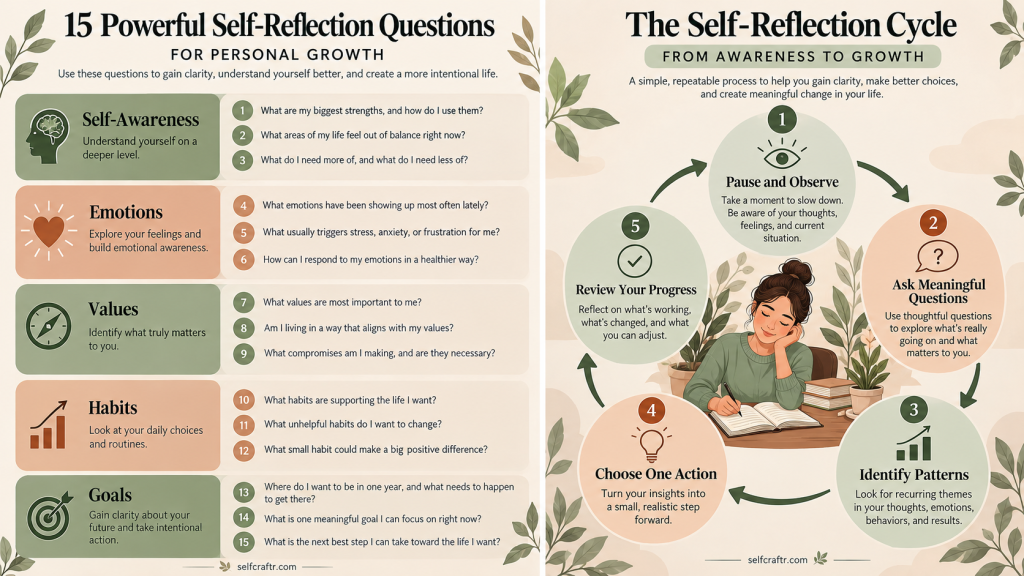
Self-Reflection Questions to Discover Your Values
Values are qualities you want to express through your choices. Moments when you felt proud, conflicted, or energized offer clues.
- When did I feel most like myself this month?
- Which commitment matters to me even when nobody notices?
- What have I said yes to that conflicts with my priorities?
- Whose approval am I trying to earn, and at what cost?
Choose one value, such as fairness, curiosity, or family, and identify a decision this week that could reflect it more clearly.
Questions to Understand Emotions and Triggers
Emotions offer information, not necessarily accurate explanations. Feeling rejected doesn’t prove rejection was intended. Separate the event, your interpretation, and your reaction.
Ask yourself: “What happened immediately before my mood changed?” “What story did I tell myself about it?” “What did I need in that moment?” and “What other explanation might fit?”
Look for recurring situations. If reflection becomes overwhelming, stop, ground yourself, and seek support instead of pushing through.
Questions That Challenge Limiting Beliefs
A limiting belief is a fixed conclusion, such as “I’m not creative.” Past disappointments do not make it universally true. Test it against evidence, not forced optimism.
Try asking, “Where did I learn this belief?” “When has it been less true?” and “What small experiment could test it?” Someone who believes they’re bad at public speaking might practice a short introduction with a trusted colleague. The result provides more useful information than another round of internal criticism. Aim for flexible beliefs, not permanently positive ones.
Questions to Spot Habits That Help or Hurt
Your schedule may reveal priorities more clearly than intentions. Examine which routines help and which create friction. Consider interruptions and preparation before blaming discipline.
Ask, “Which part of my day consistently goes well?” “What usually happens just before I procrastinate?” “Which task consumes energy without adding much value?” and “What could I make easier?”
Choose one change small enough to repeat, such as setting out materials the night before. Review whether the change actually helped before adding another habit.
Questions for Learning From Mistakes Without Shame
Separate your decision from your identity. “I missed a deadline” names a problem; “I’m unreliable” turns it into a permanent label. Examine the conditions behind it.
Ask, “What did I know at the time?” “Which warning sign did I overlook?” “What was outside my control?” and “What would I repeat or change?”
Make the lesson concrete. If an estimate was unrealistic, add a buffer or ask for clarification earlier. Accountability means repairing what you can and improving the process, not repeatedly punishing yourself.

Questions to Improve Relationships and Boundaries
Relationships reveal patterns: avoiding disagreement, expecting mind-reading, or giving too much. Recognize your part without assuming responsibility for others’ choices.
Consider, “When did I feel understood?” “Which conversation am I avoiding?” “Did I clearly express my needs?” and “Where did I agree out of guilt rather than willingness?”
A useful follow-up is one respectful sentence you could actually say: “I can help on Friday, but I can’t take this on today.” Boundaries become meaningful through communication and follow-through, not private insight alone.
Questions to Clarify Goals and Priorities
A meaningful goal connects to your values and leads to controllable action. Separate your desired outcome from the behaviors that move you toward it.
Ask, “What would make the next three months worthwhile?” “Why does this goal matter now?” “What am I willing to stop doing?” and “What would progress look like next week?”
If your answer is “be healthier,” choose a specific behavior to try rather than treating the phrase as a complete plan. For help making goals measurable and adaptable, use our guide to smarter goals that adapt with you.
Questions for Difficult Decisions and Life Changes
Big decisions rarely offer certainty. Reflection clarifies trade-offs without predicting the future. Write down your options, assumptions, and controllable consequences.
Ask, “What am I afraid will happen?” “What would I choose if I weren’t trying to impress anyone?” “Which option best fits my current responsibilities?” and “What information am I missing?”
Distinguish a reversible experiment from a high-stakes commitment. You might try a course before changing careers. When choices affect safety, health, or finances, pair reflection with qualified advice and reliable information.
Build a Weekly Self-Reflection Routine That Leads to Action
Spend ten minutes each week noting one success, one challenge, and one pattern. Then ask, “What will I do differently?”
Turn the answer into a manageable action with a time and place. Instead of “be more assertive,” write “On Monday, I’ll ask my manager which project takes priority.” Check the result the following week, without grading your entire personality. Record what worked, too.
What Research Reveals About Reflection and Behavior Change
Research supports some specific reflection practices, but not the claim that any journaling prompt transforms your life. In a working paper on learning through reflection, Di Stefano and colleagues reported experiments in which reflecting on experience could improve subsequent task performance. These findings concern learning settings, not every form of personal journaling.
A 2016 meta-analysis of progress monitoring examined 138 studies involving 19,951 participants and found that interventions increasing progress monitoring also improved goal attainment on average. That supports recording actions and results, rather than relying on insight alone.
Researchers have also distinguished reflection from rumination: thoughtful examination is not the same as repeatedly circling distressing thoughts. Use questions that lead toward understanding and choices; pause when writing only intensifies distress.
Recommended Journals for Self-Reflection Questions
A guided journal can reduce the effort of choosing a prompt. The best option depends on whether you want quick check-ins, deeper exploration, or a structured link between reflection and goals. None is essential; a plain notebook works, too.
Intelligent Change The Five Minute Journal
Best for: Beginners who want short daily check-ins
Its undated format combines morning gratitude and intention prompts with evening reflections, making it approachable when writing feels intimidating. The structured pages encourage consistency without demanding long entries, and the weekly challenges add variety. However, the emphasis on gratitude may feel too narrow if you want to examine difficult relationships or complex decisions in depth.
BestSelf Self Journal – Undated 13-Week Goal Planner (Grey Mist)
Best for: Turning reflection into measurable goals
This 13-week planner connects goal-setting with daily planning, habit tracking, and weekly reviews. Its undated pages suit readers who want to evaluate whether their actions match their priorities and revise the plan. The trade-off is structure: time-blocking and regular tracking may feel excessive if you mainly want a private space to explore emotions.
The Daily Stoic Journal: 366 Days of Writing and Reflection on the Art of Living
Best for: Readers interested in practical philosophy
Ryan Holiday and Stephen Hanselman’s guided journal uses daily writing prompts and weekly Stoic themes to examine judgment, responsibility, and what lies within your control. It offers a clear focus for readers who prefer philosophical questions over open-ended diary writing. Its approach is deliberately Stoic, so it may not suit someone seeking a broad range of contemporary psychological exercises.
Burn After Writing by Sharon Jones
Best for: Candid, private self-exploration
This prompt-led journal invites readers to confront personal memories, opinions, and feelings they might avoid in ordinary conversation. Its direct questions can appeal to people who want deeper honesty rather than a productivity system. Some prompts may stir discomfort, and the title is not an instruction to burn the book; protecting your privacy matters more than performing a ritual.
The 52 Lists Project: A Year of Weekly Journaling Inspiration by Moorea Seal
Best for: List lovers who dislike daily journaling
This undated journal offers a different list-making theme each week, with room to explore interests, memories, and hopes. Its seasonal format supports lighter, creative reflection without requiring long narratives or daily entries. The main limitation is pace: weekly lists may be too infrequent for someone seeking detailed mood tracking or day-by-day accountability.

Frequently Asked Questions About Self-Reflection Questions
How frequently should I use self-reflection questions?
Start with a frequency you can maintain, such as five minutes twice a week or a longer check-in every Sunday. Daily writing can help you capture details, while weekly reflection may make patterns easier to spot. Consistency matters more than an arbitrary streak. If it feels burdensome, shorten it.
What should I write if I don’t know how I feel?
Begin with observable facts rather than searching for the perfect emotion word. Explain what happened, note any physical sensations you noticed, and identify what you felt like doing afterward. “I went quiet when the meeting changed direction” is a useful start. Return later without forcing an explanation.
Can self-reflection questions help with overthinking?
They may help when you move from repetitive worry toward a specific observation or decision. Set a brief time limit and finish with “What is one useful next step?” If you keep returning to the same distressing thoughts without gaining clarity, take a break. Persistent rumination or significant distress may call for support beyond journaling.
Is handwritten journaling better than digital journaling?
Choose the method that makes honest reflection convenient and private. Paper avoids notifications; digital notes are searchable. Neither format automatically produces better answers. If privacy matters, consider where your entries are stored, who can access them, and whether you can comfortably revisit them later.
What if my answers never seem to change?
Repeated answers can mean you’re facing a persistent situation, using questions that are too broad, or noticing a pattern before you’re ready to act. Compare examples across entries. Try changing one behavior, requesting feedback, or asking a more specific question. If the issue remains painful, additional support may be appropriate.
Conclusion: Turn Self-Reflection Into Real Growth
The most useful Self-Reflection Questions help you notice what happened, understand what mattered, and choose a realistic response. Start with a current concern rather than trying to examine your entire life at once. Separate facts from assumptions, acknowledge your strengths, and look for patterns across several experiences.
If you prefer gentle daily guidance, The Five Minute Journal offers a simple entry point. If your main challenge is following through on priorities, the BestSelf Self Journal connects reflection with a shorter goal cycle. Neither replaces honest thinking or action.
Pick one question this week, write a specific answer, and finish with one change you can test. The next reflection should evaluate that experiment, not start the same conversation from scratch.