
How To Get Your Life Together Without Getting Overwhelmed

We may earn a commission for purchases made using our links. Please see our disclosure to learn more.
If you’ve been thinking, “I really need to Get Your Life Together,” you’re not lazy or broken. You’re probably carrying too much, for too long, with too few systems.
I’ve had seasons where my “plan” was basically vibes… and my to-do list looked like a horror movie. So let’s make this simple and kind: you’re going to build momentum with small moves that actually fit your real life (work, kids, school, mental health days, all of it).
By the end of this, you’ll have a step-by-step reset: what to do first, what to ignore for now, and how to keep going without burning out.
Affiliate disclaimer: This article contains affiliate links in the product section, which may earn a small commission at no extra cost to you.
What “Get Your Life Together” Really Means (And What It Doesn’t)
Let’s define the goal before you chase it.
Getting your life together doesn’t mean:
- Becoming a perfectly scheduled robot
- Fixing everything in one weekend
- Never feeling anxious, messy, or behind again
Getting your life together does mean:
- You can find your keys (most days)
- Your bills and basic tasks aren’t constantly ambushing you
- You have a few routines that keep you steady when life gets loud
- You trust yourself again because you do what you say you’ll do—small and often
Think of it like tidying a room, not rebuilding the house. You’re not reinventing yourself. You’re creating a floor you can stand on.
The 10-Minute Reset: Your “Start Here” Button
When you feel overwhelmed, your brain begs for a huge fix. That’s a trap. Start tiny.
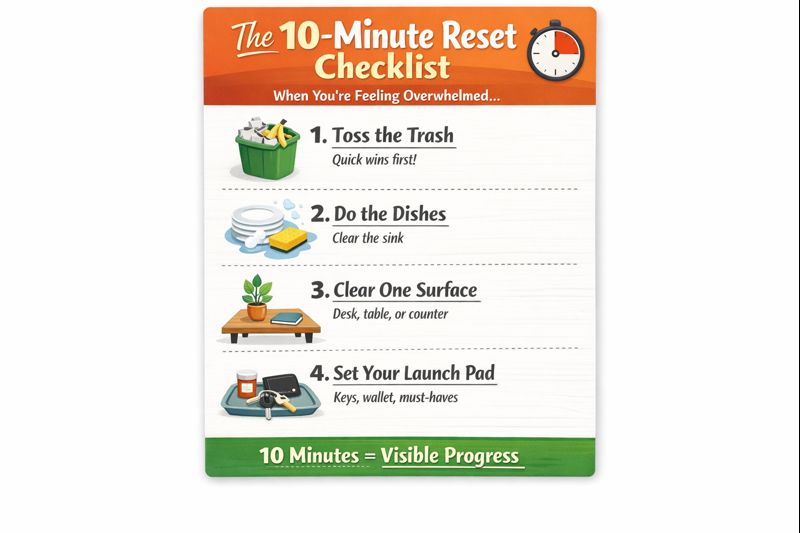
Set a timer for 10 minutes and do this:
- Trash + dishes (fast wins)
- One surface (desk, table, counter)
- One “launch pad” spot (where essentials live: keys, wallet, meds)
Why this works
Because your nervous system needs proof that change is possible. Ten minutes is short enough to feel safe, and big enough to create visible progress.
If you can’t do ten, do two. Seriously. Two minutes still counts.
Pick One Anchor Habit That Makes Life Easier
An anchor habit is one small habit that “pulls” other good habits behind it—like a little tugboat.
Choose one based on what’s making you feel most out of control:
- If mornings are chaos: prep your bag + outfit at night
- If your home feels messy: 5-minute nightly reset (trash + dishes)
- If your brain feels loud: 3-minute brain dump + pick top 1 priority
- If money stress is constant: weekly 15-minute money check-in
The secret: make it ridiculously easy
You’re not proving discipline. You’re building a groove.

The 2-Minute Rule for Momentum (When You Feel Behind)
When you’re trying to Get Your Life Together, motivation will ghost you. So we use a trick: start with a 2-minute version.
Examples:
- “Exercise” → put on shoes + stretch 2 minutes
- “Clean kitchen” → wash 5 items
- “Budget” → open banking app and look (no judging)
- “Work on goals” → write one sentence
Two minutes is the doorway. Once you’re moving, continuing is easier.
And if you stop at two? You still kept a promise to yourself. That’s not small. That’s trust-building.
A Gentle Life Audit (5 Areas That Actually Matter)
You don’t need a dramatic life overhaul. You need clarity.
Grab a note and rate these from 1–10 (no shame, just data):
- Health (sleep, stress, energy)
- Home (clutter, chores, comfort)
- Money (bills, spending, savings)
- Time (schedule, boundaries, focus)
- Meaning (purpose, creativity, faith, connection—whatever that is for you)
Now circle the lowest number and ask:
“What would make this just 1 point better this week?”
Not ten points. One. That’s how you get traction without spiraling.
A Simple Daily Routine That Holds You (Morning + Night)
Routines aren’t there to control you. They’re there to carry you when you’re tired.
A “real human” morning routine (10–20 minutes)
- Drink water (or anything hydrating)
- Quick wash / brush / clothes
- Look at your day and pick Top 1
- One tiny reset: bed made or counter cleared or bag packed
A “future-you” night routine (10 minutes)
- Set out essentials (keys, wallet, meds)
- Quick tidy of one hotspot
- Plug in phone away from bed (if possible)
- Write: “Tomorrow’s Top 1”
If you only do one part, do the night routine. Waking up to a calmer start is basically a cheat code.
If-Then Planning: The Follow-Through Hack
Most people don’t fail because they’re weak. They fail because they didn’t decide what to do when life gets messy.
That’s where If-Then planning helps:
- If I get home exhausted, then I’ll do a 5-minute reset before I sit
- If I miss a workout, then I’ll walk 10 minutes after lunch
- If I start scrolling, then I’ll set a 5-minute timer and stop after
It’s like writing your brain a backup plan.
And yes—this is especially helpful if you have ADHD, anxiety, depression, chronic fatigue, or just… a life.
Declutter the 5 Hotspots That Cause the Most Stress
You don’t need to “declutter your whole house.” Start where stress actually lives.
Hit these five hotspots first:
- Entryway / where you drop stuff
- Kitchen counter
- Bathroom sink area
- Your bed or bedside table
- The “doom chair” (you know the one)
The quick method
- Make 3 piles: Trash / Put away / Not sure
- Only “Not sure” gets a box. Label it. Set a review date.
Decluttering is not a personality test. It’s just reducing friction.

Money + Time: A Calm Weekly Plan (That Doesn’t Hate You)
Money and time are the two levers that make life feel stable. You don’t need perfection—just visibility.
The weekly 15-minute check-in
Pick one day (Sunday, payday, Wednesday—whatever works). Then:
- Check account balances
- Pay the next urgent bill
- Choose one “no-spend” day
- Look at your calendar and protect 1–2 focus blocks
A simple budgeting frame (no fancy spreadsheets)
Try this baseline:
- Needs (bills, food, transport)
- Future you (savings, debt payoff—even tiny)
- Life (fun, treats, hobbies—yes, include this)
If your budget never includes joy, it won’t last.
Mind + Body Basics: Sleep, Stress, Movement, Food
This is the boring section that changes everything.
If you want to Get Your Life Together, your brain needs fuel and recovery. Not “wellness perfection.” Just basics.
Sleep (start with one upgrade)
- Same wake time most days
- Dim lights earlier
- Phone a little farther away
- One calming cue (shower, tea, audiobook)
Stress (one nervous-system reset)
Try one:
- 4-7-8 breathing
- 5-minute walk
- Stretch your shoulders + jaw
- Put one hand on your chest and slow down your exhale
Movement + food (keep it practical)
- Add protein + fiber to one meal
- Walk while you take a call
- Do 10 squats while coffee brews
- Keep one “easy meal” stocked
Your goal is not a new identity overnight. Your goal is stability.
Also: APA’s Stress in America reporting shows a lot of adults rate their stress very high (top-range scores), which is a good reminder that you’re not “behind”—you’re human.
Relationships + Support: Boundaries, Honest Help, and Repair
A life reset is harder when you’re trying to do it alone and keep everyone happy.
Let’s normalize two things:
1) The “Kind No”
A boundary can be warm and firm:
- “I can’t do that this week, but I can next month.”
- “I’m not available after 8pm.”
- “I can help for 20 minutes, then I need to rest.”
2) Asking for help without the guilt spiral
Try:
- “Can you sit with me while I start?”
- “Can you take one task off my plate today?”
- “I’m overwhelmed—can we make a plan together?”
Also, if you’ve been snappy or distant because you’re stressed, repair matters:
- “I’m sorry I was short. I’m overloaded. I care about you.”
That’s getting your life together too.
When You Feel Stuck: Reflection Tools (Including Tarot) for Clarity
Sometimes you’re not lazy—you’re unclear. Your brain can’t move because it doesn’t trust the direction.
This is where reflection tools help: journaling, therapy prompts, prayer, meditation, even a good talk with a friend who tells the truth kindly.
And yes—tarot can be used as a personal development tool (less “predict my future,” more “help me see my patterns”). If you want a structured way to use it for goals and self-awareness, check out this guide: tarot readings for personal development goals.
A quick “stuck” prompt that works
Ask yourself:
- “What am I avoiding—and what am I afraid it means about me?”
- “What would I do if I trusted I could handle the outcome?”
- “What’s the next kind step?”
Kind steps keep you moving.
Product Section: 5 Tools That Support Your Reset
These are practical, low-friction tools that support routines, organization, and follow-through.
1) Clever Fox Planner (Weekly & Monthly)
Short description: A structured planner that helps you map weekly priorities and keep goals visible.
Features: goal sections, weekly + monthly layouts, durable cover.
Use cases: Great if you want one place for tasks, habits, and planning—especially if your brain feels “tab overload.”
2) Rocketbook Core / Everlast Reusable Smart Notebook
Short description: A reusable notebook that connects your notes to the cloud (goodbye, lost sticky notes).
Features: wipe-clean pages, app scanning, multiple page styles.
Use cases: Perfect for brain dumps, weekly reviews, or students/professionals who need notes without paper clutter.
3) Time Timer MOD (60-Minute Visual Timer)
Short description: A visual timer that makes time feel real (especially helpful when focus is slippery).
Features: silent operation option, clear visual countdown, simple controls.
Use cases: Ideal for Pomodoro sessions, chores, homework, “just start for 10 minutes,” and ADHD-friendly time blocking.
4) Brother P-touch PTD220 Label Maker (Amazon search page)
Short description: Labeling turns “where does this go?” into “oh, right here.”
Features: multiple fonts/symbols, tape options, fast printing.
Use cases: Great for pantry bins, cables/chargers, files, kids’ school supplies—anywhere clutter keeps respawning.
5) Atomic Habits by James Clear
Short description: A habit book that’s actually usable—built around identity, systems, and small wins.
Features: clear frameworks, practical examples, easy to apply.
Use cases: Best if you need motivation that doesn’t rely on willpower and want a plan for consistency.
Research-Backed Section: What Science Says (And Why This Feels Hard)
You asked for credibility, so here are two research-backed ideas that directly support the “Get Your Life Together” process.
1) Habits take longer than you think—and that’s normal
A well-known study on habit formation found that habits can take weeks to months to become automatic, and the timeline varies a lot by person and behavior. That’s a big deal because it means you’re not failing—you’re in the messy middle of learning.
How to use this: Stop waiting to “feel automatic.” Instead, aim for “I did it again today, even imperfectly.”
2) If-Then plans boost follow-through
A major meta-analysis on implementation intentions (the “If X happens, then I’ll do Y” method) found that making these plans meaningfully improves goal achievement across many studies.
How to use this: Write 1–3 If-Then plans for your hardest moments (tired, stressed, distracted). That’s where your system earns its pay.
FAQs: Get Your Life Together Questions
How do I get my life together when I feel depressed or burned out?
Go smaller. Pick one anchor habit (sleep routine, meds, one walk, one meal), and build from there. Progress comes from consistency, not intensity. Also, consider professional support if it’s available to you—you deserve help.
What’s the fastest way to get your life together in a week?
Do the basics that reduce daily friction: a 10-minute reset, one nightly routine, declutter one hotspot, and a 15-minute money/time check-in. The goal is fewer daily emergencies.
How do I get my life together with ADHD?
Use visible cues and short timers. Keep tasks tiny, reduce steps, and rely on external structure (visual timers, checklists, body-doubling). If-Then plans help a lot because they remove decision fatigue.
How do I stop procrastinating and actually follow through?
Make the first step embarrassingly easy (2 minutes). Then set a timer and stop negotiating with your brain. Follow-through is a system problem, not a character flaw.
How do I get my life together when my house is always messy?
Stop trying to clean the whole house. Focus on the five hotspots first, create a “not sure” box, and do a 5–10 minute reset daily. Mess often comes from too many decision points—reduce them.
Conclusion: A Realistic Promise to Yourself
You don’t need a brand-new personality to Get Your Life Together. You need a few small systems that keep life from constantly sliding into chaos.
Start with the 10-minute reset. Pick one anchor habit. Make it tiny. Add one calm weekly check-in. Protect your sleep and your focus. Ask for help. Repair when needed.
And if you fall off? You’re not back at zero. You’re practicing the most important skill of all: coming back.