
How Can You Cultivate Emotional Resilience?

We may earn a commission for purchases made using our links. Please see our disclosure to learn more.
A difficult conversation, sudden setback, or uncertain season can make your emotions feel larger than everything else. You may understand what happened yet still struggle to recover your focus, patience, or confidence. That is where Emotional Resilience matters. It does not erase pain or make every response calm. Instead, it helps you face pressure without abandoning yourself or acting against your values. This guide explains how resilience develops through awareness, body regulation, flexible thinking, supportive relationships, boundaries, and recovery habits. It also offers research-backed guidance and carefully selected tools. The goal is not to become unshakable, but to become better at returning to steadiness after life shakes you.
What Emotional Resilience Really Means
Emotional Resilience is the capacity to adapt and keep functioning when stress disrupts your balance. A resilient person still feels anger, grief, and fear. However, they can recognize the emotion, think clearly enough, and choose a useful response.
Think of resilience as bicycle suspension rather than armor. The bumps remain, but you absorb the impact and stay upright. Progress may mean apologizing sooner, asking for help earlier, or recovering faster.
Why Emotional Resilience Is Not Emotional Suppression
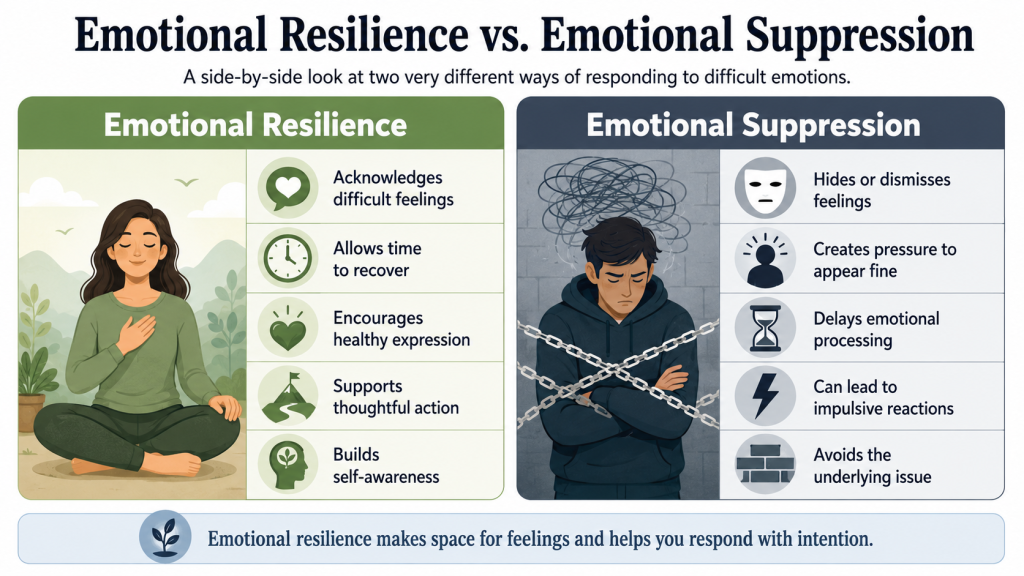
Suppression says, “This feeling is unacceptable.” Resilience says, “This feeling is here, and I can decide what to do with it.”
You need not express every emotion immediately. Sometimes the wiser choice is to pause and return later. The key is returning. Name what happened, notice what the emotion needs, and choose a responsible response. Emotional Resilience combines honest contact with discomfort and control over your actions.
Start by Naming What You Feel
Vague distress often feels larger than a specific emotion. “I feel terrible” offers little direction, while “I feel disappointed and worried” creates usable information.
Ask: What emotion is present? Where do I notice it physically? What triggered it? You may discover that irritation covers fatigue or anxiety comes from uncertainty rather than immediate danger. A rough label is enough. The goal is to respond to the feeling rather than an unnamed wave.

Regulate Your Body Before Solving the Problem
When your body is highly activated, a small problem can feel urgent and permanent. Before sending the message, lower the intensity slightly.
Lengthen your exhale for several comfortable breaths, unclench your jaw, place both feet down, or name five neutral objects. A brief walk may help. Next, inquire, “Am I stable enough to answer? Regulation establishes a buffer between emotion and behavior.
Reframe the Story Without Denying Reality
A setback contains facts and interpretation. The fact may be painful: your proposal was rejected. The interpretation may become sweeping: “I always fail.”
Write the facts, then list two other plausible interpretations. This widens a story that stress has narrowed. When thoughts keep circling without producing a decision, Selfcraftr’s guide to stop overthinking and clear your head offers a useful companion process. Finish with a believable thought: “This hurts, and I can request feedback.”
Build a Recovery Routine for Difficult Days
Do not wait until you feel overwhelmed to invent a coping plan. Create a short routine while you feel steady.
It might include eating, showering, stepping outside, postponing nonessential decisions, contacting someone, and preparing for sleep. Add one action that restores agency, such as clearing a surface. Treat this as a minimum viable day, not a productivity challenge. Emotional Resilience grows when distress repeatedly meets care and structure.
Strengthen Support Without Losing Independence
Resilience is not a solo sport. Supportive relationships provide perspective and the relief of being understood. Make requests specific: “Could you listen for ten minutes without offering solutions?”
Build a varied support map. One person may offer warmth, another practical advice, and another healthy distraction. Emotional Resilience includes receiving help while keeping responsibility for your choices. Connection should expand your capacity, not require someone else to manage every feeling.

Use Boundaries to Protect Your Capacity
A boundary explains what you will do to protect your capacity: “I will continue this conversation when we can speak without insults,” or “I cannot take on another project this week.”
Start with situations that leave you resentful or depleted. Decide what would make participation sustainable, then communicate it briefly. A boundary may feel rude when you are used to overextending. Yet saying no earlier can prevent a harsher reaction later and preserve thoughtful responses.
Practice Small, Chosen Discomfort
Confidence grows when you discover that discomfort is survivable. Choose low-risk challenges: ask a question, request clarification, or admit a small mistake promptly.
Predict what you fear will happen, then record what happened and how you coped. Severe distress, trauma triggers, and unsafe situations need different care. The aim is gradual practice, not flooding. Each manageable repetition offers evidence that discomfort can rise, pass, and leave you capable of choosing again.
Track Progress Without Turning It Into a Test
If you measure resilience by whether you still get upset, you will miss real improvement. Track recovery time and choices made while activated. Did you pause before sending the message? Did you notice the spiral earlier?
Weekly, note one trigger, one helpful response, and one adjustment. Keep the tone observational, not prosecutorial. Emotional Resilience develops unevenly; work stress may improve while family conflict remains difficult. That does not erase progress. It shows where your next practice belongs.
What Research Says About Building Emotional Resilience
Research supports several complementary approaches, although no method works equally well for everyone. A 2024 meta-analysis of 64 independent samples and 29,824 participants found a moderately strong association between cognitive reappraisal and resilience (r = 0.47). Because much evidence was correlational, it cannot prove that reframing causes resilience. Read the cognitive reappraisal and resilience meta-analysis.
A 2025 synthesis of 60 meta-analyses found a positive association between social support and psychological adjustment (r = 0.24) across mental health, educational, and workplace outcomes. The finding supports connection as one resilience resource, but it does not show that contact alone creates resilience. Review the social support and psychological adjustment synthesis.
A 2025 review of randomized controlled trials found that cognitive-behavioral, mindfulness-based, and combined programs improved adult resilience. However, possible publication bias and wide study differences mean outcomes depend on the program and participant. See the adult resilience intervention review.
A 2026 meta-analysis of ten controlled studies found a small-to-moderate improvement from exercise, with programs longer than eight weeks showing larger effects. The limited evidence supports movement as one helpful habit, not a stand-alone cure. Explore the exercise and resilience meta-analysis.
Recommended Products for Emotional Resilience
Choose a tool that matches how you naturally learn. Workbooks provide progression, while cards and guided notebooks lower the barrier to short daily practice.
| Product | Format | Best fit |
| The Resilience Workbook | Workbook | Broad foundation |
| The Dialectical Behavior Therapy Skills Workbook | Workbook | Intense emotions |
| The Mindful Self-Compassion Workbook | Workbook | Harsh self-talk |
| Mindfulness Cards | Card deck | Brief daily practice |
| The CBT Deck | Card deck | CBT micro-practices |
The Resilience Workbook: Essential Skills to Recover from Stress, Trauma, and Adversity
Best for: Readers wanting a broad, structured starting point
Glenn R. Schiraldi’s 288-page workbook combines positive psychology, cognitive behavioral methods, mindfulness, and stress regulation. Its broad scope suits readers who prefer one organized resource over several specialized books. However, the volume of exercises may feel demanding, so it works best when completed gradually.
The Dialectical Behavior Therapy Skills Workbook: Practical DBT Exercises for Learning Mindfulness, Interpersonal Effectiveness, Emotion Regulation, and Distress Tolerance
Best for: Readers wanting concrete tools for intense emotions
This second-edition workbook organizes exercises around mindfulness, emotion regulation, interpersonal effectiveness, and distress tolerance. Its clear structure suits readers who prefer practical steps over open-ended journaling. The material can feel clinical, so people dealing with complex symptoms may benefit from professional guidance alongside it.
The Mindful Self-Compassion Workbook: A Proven Way to Accept Yourself, Build Inner Strength, and Thrive
Best for: Readers whose setbacks trigger harsh self-criticism
Kristin Neff and Christopher Germer provide exercises for mindful awareness and a kinder response to difficulty. It fits readers who understand their problems intellectually but become punitive toward themselves. Its reflective pace is valuable, although people wanting quick, task-focused coping instructions may prefer a structured skills manual.
Mindfulness Cards: Simple Practices for Everyday Life
Best for: Busy readers who prefer short daily prompts
Rohan Gunatillake’s deck offers more than 50 mindfulness prompts across several practical categories, plus blank cards for personal exercises. Drawing one card reduces the effort of choosing a practice. The portable format suits brief check-ins, though it provides less depth and progression than a workbook.
The CBT Deck: 101 Practices to Improve Thoughts, Be in the Moment & Take Action in Your Life
Best for: Readers who want brief, structured CBT practice
Seth J. Gillihan’s deck contains 101 daily practices drawn from cognitive, behavioral, and mindfulness-based techniques. Each card provides one portable exercise, making it useful for readers who avoid long workbook sessions but want more structure than a general prompt. Because the cards are brief and self-directed, they cannot replace individualized therapy for persistent symptoms.
When Self-Help Is Not Enough
Self-guided tools can support growth, but they cannot do every job safely. Consider a licensed mental health professional when distress persists, disrupts daily functioning, fuels substance use, damages relationships, or connects to trauma that feels difficult to approach alone.
Seek professional support if exercises intensify panic, dissociation, or hopelessness. If you may harm yourself or someone else, contact local emergency services or an immediate crisis resource. Recognizing that you need more support is itself a resilient decision.
Emotional Resilience FAQs
Can Emotional Resilience Be Learned as an Adult?
Yes. Adults can strengthen it through emotional awareness, regulation, flexible thinking, communication, and recovery habits. Progress usually comes through repeated responses to manageable challenges rather than one breakthrough. Your history may affect the pace, but resilience is not limited to childhood learning.
How Long Does It Take to Become More Emotionally Resilient?
There is no universal timeline. You may notice changes within weeks, while deeper patterns take months of practice. Measure progress by your responses and recovery, not by the absence of difficult feelings. Sustainable improvement usually comes from small habits repeated under pressure.
Is Emotional Resilience the Same as Emotional Intelligence?
They overlap but differ. Emotional intelligence involves recognizing, understanding, and managing emotions in yourself and others. Emotional Resilience focuses on adapting and recovering during adversity. Emotional intelligence supports resilience when it helps you name feelings, communicate clearly, and choose a response instead of acting impulsively.
Can Journaling Improve Emotional Resilience?
Journaling helps when it turns experience into clear information. Note the trigger, emotion, automatic story, evidence, need, and next action. However, unstructured writing can become rumination. If thoughts keep circling, use a timed prompt, switch to body regulation, or discuss the pattern with a professional.
What Should I Do When a Coping Technique Does Not Work?
Do not expect one technique to remove every feeling. Ask whether it lowered the intensity, delayed an impulsive action, or clarified what you need. Then try another category: body regulation, reframing, practical problem-solving, social support, or rest. Persistent or worsening distress deserves professional assessment rather than endless self-experimentation.
A Practical Final Recommendation for Emotional Resilience
Emotional Resilience grows through awareness, regulation, flexible thinking, connection, boundaries, and recovery habits. Start where friction is greatest. If strong feelings derail decisions, practice a body-based pause and consider The Dialectical Behavior Therapy Skills Workbook. If self-criticism keeps setbacks alive, The Mindful Self-Compassion Workbook offers a gentler entry point. Busy readers may use Mindfulness Cards more consistently than a book they never open.
Choose one skill, connect it to a recurring situation, and track it for four weeks. Do not aim to feel good constantly. Aim to recognize what is happening, protect what matters, and return to purposeful action with less delay. That is the practical path to lasting Emotional Resilience.