Tarot Readings for Personal Development Goals: What to Ask & Why
We may earn a commission for purchases made using our links. Please see our disclosure to learn more.
Ever feel like you’re doing all the right things… but you still feel stuck? Like you want to grow, heal, level up—whatever word you use—yet your brain keeps spinning the same old stories?
That’s where tarot readings for personal development goals can be surprisingly powerful.
Not because tarot is a magic remote control for your life. (If it were, we’d all be sipping iced coffee on a beach with perfect boundaries and a 12/10 nervous system.) But because tarot gives you something most personal growth advice doesn’t: a mirror with personality.
It helps you name what’s really going on, spot patterns, and turn vague goals like “be more confident” into practical next steps you can actually take.
Why tarot readings for personal development goals work so well
Personal development goals usually fail for one of two reasons:
- The goal is fuzzy (“I want to be better”)
- The next step is unclear (“Okay… but how?”)
Tarot helps with both.
A card image is like a prompt that bypasses your usual mental defenses. You stop performing for yourself and start telling the truth. And when you tell the truth, growth gets a lot easier.
Think of tarot like a conversation starter with your own intuition—plus a little structure so you’re not just journaling in circles.
Tarot boundaries: what to expect and what to ignore
Let’s set a healthy expectation upfront:
- Tarot is great for reflection, self-awareness, decision support, and goal clarity.
- Tarot is not a guarantee machine. It doesn’t replace therapy, medical advice, legal advice, or common sense.
If a reading makes you feel panicky, powerless, or obsessed with “what will happen,” that’s your cue to pause. The most helpful tarot practice should make you feel more grounded, not more trapped.
A simple boundary I love: Use tarot to ask “How do I grow?” not “What will they do?”
Pick a goal that’s real (and not just “be better”)
Here’s the trick: your goal has to be measurable—even if it’s emotional.
Instead of:
- “I want to be happier”
Try:
- “I want to have 3 calm mornings per week”
- “I want to stop people-pleasing at work”
- “I want to rebuild trust in myself”
- “I want to speak up once in meetings”
- “I want to be consistent with my habits for 14 days”
If you can’t measure it, tarot can still help—but you’ll get clearer results when the goal has a finish line.

Set intentions in 60 seconds
Before you shuffle, do this quick “60-second why check”:
- Name the goal (one sentence)
- Name the feeling you want (calm, courage, clarity, discipline, self-respect)
- Name the type of help you’re asking for (blind spot, next step, mindset shift, boundary)
Example:
“My goal is to stop procrastinating on my portfolio. I want confidence and momentum. Show me what’s blocking me and the next step I can take today.”
That’s it. No fancy rituals required. (Unless you love fancy rituals. Then please, light the candle.)
Ask empowering questions (with examples)
The fastest way to level up your tarot practice is to upgrade your questions.
Less helpful:
- “Will I succeed?”
- “Is this person my soulmate?”
- “When will I be happy?”
More helpful:
- “What’s the most important skill I need to build right now?”
- “What belief is holding me back from committing?”
- “How can I show up more consistently this week?”
- “What am I avoiding because it scares me?”
- “What would self-respect do here?”
A good tarot question has three qualities:
- It gives you agency
- It focuses on growth
- It leads to action
The 3-card “Mirror Check-In” spread
This is my favorite spread for busy days, messy emotions, and “I don’t even know what I need.”
Pull 3 cards:
- What’s true right now?
- What’s influencing me (seen or unseen)?
- What’s my best next step?
Make it even more goal-focused
Add this line before you pull:
“In relation to my goal of ____.”
It’s simple, repeatable, and perfect for a daily tarot practice.
The 5-card “Goal Map” spread
When you want structure (and less overthinking), use this:
- The goal (what I’m really aiming for)
- The current pattern (what keeps repeating)
- The obstacle (internal or external)
- The resource (what will help me)
- The next action (small and specific)
The magic is card #5
Because personal growth isn’t just insight. It’s behavior.
Your “next action” should be something you can do in 15–30 minutes. If it’s bigger than that, break it down until it’s not scary.
Career and money goals: questions that create momentum
If your goal is career growth, more money, or purpose-driven work, tarot can help you stop spinning and start choosing.
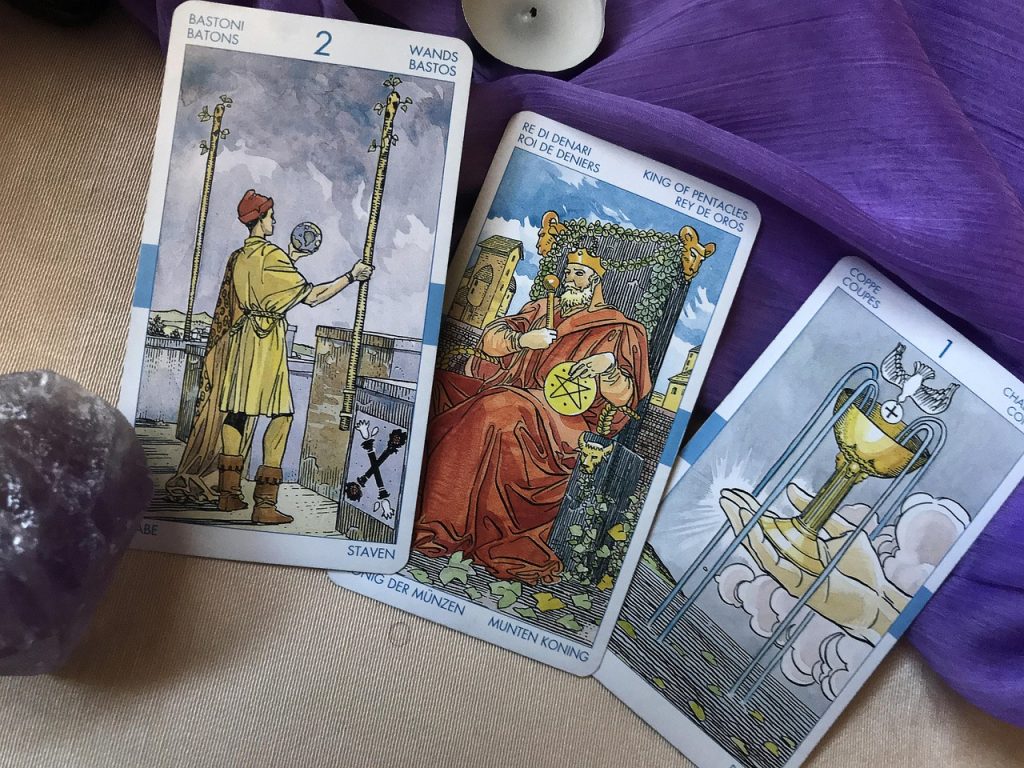
Try questions like:
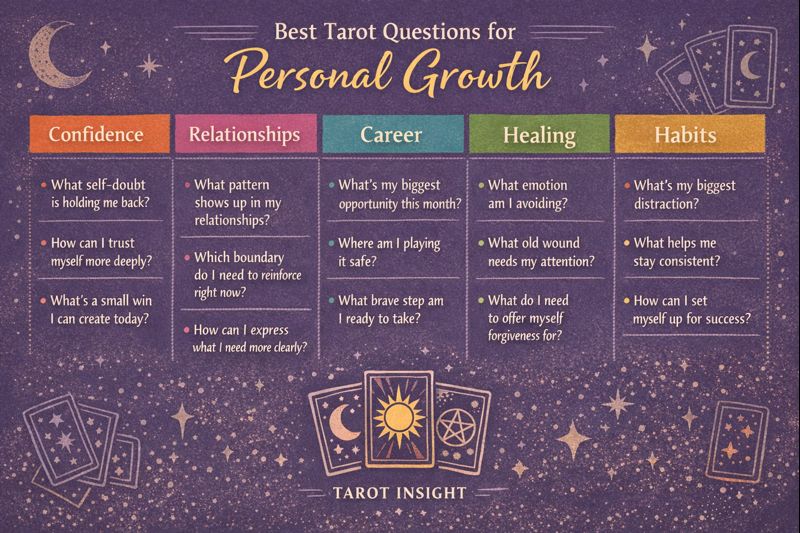
- “What skill will create the biggest career payoff this quarter?”
- “What’s the real reason I’m playing small?”
- “Where am I undervaluing myself?”
- “What would make this goal feel sustainable—not draining?”
- “What’s one brave action I’m ready for, even if I’m nervous?”
Mini action ideas (because you’re not just here to vibe)
- Update one section of your resume/portfolio
- Ask for feedback from one trusted person
- Practice one uncomfortable conversation
- Apply to one role (even if you don’t feel “ready”)
Relationship goals: questions for healthier connection
If your personal development goals involve love, family, friendships, or communication, tarot can help you focus on what you control: your patterns, needs, and boundaries.
Ask:
- “What dynamic keeps showing up in my relationships?”
- “Which boundary do I need to reinforce right now?”
- “How can I express what I need more clearly?”
- “What do I think might happen if I tell the truth?”
- “Where am I asking someone else to fix what I can heal?”
Gentle reminder
Tarot is best here when it helps you build self-respect and emotional clarity, not when it turns into surveillance on someone else’s behavior.
Confidence and mindset goals: questions that rebuild self-trust
Confidence isn’t a personality trait. It’s a relationship with yourself.
Ask:
- “What evidence am I ignoring about my progress?”
- “What inner voice is the loudest right now—and whose is it?”
- “What would self-trust look like this week?”
- “What’s the smallest win I can create today?”
- “What belief do I need to release to grow?”
A quick reframe that helps
If you pull a “scary” card, try asking:
“What is this teaching me about my strength?”
Because you’re not doing tarot to judge yourself. You’re doing it to understand yourself.
Health, habits, and routine goals: questions for consistency
This is where tarot can be shockingly practical.
Ask:
- “What habit will make everything else easier?”
- “What’s my biggest trigger for falling off track?”
- “What do I need to simplify?”
- “What kind of support am I resisting?”
- “What does my body need more of: rest, movement, nourishment, or boundaries?”
Make it measurable
Instead of “get healthy,” try:
- “Walk 20 minutes 3x/week”
- “Cook one nourishing meal on Sundays”
- “Put my phone away 30 minutes before bed”
Tarot won’t do the push-ups for you, but it can absolutely show you what’s sabotaging your follow-through.
Shadow work without spiraling: gentle prompts
Shadow work sounds intense, but it really means:
the parts of you you’ve been avoiding, judging, or hiding.
Tarot can help you meet those parts with compassion.
Ask:
- “What am I not admitting to myself?”
- “What pattern am I repeating to feel safe?”
- “What emotion am I avoiding?”
- “What do I need to forgive myself for?”
- “What part of me wants attention—not punishment?”
Safety note (real talk)
If shadow work starts to feel overwhelming, it’s okay to stop. Ground yourself. Talk to someone supportive. Tarot is a tool—your well-being comes first.
Tarot journaling prompts that turn insight into action
If tarot is the mirror, journaling is the glue.
Here’s a simple journaling format that keeps things grounded:
- What did I pull?
- What’s the message in plain language?
- What does this mean for my goal?
- One action I’ll take in 24 hours
- One way I’ll track it
5 quick tarot journaling prompts
- “If this card were advice from my future self, what would it say?”
- “Where is this already true in my life?”
- “What’s the smallest brave step here?”
- “What would I do if I trusted myself 10% more?”
- “What boundary would protect this goal?”
This is how tarot readings become personal development—not just pretty pictures and vibes.
Make it a ritual: your tarot-friendly self-care night
Want to know what makes a tarot practice stick?
Not discipline. Comfort.
If you associate tarot with calm, reflection, and a little “reset energy,” you’ll come back to it—even when life gets busy.
A simple self-care night flow:
- Clean space (5 minutes)
- Tea / shower / cozy clothes
- One spread (3 or 5 cards)
- 10-minute journal
- One tiny action plan for tomorrow
If you want a cozy blueprint for that kind of evening, check out this self-care night routine guide.
Recommended product picks from Amazon
Below are tools that make tarot readings for personal development goals easier, clearer, and more consistent—especially if you’re building a journaling-based practice.
1) The Light Seer’s Tarot Deck (Chris-Anne)
A modern, emotionally intuitive deck that’s great for mindset work and self-reflection. Rated 4.8 with 19,772 global ratings.
Features: Modern imagery, clear emotional storytelling, approachable guidebook feel
Best for: Confidence goals, healing work, daily pulls, journaling-friendly readings
2) The Wild Unknown Tarot Deck and Guidebook (Kim Krans)
Symbolic and nature-forward—this deck is amazing when you want insight without overexplaining. Rated 4.8 with 21,716 global ratings.
Features: Minimalist visuals, strong archetypes, great for intuitive reading
Best for: Shadow work, creativity goals, “what am I not seeing?” readings
3) The Authentic Rider-Waite® Tarot Deck (U.S. Games Systems)
The classic foundation deck. If you want to learn the “core language” of tarot, this is it. Rated 4.8 with 24,134 reviews.
Features: Traditional imagery, widely supported meanings, beginner-friendly structure
Best for: Learning tarot, goal-setting spreads, consistent interpretations
4) Tarot for Beginners (Lisa Chamberlain)
A straightforward guide that helps you read with clarity (without the mystical word salad). Rated 4.7 with 5,196 global ratings.
Features: Clear meanings, practical tips, easy reference style
Best for: New readers, building confidence, turning pulls into action
5) The Modern Witch Tarot Journal (Lisa Sterle)
Because the real growth happens when you track patterns over time. Rated 4.8 with 1,316 global ratings.
Features: Guided pages, space for spreads, reflection prompts
Best for: Tarot journaling, habit goals, personal growth tracking
What research and expert perspectives suggest
Here’s the grounded truth: tarot supports personal development best when it leads to reflection + progress tracking + action.
A major meta-analysis on goal progress monitoring found that interventions encouraging people to monitor progress improved goal attainment (average effect size d+ = 0.40), and effects were stronger when progress was physically recorded. In other words: reflecting is good—writing it down is even better. See this progress monitoring meta-analysis on goal attainment (Harkin et al., 2016).
On the tarot side, one peer-reviewed perspective frames tarot as a projective technique—similar in concept to other image-based reflective methods—where meaning is shaped through interpretation and personal narrative (which is exactly what personal development work often needs). See Tarot as a projective technique (Semetsky, 2006).
Put those two ideas together and you get a practical formula:
Pull cards → reflect honestly → write it down → take one small action → repeat.
FAQs about tarot readings for personal development goals
What should I ask in a tarot reading for personal growth?
Ask questions that give you agency: “What’s my next step?”, “What belief is blocking me?”, “What habit would help most right now?”
Can tarot help with goal setting?
Yes—tarot can clarify what you want, why you want it, and what’s getting in the way. Pair it with journaling and a small action plan for best results.
How often should I do tarot for self-improvement?
Daily or weekly works well. Daily pulls build awareness; weekly spreads help you plan and track progress without overthinking.
What if I draw a card that feels “negative”?
Treat it like feedback, not a verdict. Ask: “What is this warning me about?” or “What’s the lesson here?” Then choose one small action.
Do I need to be psychic to use tarot for personal development goals?
Nope. You need honesty, curiosity, and a willingness to act on what you learn. Intuition grows with practice.
Conclusion
If you’ve been craving change, here’s the encouraging part: you don’t need a perfect plan—you need a consistent one.
Tarot readings for personal development goals work best when you use them like a supportive coach: clarifying your patterns, spotlighting your blind spots, and nudging you toward one brave next step.
So tonight (or whenever you read this), try a 3-card check-in. Journal for 10 minutes. Pick one action you can finish in under 30 minutes.
Then do it.
That’s how “insight” becomes “I’m actually changing my life.”