
Best Watch for Heart Rate Monitoring: Budget Picks
We may earn a commission for purchases made using our links. Please see our disclosure to learn more.
You want better heart-rate tracking… without turning your life into a science fair.
Maybe you’re training for fitness. Maybe you’re trying to understand stress. Or maybe you just want a heart rate monitor watch that doesn’t wildly “guess” your pulse the second you break a sweat.
Either way: this guide will help you find the best watch for heart rate monitoring for your lifestyle, budget, and phone—and show you how to get cleaner, more reliable readings once it’s on your wrist.
What “good heart rate monitoring” really means (and what it doesn’t)
A watch can be “good” at heart rate tracking in two different ways:
- Consistency (your trends look believable day to day)
- Accuracy (the number is close to a reference device)
Most people don’t need medical-grade perfection 24/7. What you do need is a watch that tracks changes reliably—so you can tell when you’re improving, overdoing it, or running on fumes.
Resting HR vs workout HR vs all-day HR
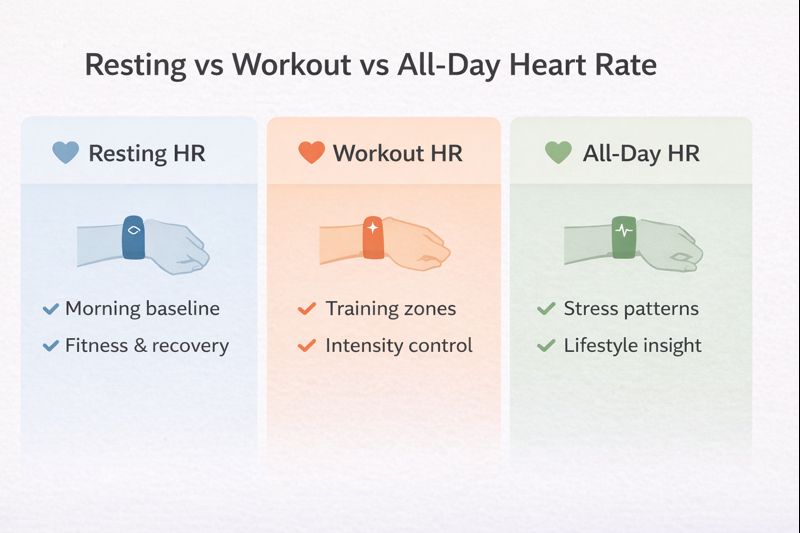
- Resting heart rate: great for spotting long-term fitness changes or stress/sleep issues.
- Workout heart rate: crucial for training zones and pacing.
- All-day monitoring: helpful for stress awareness, recovery, and lifestyle patterns.
Accuracy vs “close enough to be useful”
Think of wrist heart rate like a car’s speedometer: it’s usually close, but bumps (movement) and weird conditions (loose fit, sweat, tattoos) can throw it off.
Who benefits most from a heart-rate watch (and who doesn’t)
A fitness tracking watch is worth it if you want any of these:
- Fat-loss or cardio training using heart rate zones
- Running/walking consistency (not just steps—effort level)
- Stress awareness (especially if you get that “wired but tired” feeling)
- Better sleep habits (sleep + heart rate tells a story)
- Recovery tracking (so you don’t train hard on an empty battery)
You might not need a watch if you only want occasional checks and you hate wearing things. In that case, a simple finger pulse check (or a chest strap during workouts) might suit you better.
How wrist heart rate tracking works (plain English)
Most watches use an optical heart rate sensor (PPG). Little lights shine into your skin, and the watch estimates pulse by detecting blood-volume changes.
Why readings sometimes look “wrong”
Wrist-based heart rate monitors can struggle when:
- You’re doing high-motion workouts (burpees, kettlebells, boxing)
- The watch is loose or sliding
- Your wrist is cold (less blood flow near the surface)
- You have tattoos under the sensor
- You’re gripping something hard (bike handlebars, heavy lifts)
It’s not that the watch is “bad.” It’s that wrists are a noisy place to measure heart rate.
Wrist watch vs chest strap: the honest comparison
If you’ve ever wondered, “Should I just get a strap?”—you’re not alone.
When a watch is totally enough
- Walking, jogging, gym machines
- Zone-based training for beginners/intermediate
- Daily stress + sleep patterns
- General fitness improvement
When a chest strap wins
- Sprint intervals, HIIT, CrossFit-style workouts
- Race training where a few beats matter
- If you want the cleanest possible data during movement
A good move: use a watch daily, and add a strap only if your workouts demand it.
Buying checklist: features that actually matter
If you’re shopping for the best watch for heart rate monitoring, prioritize these:
- Continuous heart rate monitoring (not just spot checks)
- Heart rate zones + alerts (zone 2, fat burn, cardio, peak, etc.)
- Workout tracking with reliable summaries
- Comfortable fit (seriously, this affects accuracy)
- Battery life that matches your habits
- Sleep tracking heart rate (resting HR trends are gold)
Nice-to-haves (depending on you):
- ECG smartwatch features (for compatible regions/users)
- HRV tracking (recovery + stress insight)
- Built-in GPS (for phone-free runs)
Comfort and fit: the sneaky reason your numbers are off
This is the part most people skip… then they complain their watch “lies.”
For better readings:
- Wear it one finger-width above your wrist bone
- Keep it snug, not tourniquet-tight
- For workouts, tighten one notch more than your normal fit
- If you’re between sizes, pick the band that lets you go snug
If the sensor bounces, your heart rate bounces. Simple as that.
Battery life and charging habits (don’t ignore this)
Battery life isn’t just convenience. It changes how much data you collect.
Ask yourself:
- Will you actually charge it daily?
- Do you want overnight tracking every night?
- Do you travel often?
A “better” watch that’s always dead is worse than a simpler one you wear nonstop.
iPhone vs Android: choose the ecosystem that makes life easier
This is where people accidentally waste money.
- If you love iPhone simplicity, lean toward watches that play nicely with iOS.
- If you’re on Android, make sure features (like replies, apps, integration) actually work the way you want.
No one wants to fight their watch app at 7 a.m. while half-asleep.
5 Best Watches for Heart Rate Monitoring
These are strong commercial-intent picks—popular, well-reviewed, and built for continuous heart rate monitoring.
1) Fitbit Versa 4 Fitness Smartwatch
Why it’s here: a friendly, “just works” fitness smartwatch with solid heart-rate zones and easy-to-read data.
Standout features:
- 24/7 heart rate + zone minutes
- Built-in GPS (great for walks/runs without your phone)
- Strong sleep + daily readiness style insights
Best for:
You want a simple, motivating watch for workouts, weight loss, walking goals, and everyday health.
2) Garmin vívoactive 5 (AMOLED GPS Smartwatch)
Why it’s here: an excellent “all-rounder” with strong workout tools and recovery-style insights.
Standout features:
- Wrist-based heart rate monitor with training metrics
- Great activity variety (gym, walks, runs, yoga, more)
- Long battery life for its class
Best for:
You want reliable fitness + lifestyle tracking and you like seeing trends (not just numbers).
3) Garmin Forerunner 165 Running Smartwatch
Why it’s here: a runner-focused pick with a clean display and strong training tools.
Standout features:
- Great heart-rate-based training support
- Recovery insights + run-friendly metrics
- AMOLED screen that’s easy to glance at mid-run
Best for:
You run (or want to start running) and you care about pacing, zones, and progress.
4) Fitbit Sense 2 Advanced Health & Fitness Smartwatch
Why it’s here: strong for people who want heart rate + stress-style tools in the same place.
Standout features:
- 24/7 heart rate + sleep tracking
- Stress-focused tools (breathing, mindfulness-style support)
- Built-in GPS
Best for:
You want heart rate tracking and you’re also trying to manage stress, recovery, and sleep habits.
5) SAMSUNG Galaxy Watch 6 Classic (Renewed) 47mm
Why it’s here: feature-rich for Android users who want a full smartwatch feel.
Standout features:
- Heart-rate zones + fitness coaching features
- Great screen + classic rotating bezel vibe
- Strong smartwatch experience on Android
Best for:
You want heart rate monitoring and a full smartwatch—notifications, apps, and a premium feel.
How to choose the right one (quick scenarios)
If you’re thinking, “Cool list… but which one is my best watch for heart rate monitoring?” try this:
- I’m starting fitness + want simplicity: Fitbit Versa 4
- I want balanced fitness + lifestyle trends: Garmin vívoactive 5
- I’m getting serious about running: Garmin Forerunner 165
- I’m stress-aware + want health-style tools: Fitbit Sense 2
- I’m Android-first + want smartwatch features too: Galaxy Watch 6 Classic
How to get more accurate heart-rate readings (fast wins)
Try these before blaming the watch:
- Warm up 3–5 minutes before judging your HR data
- Tighten the band for workouts
- Keep the sensor clean (sweat film is real)
- Avoid wearing it on a super-bony spot
- If you lift heavy, consider switching wrists or wearing it higher
Bonus tip: if you do cycling or rowing, a snug fit matters a lot because of wrist angle and grip.
Common heart-rate tracking mistakes (and easy fixes)
These are the usual culprits:
- Loose band → jumpy readings
- Starting a workout cold → weird spikes or low numbers
- Relying on single moments instead of trends
- Comparing to a friend’s watch (different sensors + fit + skin = different results)
If you want cleaner data, focus on patterns:
- Is your resting HR trending down over weeks?
- Are your easy walks staying in an easy zone?
- Does your heart rate recover faster after a workout than it used to?
That’s where the value is.
Research-backed: what science says about wearable HR accuracy
Let’s get grounded for a second.
A well-known 2019 study in JMIR mHealth tested popular consumer wearables against ECG and found that devices like Apple Watch and Fitbit models showed acceptable overall heart rate accuracy (under ~10% error on average) across a 24-hour period, with some situations (like certain daily activities) being trickier than others. That’s a fancy way of saying: for most normal life + many workouts, modern wearables can be “accurate enough” to guide behavior.
But there’s also a big asterisk.
A 2020 paper in npj Digital Medicine breaks down why optical wrist sensors can get noisy—especially because of motion artifacts, differences across skin types, and how signals can overlap or get distorted. Translation: if your workout is chaotic (HIIT), your watch can struggle, and it’s not a personal failure.
One of my favorite “real life” ways to use this info: pair heart-rate trends with how you actually felt. If your heart rate is higher than usual and you slept poorly and work was intense… that’s not random. It’s context.
If you want an easy way to track that context, this mood journal tracker is a simple add-on that helps you spot patterns between stress, sleep, and your heart rate—without overthinking it.
FAQs about the best watch for heart rate monitoring
Is a smartwatch accurate enough for heart rate monitoring?
For most people, yes—especially for resting HR trends, walking/running, and general training zones. High-motion workouts can be less reliable, where a chest strap may be better.
What’s the best watch for heart rate monitoring for beginners?
If you want a straightforward experience with clear insights, the Fitbit Versa 4 is an easy starting point. Simple app, easy data, solid daily tracking.
Which watch is best for heart rate zones and fat-loss training?
Look for clear heart rate zones, alerts, and consistent readings. Garmin and Fitbit both do zones well—choose based on which app style you’ll actually use.
Should I worry if my watch shows a sudden spike in heart rate?
Not automatically. Check fit, movement, and whether you were gripping something. If spikes repeat with symptoms (dizziness, chest pain, fainting), talk to a clinician.
What’s the best watch for heart rate monitoring and stress tracking?
Fitbit Sense 2 is strong if you want heart rate plus stress-style tools and recovery context, especially when paired with sleep tracking.
Final thoughts: your “best” watch is the one you’ll wear
Here’s the honest truth: the best watch for heart rate monitoring isn’t the one with the longest spec sheet. It’s the one that fits your wrist, matches your phone, and becomes part of your day without friction.
Pick the watch that makes you feel supported—not judged by numbers.
And if you want a tiny challenge: wear it for two weeks, then look at trends (not single readings). Your body is talking. This just helps you listen.