
Mood Journal Tracker: 5 Templates to Track Emotional Shifts
We may earn a commission for purchases made using our links. Please see our disclosure to learn more.
If you’ve ever said, “I think I’ve been okay lately…?” and immediately realized you’re not sure, you’re not alone. Moods are sneaky. One day you’re fine, the next you’re crying because your sock feels “too loud.” (Why is that a real thing, though?)
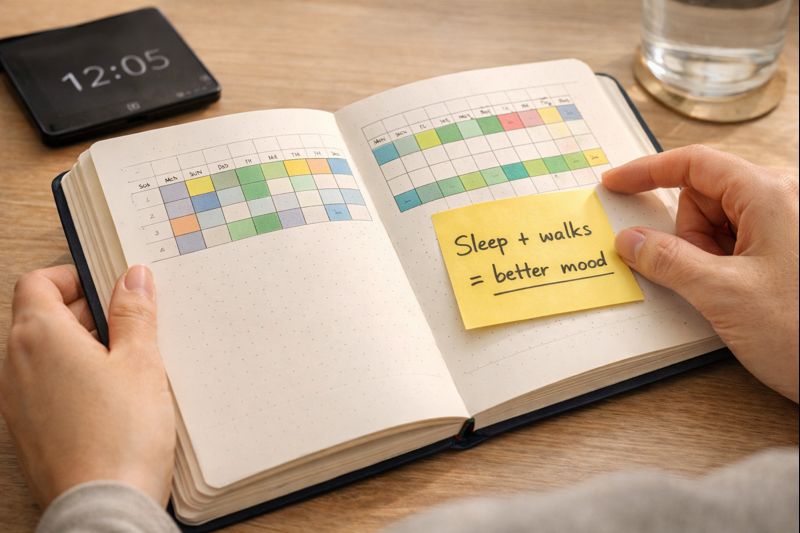
That’s where a Mood Journal Tracker becomes your secret weapon. Not in a stiff, clinical way. More like: “Ohhh, that’s why I’ve been extra irritated every Sunday” or “Wait, I actually feel better on the days I take a 10-minute walk.”
Affiliate note: This post includes a few Amazon product recommendations that may earn a small commission at no extra cost to you.
What a Mood Journal Tracker Actually Is (and what it’s not)
A Mood Journal Tracker is basically a tiny “emotional receipt.” It captures what you felt and what was happening around it—so you can see patterns over time.
What it is
- A daily mood log (quick + consistent beats long + perfect)
- An emotion tracker that helps you name feelings (not just “good/bad”)
- A mirror that shows you your triggers, habits, and recovery moves
What it’s not
- A “fix-your-life” notebook
- A place to judge yourself
- A replacement for therapy or mental health support (it can support it, though)
Think of it like a fitness tracker—but for your inner world. You’re collecting signals, not scoring your worth.
Why tracking beats “just thinking about it”
Your brain is a chaotic storyteller. It loves dramatic summaries like:
- “I’m always anxious.”
- “Nothing helps me.”
- “I never have a good day.”
Mood tracking adds receipts.
Here’s the magic
When you track, you stop relying on vibes and start seeing data:
- Sleep and mood connections
- Social time vs. burnout
- Certain foods/caffeine and irritability
- Hormones, deadlines, grief anniversaries—real stuff that matters
And honestly? Sometimes the biggest win is realizing:
“I’m not broken. I’m responding to patterns.”
Choose your tracking style: words, numbers, colors
If you’ve tried journaling and hated it, it might not be “you.” It might just be the wrong format.
Three easy styles
- Color-based: fast, visual, low effort
- Number-based: good for people who like structure (1–10 mood scale)
- Word-based: best if naming emotions helps you process
Pro tip: start with the easiest option and “upgrade” later. Consistency first. Depth later.
Setup basics: make it too easy to skip
A Mood Journal Tracker only works if it’s stupid simple.
The “2-minute rule”
If it takes more than 2 minutes on busy days, it won’t survive real life.
A setup that actually sticks
- Keep it where you already are: bedside, desk, coffee station
- Pick a time anchor: after brushing teeth, after lunch, before doom-scrolling
- Use a “minimum entry”: one color + one word is a complete win
Also: if you miss a day, you’re not failing. You’re being human.
Template 1: The 1-Minute Color Code Mood Journal Tracker
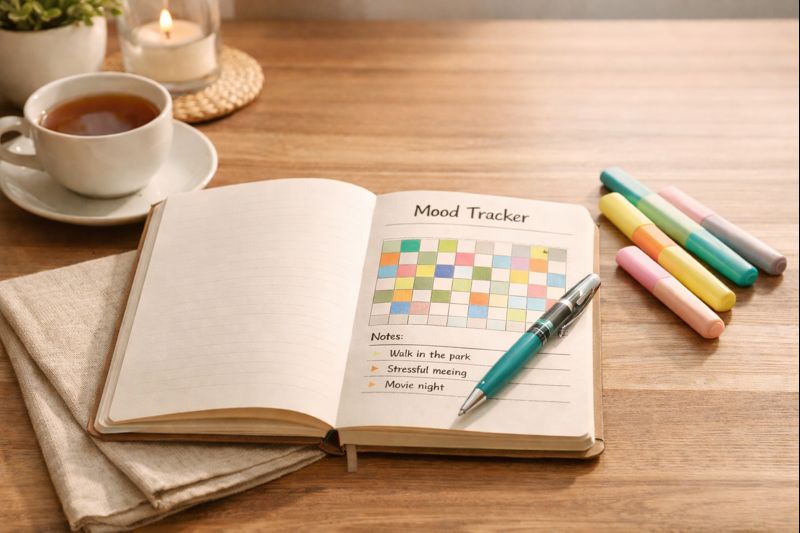
This is the easiest Mood Journal Tracker template I know. It’s basically emotional doodling with purpose.
How it works
Pick 5–7 colors that represent moods. Example:
- Green = calm/steady
- Yellow = motivated/hopeful
- Blue = sad/low
- Red = angry/irritable
- Gray = numb/foggy
- Pink = connected/loved
- Orange = anxious/overstimulated
Daily entry (literally 60 seconds)
- Color of the day (or split the day into AM/PM)
- One word: “heavy,” “okay,” “wired,” “tender,” “peaceful”
- Optional: tiny note (“slept late,” “argument,” “walk helped”)
Why it’s powerful
After 2–3 weeks, you’ll see patterns at a glance. It’s like your month becomes a mood map.
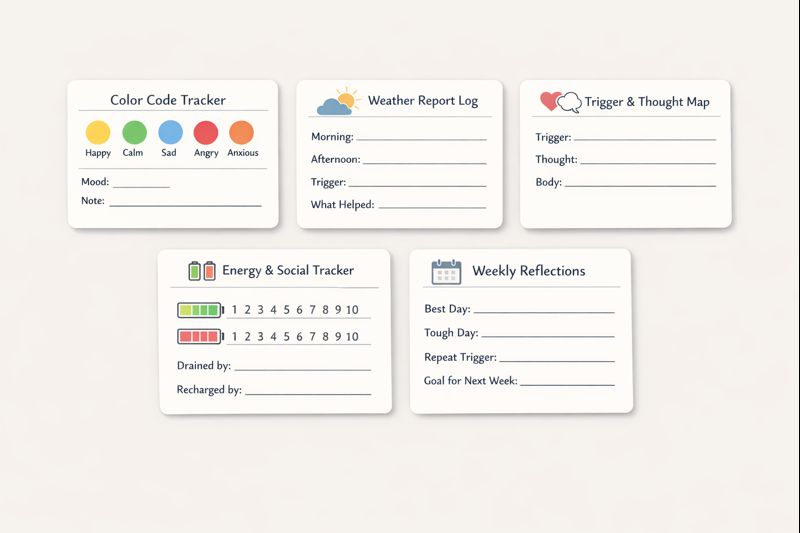
Template 2: The “Weather Report” Emotional Tracking Log
Because moods change like weather—and you don’t blame the sky for having clouds.
Your entry format
- Forecast (morning): “likely scattered anxiety”
- Weather (afternoon): “sunny + productive”
- Storm warning (trigger): “meeting with boss”
- What helped: “music + 10-min reset”
- What made it worse: “skipping lunch”
Why people love it
It’s gentle. It reduces shame. You’re describing a system, not blaming a personality.
And yes, you’re allowed to have “random fog with a chance of crying.”
Template 3: Trigger–Thought–Body Map (CBT-lite, no fancy words)
This one is for when your mood feels like it “comes out of nowhere.” Spoiler: it usually doesn’t.
Quick map (3 lines)
- Trigger: What happened? (or what didn’t happen)
- Thought: What did your brain say?
- Body: What did your body do?
Example:
- Trigger: friend didn’t reply
- Thought: “They’re mad at me.”
- Body: tight chest, stomach drop
Add one more line (the game changer)
- Kind reframe: “They might be busy. I can check in later.”
This template makes your Mood Journal Tracker feel like a flashlight—small, but it helps you stop tripping over the same emotional furniture.
Template 4: The Energy + Social Battery Tracker
Sometimes “mood” is actually capacity.
You might not be sad—you might be socially maxed out, under-slept, and running on iced coffee fumes.
Track two batteries (0–10)
- Energy battery: physical/mental fuel
- Social battery: people tolerance (yes, that’s real)
Add one line
- “What drained me?”
- “What recharged me?”
This is especially helpful if you’re:
- caregiving
- working shifts
- neurodivergent
- parenting
- juggling multiple cultures/expectations (where “rest” can feel complicated)
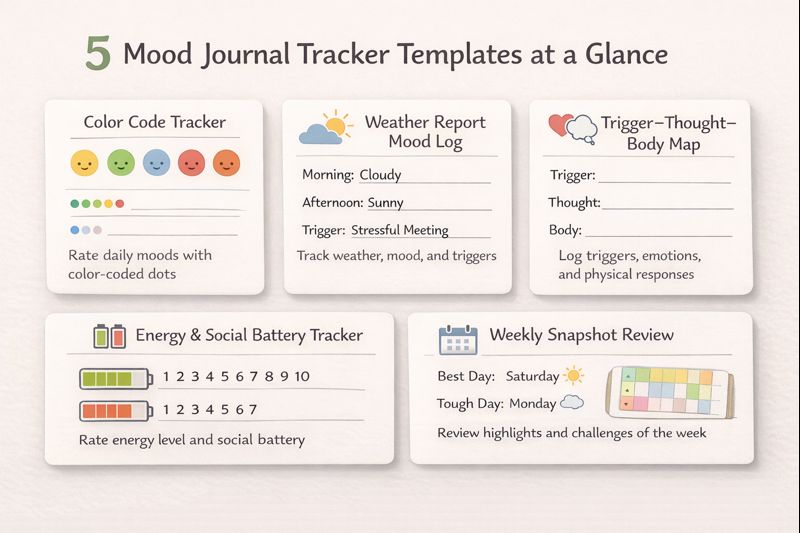
Template 5: The Weekly Pattern Snapshot
This is the “Zoom out” Mood Journal Tracker template—perfect if daily tracking feels like too much.
Once a week, answer:
- Best day (and why)
- Hardest day (and why)
- One repeating trigger
- One repeating comfort
- One thing to try next week
Bonus: rate your week in 3 words
Examples:
- “Busy but proud”
- “Tender and tired”
- “Better than expected”
This is ideal for people who want insight without daily homework vibes.
Prompts that don’t feel like homework
If blank pages intimidate you, use prompts that feel like conversation—like texting a friend who gets it.
Easy prompts for a Mood Journal Tracker
- “Right now, I feel ___ because ___.”
- “My body is asking for ___.”
- “The most annoying thing today was ___ (and what I needed was ___).”
- “One tiny win I’m not giving myself credit for: ___.”
- “If today had a theme song, it would be ___.”
If you’re going through something heavy
Try:
- “What do I want to be true?”
- “What do I actually know is true?”
That gap is often where anxiety lives.
How to spot patterns without spiraling
Mood data is helpful… until your brain turns it into a courtroom.
A healthier way to review
Instead of “What’s wrong with me?” ask:
- “What shows up before my low days?”
- “What helps—even a little?”
- “What drains me faster than I admit?”
Pattern spotting without perfectionism
- Look for trends, not “proof”
- Compare weeks, not single days
- Don’t analyze on your worst day (seriously)
Your Mood Journal Tracker is a compass, not a critic.
When your tracker says “help”—and how to respond
Sometimes tracking reveals a tough truth: you’ve been low longer than you realized. That’s not failure. That’s information.
Use a simple flag system
If you notice:
- frequent “numb” days
- sleep collapsing
- constant dread
- loss of interest
- feeling unsafe or out of control
…take that seriously.
What to do next (gentle, practical steps)
- Tell one trusted person: “I’ve been struggling more than I realized.”
- Bring your tracker to a professional (doctor/therapist/coach)
- Reduce the tracking load (switch to color-only for a while)
If tracking makes you feel worse, it’s okay to pause. Your wellbeing comes first.
Digital vs paper mood trackers (and how to mix both)
Paper feels grounding. Digital feels convenient. You can use both without being “inconsistent.”
Paper wins when you want…
- fewer distractions
- a ritual feeling
- creativity (stickers, doodles, margins)
Digital wins when you want…
- reminders
- charts automatically
- quick entries on the go
My favorite hybrid
- Digital: quick daily mood rating
- Paper: weekly reflection + one insight
No one gets a trophy for “doing it the hard way.” Choose what you’ll actually use.
Affiliate Picks: 5 Amazon Tools That Make Mood Tracking Easier
You don’t need supplies, but the right tools can make your Mood Journal Tracker feel inviting instead of intimidating.
1) Sharpie Clear View Highlighter Sticks, Chisel Tip, Assorted, 8 Count
Why it’s useful: clear tip helps you highlight neatly (great for mood blocks and key patterns).
Features: clear view tip, chisel tip, quick marking.
Best for: people who want a clean, color-coded mood tracking journal without messy lines.
Rating shown on Amazon: 4.8/5 (15,080 reviews).
2) Sharpie Pocket Highlighters, Mild Pastel Colors, Assorted, 12 Count
Why it’s useful: softer colors = less visual overwhelm (especially if bright neons stress you out).
Features: mild pastel tones, compact size, chisel tip.
Best for: students, office folks, anyone building a calm-looking daily mood log.
Rating shown on Amazon: 4.6/5 (2,440 reviews).
3) Sharpie Tank Highlighters, Chisel Tip, 12 Assorted Fashion Colors, Value Pack (36 Count)
Why it’s useful: bulk pack if you’re color-coding moods across months (or sharing with family/kids).
Features: long-lasting ink, chisel tip, big value pack.
Best for: heavy journaling, group/home use, classrooms.
Rating shown on Amazon: 4.8/5 (363 reviews).
4) Pentel® EnerGel™ RTX Retractable Liquid Gel Pens, Medium Point (0.7 mm), Assorted Colors, Pack of 12
Why it’s useful: Smooth, fast-drying gel ink makes mood tracking feel effortless—no smears, no skipping, just quick entries you’ll actually keep up with.
Features: Retractable gel pens • 0.7 mm medium point • quick-dry liquid gel ink • comfortable grip • assorted ink colors for color-coded mood notes.
Best for: Anyone who wants a reliable everyday pen for a Mood Journal Tracker—especially left-handed writers, busy students, and people who like color-coding emotions without messy highlighters.
5) Bullet Dotted Journal Notebook (A5 leather hardcover style, 176 numbered pages)
Why it’s useful: dot grid pages make it easy to build mood charts, habit tracker boxes, and weekly layouts.
Features: dot grid, structured pages, bullet-journal-friendly.
Best for: people who want one notebook for mood tracking + habits + reflections.
Amazon search results show similar bullet dotted journals at 4.7/5 (2K ratings).
Small extra that helps a lot: If you want structure without dates (because perfectionism is loud), pair your Mood Journal Tracker with an undated daily planner you can start anytime.
Research-backed: does a Mood Journal Tracker really help?
- A 2022 evidence review on journaling and mental illness management found journaling is commonly used as a non-pharmacological tool and summarizes the clinical landscape and gaps—useful if you want realistic expectations and informed structure. In short: journaling can support mental health, but how you do it (and consistency) matters. See the journaling evidence review (Sohal et al., 2022).
- A 2024 review of mental health smartphone apps concluded apps show small but significant symptom improvements overall, and that features like CBT elements and mood monitoring are linked with larger effects. If you track digitally, this supports the idea that mood monitoring isn’t “pointless”—it’s a meaningful ingredient. See the mood monitoring apps evidence review (Linardon et al., 2024).
Quick reality check: “small but significant” is still a win—especially when your goal is awareness, not overnight transformation.
FAQs
How do I start a Mood Journal Tracker if I hate journaling?
Start with the Color Code template. One color + one word counts. If you can do it in 30–60 seconds, you’re more likely to stick with it.
What should I track besides mood?
Track sleep, stress, energy, and one “context” note (like caffeine, conflict, cycle, workload, loneliness, or social time). Those usually explain the mood shift.
How often should I update my daily mood log?
Once a day is enough. If your mood swings a lot, do AM/PM check-ins—but keep them tiny so it doesn’t become a chore.
Can mood tracking make anxiety worse?
Yes, for some people. If tracking turns into obsessing, switch to weekly snapshots or track only “what helped” and “what drained me.” If it still feels bad, pause.
How long until I see patterns?
Most people notice something within 2–3 weeks. The bigger “oh wow” patterns show up around 30 days—because life likes to repeat itself.
If you take one thing from all this: your mood is information, not a moral grade. A Mood Journal Tracker doesn’t make you “too sensitive.” It makes you aware—and awareness is the first step toward choosing what you need instead of guessing.
Try this: pick one template and commit to 7 days, even if it’s messy. Then ask, gently:
“What did I learn about myself that I didn’t know last week?”
That’s progress. Quiet, real, and yours.