
Undated Daily Planner Ideas to Boost Your Routine
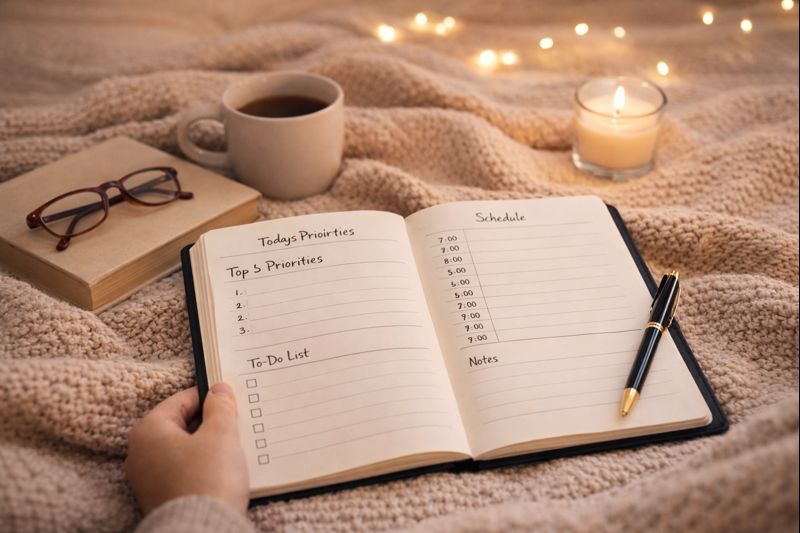
We may earn a commission for purchases made using our links. Please see our disclosure to learn more.
Some days feel like you woke up already behind, right? You’re juggling work, messages, family, maybe classes, and your brain is just… tabs on tabs on tabs. An undated daily planner can’t magically clear your to-do list—but it can give your day a calmer, more intentional shape.
In this guide, we’ll talk about what an undated daily planner is, how to use it without turning it into another chore, and how to choose one that actually fits your life. We’ll also look at some research on why daily planning helps—and I’ll share a few Amazon picks if you want something ready-made.
Quick note: This article may reference products that are available on Amazon. Treat them as friendly suggestions, not prescriptions—always choose what truly matches your needs and budget.
What Is an Undated Daily Planner?
An undated daily planner is a planner where the days aren’t pre-printed with dates. You fill in the date yourself whenever you use it.
Instead of January 1–December 31 laid out in advance, you usually get:
- A daily page (or two) with sections like schedule, to-do list, priorities, notes
- Sometimes weekly or monthly overviews
- Extra space for goals, habit tracking, or reflections
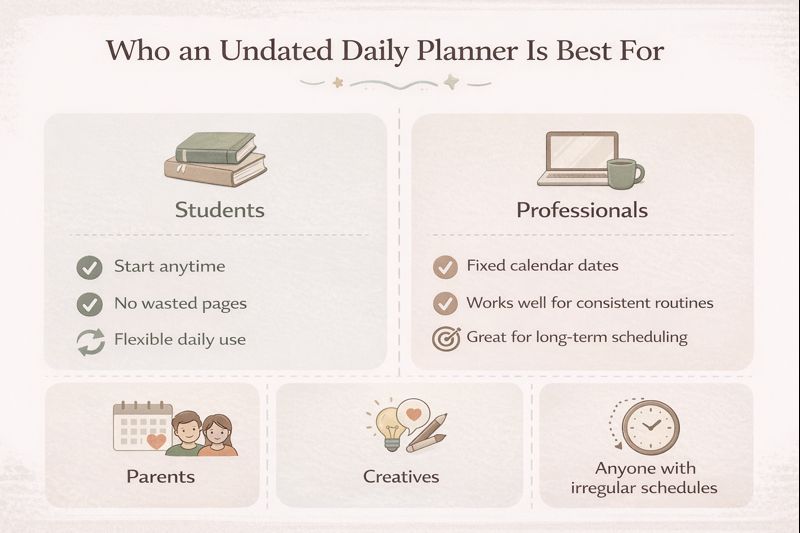
Because it’s undated, you can:
- Start any time of year
- Skip days without “wasting” pages
- Use it alongside digital tools, not instead of them
If a dated planner feels like it’s silently judging you for every blank week, undated might feel a lot kinder.
Why an Undated Daily Planner Works So Well for Real Life
Life doesn’t care that your planner started on a Monday.
Your energy, mental health, workload, and family responsibilities all fluctuate. An undated daily planner flexes with that reality:
- You can pause without guilt. Busy week? Sick day? You just don’t fill in a page. No waste, no shame.
- You can shift roles easily. Student during the semester, then freelancer over the summer? You can switch how you use your pages.
- You only plan when it’s helpful. Some seasons you might use it every day; others, only on heavy or important days.
Research backs the idea that planning and time management reduce procrastination and stress while improving performance. A 2024 study in Sustainability found that students who planned their time better experienced less procrastination and performed better academically. A 2025 systematic review in Frontiers in Education concluded that strategies like planning, goal-setting, and prioritization consistently boosted productivity and wellbeing in both education and workplace settings.
Your little planning ritual is not “overkill”—it’s literally training your brain to feel safer, more in control, and less frazzled.
Undated vs. Dated Planner: Which One Fits You?
Think of this like choosing between a fixed menu and à la carte.
Dated planner (fixed menu):
- Great if you love structure
- Ideal if you track appointments heavily
- Can feel wasteful if you’re inconsistent
Undated planner (à la carte):
- Great if your schedule is unpredictable
- Perfect if you tend to stop/start planners
- Lets you use one book for several seasons of life
Ask yourself:
- Do I feel guilty when I see blank pages?
- Do I often change how I work or study through the year?
- Do I want a tool I can use only on busy days?
If you nodded along, undated is likely your best friend.
How to Set Up Your Undated Daily Planner on Day One
Before you write anything, breathe. You don’t have to “set it up perfectly.” This is not Pinterest; this is your real life.
Here’s a simple first-day setup:
- Claim the first page for “How I want my days to feel.”
Write words like: calm, focused, playful, productive, spacious. This becomes your emotional compass. - Create a mini key.
- ✅ Done
- ➡️ Moved
- ✳ Important
- ♥ Self-care / relationships
- ✅ Done
- Add a quick reference page (or two):
- Morning routine ideas
- Evening reset checklist
- Weekly review prompts
- Morning routine ideas
- Start with tomorrow.
Instead of rewriting your entire life, just plan the next day. Let the habit grow from there.
Daily Layout Ideas to Make Your Planner Actually Useful
You don’t have to use every box on every page. Instead, think of your undated daily planner as a template you can remix.
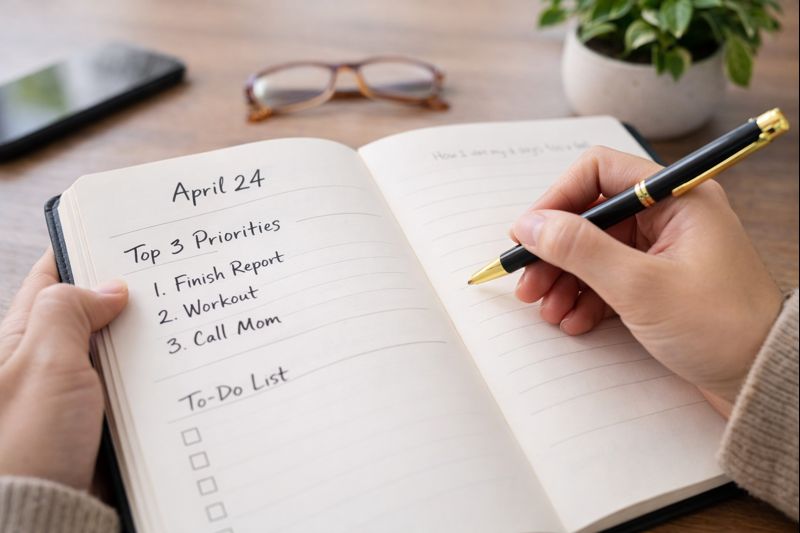
The “Three Big Things” layout
On a blank daily page, divide it roughly into:
- Top 3 priorities (If these get done, it was a good day.)
- Supporting tasks (emails, errands, admin stuff)
- Notes & reflections (things you noticed, ideas, wins)
Simple, but powerful. Great if you tend to overload yourself.
The “Brain Dump + Sort” layout
- Left side: Brain dump
Write everything swirling in your head—personal, work, tiny tasks, worries. - Right side: Sorted list
- Must do today
- Nice to do if time
- Can wait / delegate
This is especially calming if you have anxiety or ADHD tendencies—you externalize the chaos first, then gently organize it.
Time-Blocking with an Undated Daily Planner
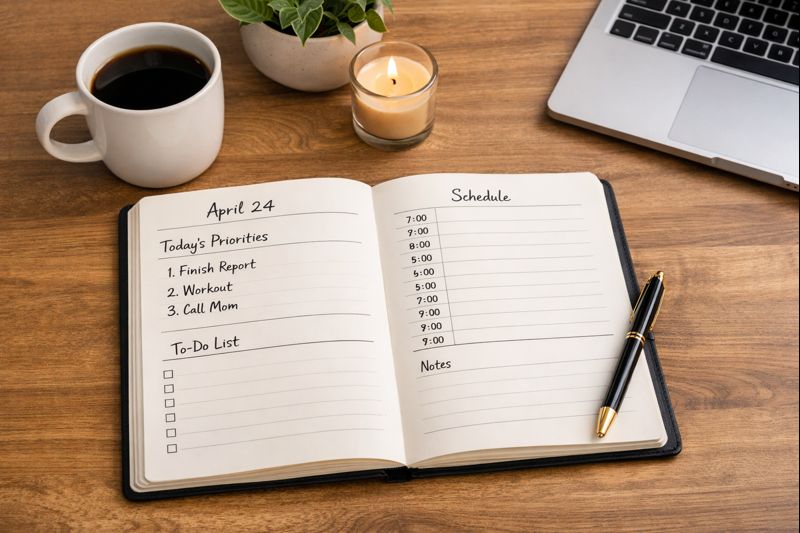
If your planner has an hourly schedule (say 6am–9pm), or if you draw one:
- Block chunks like: “Deep work,” “Admin,” “Meetings,” “Kids’ routines,” “Gym,” “Rest.”
- Don’t schedule every minute—aim for 60–70% filled. Leave buffer space.
- Use little arrows to show where tasks moved, instead of rewriting everything.
You’re not trying to live like a robot; you’re giving your brain a visual map so it doesn’t have to keep recalculating all day.
Habit Tracking & Self-Care Without the Guilt
A lot of planners turn habit tracking into a perfection contest. Let’s not.
Ideas for gentle habit tracking in your undated daily planner:
- Use a tiny row of boxes on each page for 2–3 habits only
- Celebrate streaks, but also celebrate resets
- Add one “emotional habit,” like:
- “Checked in with my feelings”
- “Spent 10 minutes tech-free”
- “Talked to someone I care about”
Think of it less as “Did I win at habits?” and more as “Did I show up for myself at least once today?”
Using Your Planner for Goals (Without Overwhelming Yourself)
Big goals can be intimidating on paper. Break them down in your planner like this:
- One page = One goal
- Why this matters to me
- What “done” looks like
- Tiny first steps
- Sprinkle steps into daily pages
Instead of “Launch side business” on a to-do list, you might see:
- Brainstorm 10 name ideas
- Research one competitor
- Draft rough pricing
- Add a weekly “micro-review”
At the end of the week, jot:
- What moved forward?
- What got stuck (and why)?
- One gentle tweak for next week
Your undated daily planner becomes a bridge between your long-term dreams and your Tuesday afternoon.
Common Planner Mistakes (and How to Fix Them)
Even the best undated daily planner can flop if you use it in ways that don’t match your brain or life.
Mistake 1: Treating it like a wish list, not a realistic plan
Fix: Cut your to-do list in half. Seriously. Move the rest to “later this week.”
Mistake 2: Only writing tasks, never wins
Fix: Add a tiny “Today I’m proud of…” line at the bottom of each page.
Mistake 3: Trying to use every feature every day
Fix: Rotate features. One week, focus on habits; next week, focus on time-blocking.
Your planner is a tool, not a test.
Research-Backed Benefits of Daily Planning
Let’s anchor all this in evidence for a second.
- A 2024 study in the journal Sustainability found that better academic time management planning in students was associated with less procrastination and improved academic performance.
- A 2025 systematic review in Frontiers in Education synthesized 107 studies and highlighted planning, prioritization, and goal-setting as core time management strategies that support productivity, wellbeing, and performance in both university and workplace settings.
Your undated daily planner is basically a simple way to practice those high-impact strategies in a concrete, everyday format.
Best Undated Daily Planner Picks on Amazon
Here are a few undated daily planner options that align with what we’ve been talking about—flexible layouts, daily pages, and space for goals and reflection. (Always double-check current ratings, reviews, and prices before buying.)
1. Smart Planner PRO – Undated Daily Planner (Small A5)
A compact planner designed around productivity and goal achievement, with daily, weekly, and monthly sections in one book.
Good for you if:
- You want a structured system (goals + daily tasks) in a small footprint
- You like having bookmarks, a back pocket, and extras built in
- You’re serious about tracking progress week by week
2. Undated Daily Planner – 6-Month A5 Productivity Organizer
This planner typically includes full-page daily layouts, hourly schedules, goal-setting sections, habit trackers, and weekly/monthly overviews.
Good for you if:
- You want one place for schedule, habits, and goals
- You like six months of focused use (not a massive 12-month book)
- You prefer clear structure but still want the freedom of undated pages
3. Asten Undated Daily Planner with To Do List
A popular spiral-bound to-do list notebook–style planner with hourly planning plus space for priorities and notes.
Good for you if:
- You love lists and time-blocking in the same view
- You want a work/study planner that can handle busy days
- You like flipping pages easily and folding the planner back on itself
4. Amazon Basics Undated Daily Planner and Journal (Six Months Coverage)
A more minimal, budget-friendly option from Amazon’s own brand, with undated layouts that cover about six months.
Good for you if:
- You prefer a straightforward, no-frills layout
- You’re experimenting and don’t want to spend too much at first
- You want something that can be used in both personal and work contexts
5. Merely Home Undated Daily Planner – Work To-Do Notebook
A larger-format work notebook with a landscape layout and multiple sections per page, designed for academic and professional use.
Good for you if:
- You have a lot of tasks and appreciate roomy pages
- You’re balancing projects, meetings, and personal tasks in one place
- You want something that looks more like a professional workspace tool than a “cute journal”
You don’t have to pick the “perfect” planner. Pick one that feels good enough to try for 30–60 days, then adjust.
How to Make Planning a Gentle Daily Ritual
To keep your undated daily planner from becoming another obligation:
- Pair it with something pleasant: coffee, tea, soft music, a candle.
- Use it at roughly the same time each day (morning setup or evening reset).
- Keep it visible—on your desk, nightstand, or kitchen counter.
- Allow your pages to be messy. Scribbles, arrows, and crossed-out tasks are proof of a used planner, not a failed one.
You’re building a conversation with yourself, not a museum piece.
FAQs About Undated Daily Planners
How do I start using an undated daily planner if I’ve always failed with planners?
Start tiny. Use it for just one thing at first: maybe your top 3 tasks, or your schedule, or a daily reflection. Once that feels natural, layer in more features—like habits or goals. You don’t have to “use it fully” from day one.
Is an undated daily planner better than a digital app?
Not necessarily “better”—just different. Many people use both. An undated planner is amazing for thinking, prioritizing, and reflecting without distractions; apps are great for reminders, shared calendars, and quick capture. Let them complement each other.
How often should I use my undated daily planner?
As often as it feels supportive. Some people love daily use, others pull it out only for heavy or important days. Because it’s undated, you can use it every day during busy seasons and occasionally during calmer ones without wasting pages.
Can I use one undated daily planner for both work and personal life?
Absolutely. You can split each page into “Work” and “Life,” or use different symbols/colors. If your brain likes separation, you can also keep one planner at your desk and another at home—but it’s not required.
What if I skip a week (or a month)?
Nothing happens… and that’s the beauty of it. Turn to the next blank page, write today’s date, and keep going. No catching up, no “fixing” gaps. Your planner is just a tool—it doesn’t measure your value.
Final Thoughts: Build a Planner That Grows With You
An undated daily planner is really just paper and lines—but what you put on those pages can reshape how your days feel: calmer, more intentional, less scrambled.
You don’t need perfect handwriting, sticker packs, or an aesthetic desk to “qualify” for planning. You just need a willingness to check in with yourself for a few minutes and ask, “What actually matters today?”
If you’d love to pair your planning habit with gentle personal growth, you might also enjoy this cozy fall reading list for self-reflection and motivation. Let your planner hold your tasks—and your books hold your heart.
You’re allowed to try, adjust, pause, and begin again. Your planner will be right there, patiently waiting for the next date you choose to write.