
Vision Mapping: A Deeper Alternative to Vision Boards

We may earn a commission for purchases made using our links. Please see our disclosure to learn more.
Ever created a vision board that looked inspiring but left you wondering what to do next? Pictures may represent your future without showing which step matters today. Vision Mapping offers a more practical way to explore those questions.
Instead of collecting images alone, you build a visual plan connecting personal values, long-term goals, potential obstacles, and realistic actions. The result can be as simple as a page of handwritten branches or as detailed as a digital diagram. You can get started without artistic skills or costly materials.
This guide explains how vision mapping differs from a traditional vision board, how to make your own, and how to keep it useful when your priorities change.
What Is Vision Mapping?
Vision mapping is a flexible visual planning exercise that connects what you want with why it matters and what you can do about it. Put a central theme, such as “balance,” in the middle. Draw branches for health, work, relationships, and personal interests.
Add smaller branches for specific outcomes, obstacles, resources, and next steps. There is no single official vision mapping method. Its value lies in making relationships between your ideas visible, rather than expecting the diagram itself to produce results. You can even distinguish outcomes you hope for from commitments you are prepared to make, using solid lines for decisions and dotted lines for possibilities.
Vision Mapping vs. Vision Boards: What Changes?
A vision board emphasizes images representing desired experiences. A vision map focuses on the connections between those experiences and the decisions required to pursue them.
| Vision board | Vision map |
| Emphasizes inspiration | Emphasizes relationships and action |
| Often uses photographs and quotes | Uses branches, notes, and optional images |
| Shows what you want | Also shows why, how, and what might interfere |
| May remain mostly decorative | Designed for regular editing |
Neither approach is automatically better. Pictures can still help. The deeper alternative is to attach a decision, habit, or milestone to each meaningful image.

Start With the Values Behind Your Goals
Before drawing anything, ask what makes a future worth pursuing. “Earn more money” may really mean security or freedom. Those motivations lead to different plans.
Try these prompts:
- Which parts of my current life feel meaningful?
- What would I change if nobody else were judging me?
- What am I not willing to give up in order to achieve this goal?
Write two or three values near the center of your map. They act as a filter when appealing ambitions compete for the same time or attention.
Choose a Few Life Areas to Explore
Create branches for areas you genuinely want to examine, such as wellbeing, learning, finances, relationships, career, or creativity. You need not fill every category. A focused career map may beat a crowded life diagram.
Mark each branch as active, later, or already going well. This prevents every thought from becoming another obligation. Two or three active priorities are enough for a first experiment; other possibilities can remain visible without demanding immediate action. If one area feels neglected, ask whether it needs a new goal or simply better protection of what already works.
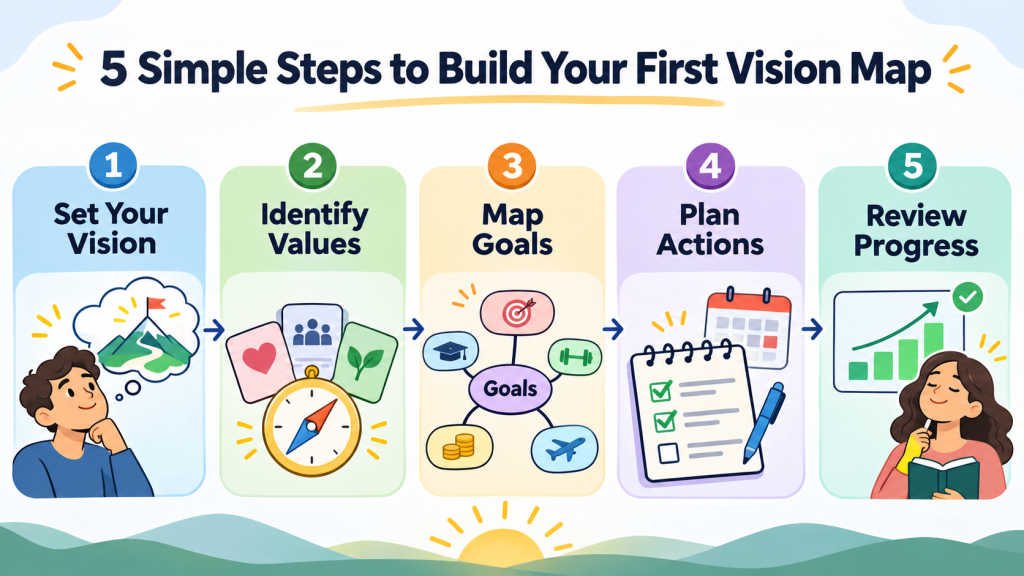
How to Create Your Vision Map Step by Step
Write a central intention inside a circle. Draw a line to each priority area. Under every area, add one outcome you would recognize in real life, then the reasons it matters.
Next, draw smaller lines for the behaviors, people, information, and resources that could help. Mark assumptions you need to investigate. Finish by circling one action you can take within the next week.
Use arrows to illustrate how the different branches connect. For example, better sleep may support focused study, while an ambitious work schedule might make sleep harder. Clarity matters more than symmetry.
Turn Broad Wishes Into Observable Actions
“Become confident” is a direction, not an instruction. Ask what confidence looks like in practice. It might mean asking one question during a meeting or practicing a presentation twice before Friday.
For each active branch, record an outcome and a behavior you control. A savings target is an outcome; scheduling a weekly transfer is a behavior. Include a date or trigger without assuming uncertain outcomes are guaranteed. Specific actions make the map usable after the initial excitement fades.
Show Obstacles and Dependencies Honestly
A useful map includes friction instead of hiding it. Next to “take an evening course,” you might write “caregiving schedule,” “course fee,” and “quiet study time.” Connect obstacles to possible responses.
Dependencies matter too: researching course requirements may need to happen before enrollment, and budgeting may need to happen before committing. Highlight steps that unlock several other goals. You might discover that arranging childcare, clearing a workspace, or requesting guidance needs to come before the more exciting task. Identifying that dependency can save frustration. If ambitions compete for time, choose a temporary priority.

Choose Paper, Wall Display, or Digital Mapping
Paper suits private reflection and quick sketches. A notebook preserves earlier versions. A wall display keeps priorities visible, although it requires space and may reveal personal details to others.
Digital mind-mapping tools make branches easy to move, collapse, or link to notes. Avoid spending more time formatting than deciding. Select the simplest format you are likely to open regularly; changing formats later is perfectly reasonable.
A Practical Vision Mapping Example
Imagine someone changing careers while protecting financial stability. Their central intention could be “meaningful work with manageable risk.” Three branches might be skills, money, and opportunities.
Under skills: complete an introductory course and create one portfolio sample. Under money: calculate essential expenses and set a savings target. Under opportunities: interview two people in the field.
Arrows reveal the sequence: research the role before choosing training, and review finances before reducing work hours. This map provides decisions to test, not a prediction of career success.
Common Mistakes That Make a Map Less Useful
The most common mistake is making every idea equally urgent. Too many active branches become overwhelming. Limit active goals and move interesting but nonessential ideas into a later section.
Avoid copying someone else’s idea of success or using impressive labels that lack personal meaning. Color coding and decoration are optional. If a branch contains an outcome but no plausible path forward, label it as a question to explore instead of disguising uncertainty with optimism.
Review Your Map Without Starting Over
Check the map briefly each week. Mark completed actions, record what blocked you, and choose the next manageable step. Each month, reconsider goals, assumptions, and deadlines.
You can deepen the reflection with self-reflection questions that help clarify goals and priorities. Keep old versions or photograph them before making major changes. They reveal evolving priorities, including goals worth abandoning. When progress stalls, change one part of the plan at a time: the action, frequency, support, or deadline. That makes it easier to learn what is and is not workable.
What Goal-Setting Research Suggests About Vision Mapping
Research does not establish that vision maps themselves cause people to achieve their dreams. The stronger evidence concerns the behaviors you can build into a map.
A 2006 meta-analysis of implementation intentions examined 94 independent tests and found that specific if–then plans improved goal attainment on average. “If I finish dinner, then I study for twenty minutes” connects cue and action.
A 2016 meta-analysis of progress monitoring covered 138 randomized studies and found that interventions encouraging people to track progress improved goal attainment. These studies tested planning and monitoring, not vision mapping as a branded technique. Use their findings to make your map more actionable, while recognizing that outcomes vary by person and goal.
Recommended Products for Vision Mapping
You can start with ordinary paper and a pen. These tools support different parts of the process without replacing reflection.
U Brands Cork Bulletin Board, 18 x 24 Inches, Light Birch Wood Frame (265U00-01)
Best for: A changeable wall map.
Its cork surface holds movable goal branches and progress notes. Its 18-by-24-inch size works for a visible home-office display, and it can hang in either orientation. Detailed layouts require extra pins and wall space. A center label can anchor the surrounding notes.
BestSelf Self Journal, Undated 13-Week Goal Planner (Grey Mist)
Best for: Connecting a map to scheduled follow-through.
This undated journal organizes goal setting, daily planning, and reflection across a 13-week period. It connects brainstorming with schedules and progress records. Its structured pages support consistent reviews, although daily planning may feel excessive if you only want occasional creative reflection.
Post-it Super Sticky Notes, 3 x 3 Inches, Supernova Neons, 24 Pads
Best for: Movable steps and milestones.
These square notes let you place tasks beside related branches, then replace them as plans change. The bright colors help distinguish current actions from future ideas, and the repositionable adhesive suits a flexible display. Keep longer instructions in a notebook or task list.
Sharpie S-Note Creative Highlighters, Assorted Pastel Colors, Chisel Tip, 12 Count
Best for: Color-coding goal relationships.
The assorted pastel markers have chisel tips suitable for headings, highlights, and connecting lines of different widths. Assign colors to areas such as health, money, or learning so the map stays readable at a glance. Test ink on thin paper and avoid excessive colors.
Bold Tuesday Vision Board Kit for Women
Best for: Beginners who prefer ready-made visual prompts.
This kit combines a foldable display, interchangeable image-and-quote cards, and a planning guide. Rearrange cards when priorities change. The curated style may not suit everyone, and you will still need to add your own actions and obstacles to create a genuine vision map.
Frequently Asked Questions About Vision Mapping
Is vision mapping the same as mind mapping?
No, although they can look similar. Mind mapping is a broad method for arranging connected ideas around a central subject. Vision mapping uses that visual structure specifically to explore a desired future, personal priorities, obstacles, and actions. Ordinary paper or mind-mapping software works.
Do I need pictures to make a vision map?
No. Words, arrows, circles, and simple symbols are enough. Pictures can help you recognize what a goal means emotionally, but they are optional. If visual clutter makes it harder to think, use only short labels and clear connections. A small photo collage can complement your action map.
How many goals should I put on my map?
Start with two or three active goals and keep additional ideas in a later section. There is no research-backed ideal number for every person. Available time matters more than filling the page. If your map starts to feel stressful, reduce the active branches before adding more detail to each one.
Can vision mapping help with career or relationship goals?
Yes, as a reflection and planning exercise, not a guarantee of results. For a career change, map required skills, financial constraints, and conversations to arrange. For relationships, focus on behaviors within your control, such as making time or communicating clearly. You cannot control another person’s choices.
How often should I update a vision map?
A weekly check-in works for next steps, while a monthly review can help you reassess priorities. These are suggestions, not scientific rules. Update sooner when circumstances change, and avoid rebuilding the design after every difficult day. A map is doing its job if it helps you make better decisions, even when its appearance stays messy.
Conclusion: Build a Map You Can Actually Use
Vision Mapping takes your hopes beyond attractive imagery by showing how values, goals, obstacles, and daily choices connect. A strong map is personal, specific enough to guide action, and flexible enough to change when life changes.
Start with paper if you want a private, inexpensive first draft. Choose a movable corkboard if seeing the whole plan helps, or pair your map with the BestSelf Self Journal when scheduling and progress reviews are your biggest challenges. Supplies are optional.
Choose one meaningful intention, build a few branches, and identify a realistic action for the next seven days. Review what happens before expanding your map. That simple cycle of reflection, action, and adjustment is a better foundation than creating a perfect-looking plan you never use.