
Shadow Work for Beginners: How to Get Started Safely

We may earn a commission for purchases made using our links. Please see our disclosure to learn more.
You may understand a pattern and still repeat it: people-pleasing, shutting down during conflict, overreacting to criticism, or hiding parts of yourself to stay accepted. That gap often draws people to Shadow Work for Beginners. Rooted in Jungian psychology, the practice focuses on noticing traits, emotions, and needs you tend to disown or avoid.
This guide explains what shadow work means, how to begin without overwhelming yourself, which prompts suit early practice, and when professional support makes more sense. You will also find research-backed context and selected books and workbooks.
What Shadow Work Actually Means
In Carl Jung’s analytical psychology, the “shadow” includes traits, desires, emotions, or capacities that do not fit the identity you consciously accept. It is not simply a collection of “bad” qualities; rejecting anger, for example, may also hide healthy assertiveness.
Modern Shadow Work for Beginners often uses journaling, trigger tracking, reflection, or therapy conversations to notice these parts. The aim is to understand what influences you so you can respond more deliberately, not excuse harmful behavior.
Why Shadow Work for Beginners Can Feel Uncomfortable
Shadow work can challenge your preferred self-image. You may notice envy beneath admiration, fear beneath perfectionism, or approval-seeking beneath constant helpfulness. That can bring shame or defensiveness.
Greater discomfort does not mean better progress. Useful reflection leaves enough mental space to observe and choose. Take one issue at a time.

Signs You May Be Ready to Begin
Some stability helps. Shadow Work for Beginners is easier when you can notice an uncomfortable feeling without immediately acting on it and can settle afterward.
You may be ready if recurring patterns make you curious and you can write without turning every answer into self-attack. If you are overwhelmed, having frequent flashbacks, or struggling to function, deeper self-exploration may need to wait.
Set Boundaries Before You Start
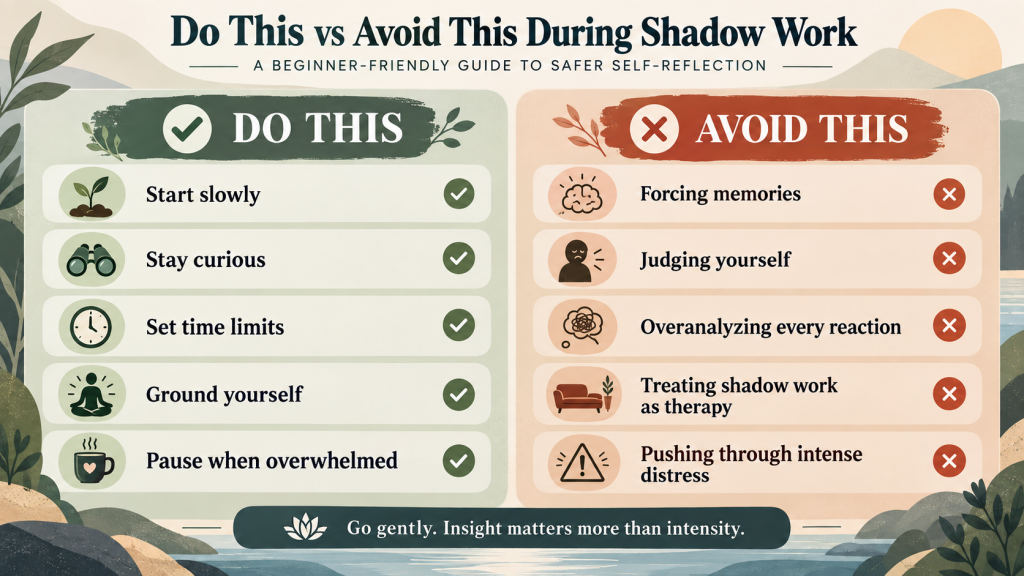
Choose a time limit and decide which topics are off-limits for now. A first session only needs to last about 10 to 15 minutes. Start when reasonably calm, not immediately after conflict or when exhausted.
For Shadow Work for Beginners, keep one grounding activity ready: slow breathing, stretching, a short walk, or talking with someone you trust. You can stop mid-prompt.
A Simple Shadow Work for Beginners Practice
Choose one recent event that triggered a strong reaction. Write the observable facts. Then name the emotion, the impulse, and the story you told yourself.
Ask, “What did this situation seem to say about me?” A delayed reply might become “I do not matter.” Then ask when that belief appeared before.
Finish with, “What does this part of me need now?” The answer might be reassurance, a boundary, or a more balanced interpretation.
Shadow Work Prompts That Start Gently
Beginner prompts should invite insight without demanding a dramatic breakthrough. Try one question per session:
- What behavior in others irritates me quickly, and what does it represent?
- When do I work hardest to appear easygoing, capable, or unaffected?
- Which emotion do I tend to criticize myself for feeling?
- Which compliment do I find most difficult to receive or believe?
- What do I secretly wish I could say no to?
- Which qualities did I learn were “too much” or “not enough”?
If a prompt becomes self-accusation, ask, “What pattern am I noticing, and what choice do I have now?”

How to Notice Triggers Without Judging Yourself
A trigger is information, not proof that your first interpretation is true. Distinguish what actually happened from the meaning you attached to it. “My coworker interrupted me twice” is an observation; “Nobody respects me” is an interpretation.
Notice your impulse: withdraw, argue, overexplain, or please. Consider what it may have been trying to protect you from.
Shadow Work for Beginners becomes more useful when curiosity replaces prosecution. Take responsibility for a reaction without treating yourself as a defendant.
What to Do When Strong Emotions Show Up
If emotion rises quickly, stop analyzing and orient to the present. Put your feet on the floor, look around, and slow your breathing. Shadow Work for Beginners should not require forcing yourself through a prompt.
Write, “This is enough for today,” then do something concrete and familiar.
If introspection starts to feel like constant depletion rather than useful reflection, this guide to healing from emotional exhaustion can help you recognize when your energy needs recovery more than another prompt.
Common Mistakes Beginners Should Avoid
Do not treat every dislike as projection. Sometimes a behavior genuinely conflicts with your values. Examine your reaction without abandoning discernment.
Avoid turning reflection into self-surveillance. Focus on recurring patterns affecting relationships, choices, or well-being.
Do not use “shadow” language as a diagnosis or excuse. “My shadow made me do it” does not remove responsibility, and labeling someone else is no substitute for discussing actual behavior.
Research-Backed Insights Behind Reflective Practices
The APA Dictionary of Psychology entry on the shadow defines Jung’s shadow as an archetype involving traits, desires, or emotions the conscious ego finds unacceptable and leaves hidden. That supports the historical concept, but the research below does not establish modern “shadow work” as a standardized treatment protocol.
Evidence is stronger for overlapping practices. A 2023 expressive-writing meta-analysis in PubMed covering 31 studies and 4,012 participants found a small but statistically significant reduction in depression, anxiety, and stress symptoms over follow-up.
A separate 2023 self-compassion meta-analysis in PubMed of 56 randomized trials found small-to-medium immediate effects, although overall risk of bias was high. NHS grounding guidance describes using the senses to focus attention on present surroundings. The takeaway is modest: reflective writing may help some people, and grounding can help when reflection becomes too activating.
Recommended Products for Shadow Work for Beginners
No book is required for Shadow Work for Beginners, but structure can help when a blank journal feels too open-ended.
| Product | Best for | Main approach |
| The Shadow Work Journal | Guided beginners | Prompts and reflections |
| The Shadow Work Workbook | Therapist-informed structure | Meditations and prompts |
| Owning Your Own Shadow | Short conceptual introduction | Jungian explanation |
| Meeting the Shadow | Deep readers | Multi-author essays |
| Inner Work | Dream-focused readers | Dreams and active imagination |
The Shadow Work Journal: A Guide to Integrate and Transcend Your Shadows
Best for: Readers who want a guided journal with plenty of structure
Keila Shaheen’s expanded 272-page journal combines prompts, exercises, reflections, and added material curated with therapist input. It suits readers who prefer guided questions over a blank page. Its main strength is accessibility; readers who want a more clinical framework may prefer a workbook written by a licensed mental-health professional.
The Shadow Work Workbook: Self-Care Exercises for Healing Your Trauma and Exploring Your Hidden Self
Best for: Beginners who prefer therapist-authored exercises
Written by licensed therapist Jor-El Caraballo, this 256-page workbook includes explanations, guided meditations, journal prompts, and affirmations. It offers clearer mental-health framing than many general journals. Because it addresses pain and trauma directly, pace the exercises and consider professional support if they repeatedly cause intense distress.
Owning Your Own Shadow: A Jungian Approach to Transformative Self-Acceptance, Exploring the Unlit Part of the Ego and Finding Balance Through Spiritual Self-Discovery
Best for: Readers who want a concise Jungian foundation
Robert A. Johnson’s compact book introduces the Jungian shadow and examines how it develops and appears in everyday life. Its short format works well if you want theory without a large workbook. It offers fewer step-by-step prompts, so readers who learn by writing may want to pair it with a notebook.
Meeting the Shadow: The Hidden Power of the Dark Side of Human Nature
Best for: Readers who want multiple perspectives on shadow psychology
Edited by Connie Zweig and Jeremiah Abrams, this 368-page collection brings together 65 essays spanning relationships, work, creativity, spirituality, and therapy. Its breadth shows how widely shadow ideas can be applied. However, it is denser than a beginner workbook and may work better as a reference you read selectively.
Inner Work: A Four-Step Journey to Self-Transformation, Unearthing Subconscious Strengths, and Interpreting Dreams with Jungian Psychology
Best for: Readers interested in dreams and active imagination
Jungian analyst Robert A. Johnson presents a four-step approach using dreams and imagination to explore unconscious material. It fits readers drawn to symbolic reflection rather than prompt-based journaling. Because dream interpretation and active imagination can feel abstract or emotionally intense, approach it slowly rather than treating it like a checklist.
How to Build a Sustainable Weekly Routine
You do not need daily practice. For Shadow Work for Beginners, try one 15-minute reflection each week and look for repeating fears, roles, or abandoned boundaries.
Then choose one behavioral experiment. If you hide disagreement to avoid rejection, express one low-stakes preference. If you dismiss praise, say “thank you” without explaining it away.
Insight matters when it changes a real choice, not when it simply creates more analysis.
When to Pause and Seek Professional Support
Pause if reflection repeatedly leads to panic, flashbacks, dissociation, urges to harm yourself, major sleep disruption, or difficulty functioning afterward. Those reactions deserve support, not a tougher prompt.
A licensed mental-health professional can help you explore painful material while monitoring overwhelm. If trauma is central, look for appropriate trauma training. Shadow Work for Beginners is not a substitute for that support.
Shadow work is optional. Therapy, mindfulness, values work, creative practice, relationships, and ordinary journaling can also build self-awareness.
Shadow Work for Beginners: Frequently Asked Questions
How frequently should beginners practice shadow work?
For many beginners, practicing once or twice a week is usually sufficient. Start with 10 to 15 minutes and notice how you feel later that day. If you become preoccupied, depleted, or unusually reactive, reduce the frequency. Consistency matters more than intensity, and you can increase sessions after learning which topics you can handle comfortably.
Can shadow work make you feel worse at first?
It can bring uncomfortable emotions into awareness, including shame, anger, grief, or fear. Mild discomfort can happen during honest reflection, but escalating distress is not something to push through. Stop, ground yourself, and return later if stable. If strong reactions keep recurring, a therapist can help you explore the material with more support.
Do I need a shadow work journal?
No. A plain notebook, secure digital document, or therapy conversation can work. A guided journal helps when you do not know what to ask or prefer a clear sequence. For Shadow Work for Beginners, choose a tool that encourages specific reflection without pressuring you to process more than you can comfortably manage.
Is shadow work the same as therapy?
No. Shadow work is a broad self-reflection practice rooted in Jungian ideas, while psychotherapy is professional treatment within a clinical relationship. Some therapists use Jungian, psychodynamic, journaling, or parts-oriented approaches, but a self-guided exercise cannot provide individualized assessment, treatment planning, or real-time support.
How do I know whether shadow work is helping?
Look for changes outside the journal. You may catch a defensive reaction sooner, notice an assumption before acting on it, communicate a boundary more clearly, or tolerate an emotion without immediately escaping it. Progress is not becoming “fully healed.” A better sign is having more awareness and choice where you once ran on autopilot.
Conclusion: Start Shadow Work for Beginners Slowly and Safely
Shadow Work for Beginners works best when curiosity comes with limits. Start with recent triggers, short sessions, gentle prompts, and a clear way to return to the present. Do not treat every reaction as hidden truth or emotional intensity as proof of progress.
If you want structure, The Shadow Work Workbook offers therapist-authored exercises, while The Shadow Work Journal provides guided journaling. Readers who prefer Jungian theory may get more from Owning Your Own Shadow.
Whatever resource you choose, let insight lead to one small behavioral change. If the practice repeatedly overwhelms you, pause and seek qualified support. Start with a question you can explore honestly, safely, and steadily enough to learn from the answer.